
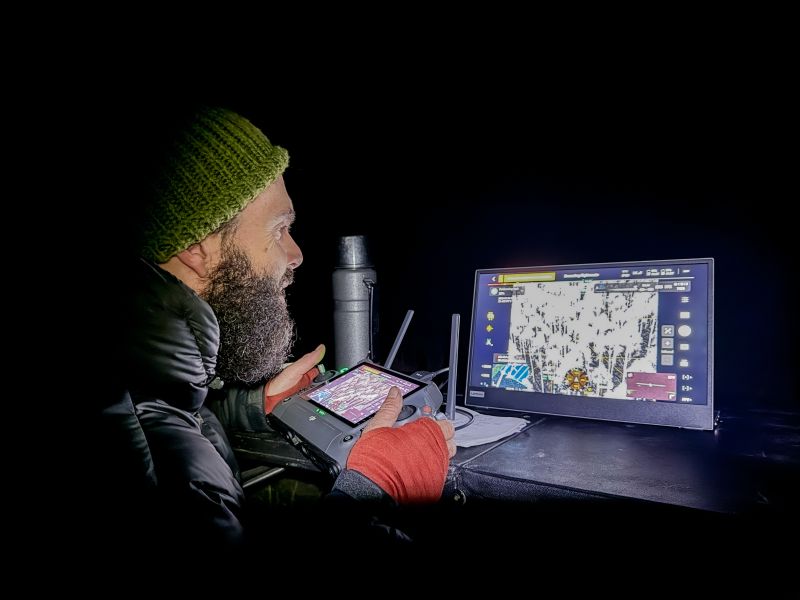
Register for Big Science Pitch 2026
Wednesday 11 November, 6-7.30pm (online event)
The Big Science Pitch gives academics the opportunity to sharpen their communication skills by presenting their research in a clear, engaging three-minute pitch.
Competing for funding, participants must convince both the judges and audience that their idea has the greatest potential impact.
Six finalists will each receive $10,000 and progress to the live Big Science Pitch final, where an expert panel will select the overall winner. An additional $10,000 People’s Choice Award will be decided by audience vote.
The 2026 Big Science Pitchers
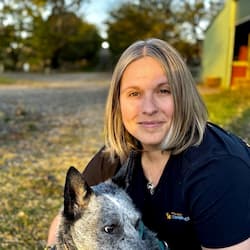
Dr Jade Fountain
Melbourne Veterinary School
Pushing buttons: What the body language of 'talking' dogs really says
Over two million “talking buttons” have been sold, yet little objective evidence shows how they affect dogs' welfare. Experts have raised concerns buttons increase frustration. I want to analyse dog body language in videos of button-pressing dog-owner interactions, to learn whether buttons are linked to happy communication or stress behaviours.

Dr Johannes Fehrmann
School of Agriculture, Food and Ecosystem Sciences
More than a thick skin: Turning tree bark into insulation for Australian homes
My research explores turning bark from responsibly sourced Australian trees into insulation for buildings. Combining bark with a fire-resistant adhesive that cures quickly at lower temperatures could reduce waste and reliance on petrochemical materials, while supporting local manufacturing and helping create healthier, more energy efficient homes using nature’s own protective layer.

Dr Philippa Bell
School of Agriculture, Food and Ecosystem Sciences
A bug's life: Rethinking how we sample insects
Insects are declining worldwide. Yet, scientists continue to sample insects using lethal methods with little consideration of the impact this may have on populations and ecosystems. I aim to test the feasibility of non-lethal sampling methods using macrophotography and image recognition to identify insects before releasing them back to nature.

Dr Jakub Maculewicz
School of Chemistry
Just one bloody drop: Rethinking human biomonitoring
Anthropogenic chemicals surround us, but quantifying exposure to them remains challenging. Conventional blood sampling is invasive, costly and difficult to scale. My research aims to use finger-prick blood microsamples to investigate chemical exposure. This could make human biomonitoring more accessible and scalable, while enabling measurement of a broader range of chemicals.
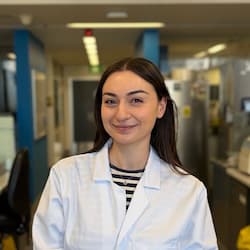
Dr Gemma Stathatos
School of BioSciences
Decoding cellular gatekeeping mechanisms during sperm development
Sperm motility is essential for male fertility in all mammals. It relies on the precise assembly of complex molecular structures along an isolated cellular compartment – the sperm tail, but the gatekeeping mechanisms that control molecule entry remain poorly understood. I aim to generate foundational knowledge on these mechanisms in mammals.
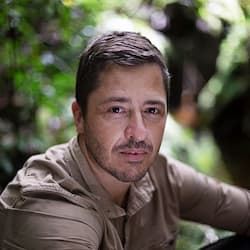
Dr Tyrone Lavery
School of BioSciences
Operation murder bird: Tracking the world’s most formidable seed disperser
Southern cassowaries are vital to New Guinea’s forests and central to community life and culture, but they’re also heavily hunted. We will satellite-track wild cassowaries to understand their movements and vulnerabilities to hunting. In the process we will reveal their role as seed dispersers and provide communities with the knowledge to sustainably manage cassowaries into the future.
Watch past Big Science Pitches
-
Pitchers
- Dr Gayathri Gopakumar – Fighting the hidden threat: A vaccine for marsupial herpesviruses
- Dr Jason Jung – Stopping seizures before they start
- Dr Katherine Morgan – From molecules to medicines: Targeting metastatic breast cancer with precision radiation
- Dr Kimberley Reid – Harvesting clean water from fog
- Dr Megan Lucas – Saving piglets, sustaining the industry
- Dr Mia Cobb – Happy dog science: helping our canine co-workers and companions to thrive
- Dr Simon Higham – Precision electrodes for restoring movement after traumatic spinal cord injury
-
Pitchers
- Dr Felipe Martelli Soares Da Silva – Protecting non-pest insects from climate change and pesticides
- Dr Ludovica Monti – Tracing the path of drug resistance in superbugs
- Dr Marie Dade – The big contribution of small green spaces in cities
- Dr Oliver Eales – Mathematical modelling of mpox in Australia
- Dr Rebecca Webb – A frog-friendly way to fight fungal infections
- Dr Veronique Paris – Reclaiming our backyards: New avenues to sustainable mosquito control
-
Pitchers
- Dr Rachele Wilson – Conserving sugarbag bees in Arnhem Land
- Dr Wing Yan Chan – The secrets of extreme corals
- Dr Brendan Lanham – Bringing back Victoria’s lost shellfish reefs from the brink of extinction
- Dr Laura Bibiana Ospina-Rozo – Interview with the green beetle: How to keep our cities cool?
- Dr Claire Taylor – Does nature always nurture? Investing in young in a changing world
- Dr Joshua Barrow – Are fishways a silver bullet solution or just another obstacle for native fish?