Early-career chemists receive Selby Research Award
University of Melbourne’s School of Chemistry researchers, Dr Ludovica Monti and Dr Marcus Giansiracusa, have received the 2025 Selby Research Award for their novel research approaches to the field of chemistry.
The award provides funds to assist an outstanding early career academic to establish their research career in chemistry or a chemistry-related discipline.
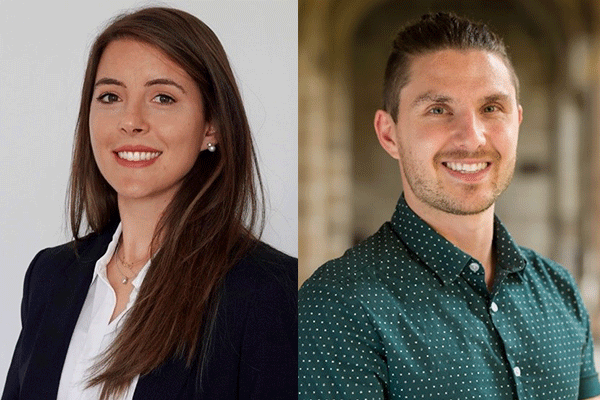 Dr Ludovica Monti and Dr Marcus Giansiracusa
Focusing on unique DNA structures known as G-quadruplexes (G4s), Dr Monti’s research aims to develop DNA-targeting therapeutics as a novel strategy for treating parasitic infections. Parasitic diseases affect millions worldwide, and the rise of drug resistance presents an urgent global health challenge.
Dr Monti’s work takes an innovative and underexplored approach to targeting a parasite’s own genetic blueprint for a more precise approach to developing a new class of antiparasitic agents.
Dr Monti earned her PhD from Sapienza University of Rome, and conducted research in Italy, USA, and the UK before joining the School of Chemistry at the University of Melbourne, where she leads a research group at the Bio21 Institute.
Rare earth elements are the target of investigation by Dr Giansiracusa. His research studies the electronic structure of metal elements called lanthanoids which hold potential next gen technological capabilities, from medical to memory storage devices and quantum computers.
In his work, Dr Giansiracusa takes a computational approach to examining these rare metals, aiming to predict the electronic states responsible for magnetic and optical properties.
Completing his MSc at the University of Melbourne, Dr Giansiracusa went on to earn his PhD at the University of Manchester. He returned to Melbourne to help establish the Melbourne Magnetometry Laboratory for the study of magnetic materials.
As part of the award, Drs Monti and Giansiracusa share in $21,000 to further their respective research.
“This recognition comes at a pivotal moment in my research journey, empowering my team to explore transformative strategies to tackle parasitic diseases,” Dr Monti said.
“I am especially grateful for the Foundation’s commitment to supporting early-career researchers and advancing science with real-world impact.”
Dr Giansiracusa said the award will accelerate his portfolio by expanding multiple research directions and providing important infrastructure to consolidate his research group in Australia.
"It will allow me to strengthen my overarching goal of advancing chemical understanding of these critical rare earth elements,” he said.