Food Resilience Planning Tools
We've curated some of the best existing resources to help stakeholders plan food systems that are more resilient to shocks and stresses.
See our report on food resilience planning for more information.
Disaster resilience scorecard for cities: Food system resilience addendum
What is it?
The scorecard was released in July 2022 by the UN Office for Disaster Risk Reduction to rank and assess a city’s food system resilience in disaster scenarios.
Why use it?
Easy-to-use bench-marking tool that comes with a useful Excel tool for interactive scoring.

Food System Resilience: A planning guide for local governments
What is it?
A comprehensive Planning Guide developed in 2022 by the John Hopkins Center for a Liveable Future and the Bloomberg Center for Government Excellence. it aims to help local governments to develop food system resilience strategies.
Why use it?
Has a focus on equity and justice. Contains a set of six sequential modules. Includes practical templates for users and links to additional information about key concepts.
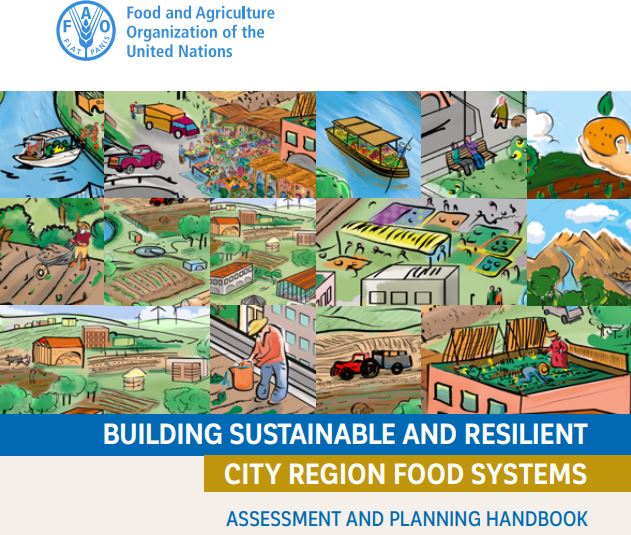
Building Sustainable and Resilient City Region Food Systems Assessment and Planning Handbook
What is it?
An in-depth Handbook released by the Food and Agriculture Organization (FAO) of the United Nations in 2023 to help stakeholders conduct a city region food system assessment.
Why use it?
Provides clear steps on how to do a resilience assessment. Designed to be used in conjunction with the FAO Toolkit. Provides a thorough assessment that takes time and resources to complete.

Community & Agriculture Resilience Audit Tool - CARAT
What is it?
CARAT was released in 2023 by the North American Food System Network (NAFSN) to help community stakeholders assess the resilience of their food system.
Why use it?
Provides a sequential template. Has indicators to measure resources within a food system. Can help to identify priorities, set goals and implement actions.
FIT4FOOD2030 Knowledge Hub
What is it?
The FIT4FOOD2030 Tools for Transformation offer hands-on resources for diverse stakeholders to ‘do’ food systems transformation. Developed during the multi-institutional collaboration FIT4FOOD2030 project funded by the European Union.
Why use it?
Tools are versatile and suit different settings, skill levels, goals and objectives. Tools can be used individually or as a part of a sequence.

Collaborative Framework for Food Systems Transformation
What is it?
This Framework was released in 2019 by the United Nations Environment Programme and helps stakeholders understand how to apply a food systems approach to policy making and implementation.
Why use it?
A simple and accessible four part framework. Has a policy and governance focus. Includes practical examples from case studies. Not food system resilience specific.

Infrastructure Resilience Planning Framework
What is it?
The Planning Framework was released in 2023 by the Cybersecurity and Infrastructure Security Agency (CISA), US federal department to help stakeholders understand the risks associated with sectors of critical infrastructure, including food and agriculture.
Why use it?
A clear step-by-step process aimed at policymakers to identify and mitigate risks to infrastructure. Not food systems specific but highlights opportunities to enhance food system resilience.
Sign up for the Foodprint Melbourne newsletter for project updates