Supporting Effective Emergency Animal Disease Responses: HASTE Scenario Workshops in NSW and QLD
In May and June 2025, HASTE brought together emergency animal disease (EAD) experts, government biosecurity agencies, and modelling specialists for two outbreak scenario workshops in Orange, NSW and Brisbane, QLD, aiming to explore how modelling tools can enhance decision-making during an EAD outbreak.
In May and June 2025, HASTE brought together emergency animal disease (EAD) experts, government biosecurity agencies, and modelling specialists for two outbreak scenario workshops in Orange, NSW and Brisbane, QLD.
These inaugural workshops were held in partnership with the New South Wales Department of Primary Industries and Regional Development (NSW DPIRD), Queensland Department of Primary Industries (QLD DPI), and Animal Health Australia (AHA). The aim was to explore how modelling tools can enhance decision-making during an EAD outbreak.
Using Modelling to Inform Real-Time Decisions
At the heart of HASTE is a key question: how can we use mathematical models to support fast, informed, and effective decision-making in response to EAD threats?
To put this to the test, the workshops centred on a simulated outbreak of lumpy skin disease—an exotic disease of major concern for Australia. As the scenario unfolded, participants received modelling outputs predicting disease spread based on various response options. Crucially, decisions made during the workshops influenced how the outbreak evolved, demonstrating the potential for modelling to guide response strategies in real time.
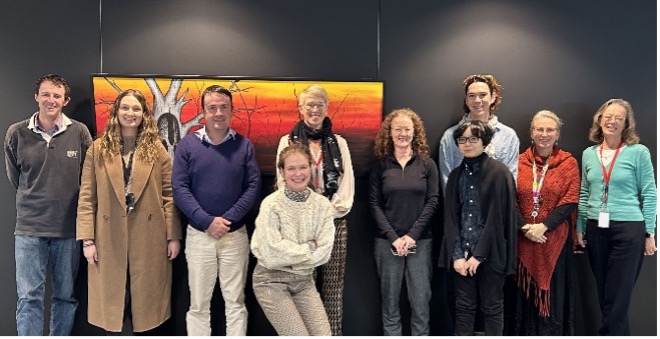
NSW DPIRD and HASTE team workshop participants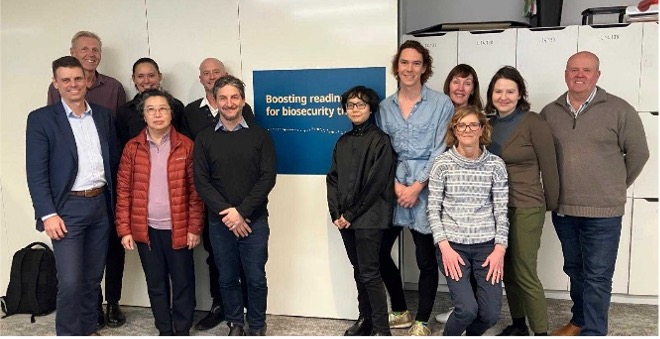
QLD DPI and HASTE team workshop participants
Workshop Goals and Insights
The workshops were designed to:
- Understand how decision-makers interpret modelling outputs
- Explore how modelling is used during an EAD response
- Improve integration of modelling into EAD response planning
- Identify gaps in current modelling tools and response systems.
Beyond introducing HASTE tools, the sessions also provided a valuable opportunity for NSW and Queensland biosecurity teams to rehearse their EAD response workflows. Participants spanned the full range of EAD response roles, including Chief Veterinary Officers (CVOs), deputy CVOs, epidemiologists, planners, and operations leads.
Key Outcomes
The workshops proved to be both productive and energising, offering the opportunity for the respective teams to collaborate in a hands-on, scenario-based setting. They demonstrated how bringing together scientific modelling, policy expertise, and operational knowledge can build stronger, more coordinated outbreak responses.
Among the key findings were:
- A need for cost forecasting tools to better support planning and resource allocation
- Recognition of social license as a critical component in EAD response decisions
- Identification of strengths and expertise within jurisdictions, and how HASTE researchers can connect with and complement these capabilities.
These workshops reinforced the value of collaboration across agencies, sectors, and disciplines. They showed how modelling can be more than a technical input—it can be a practical decision-making tool, integrated with real-world response systems to protect Australia’s animals, industries and communities.
HASTE was established to address the growing need for rapid, scalable, and interoperable decision-support tools in response to emergency animal disease outbreaks. It is a partnership between The University of Melbourne, Australian Research Data Commons (ARDC), CSIRO and the Australian Government Department of Agriculture, Fisheries and Forestry.