
Important information
Agriculture Discovery Week is for commencing students in the Bachelor of Agriculture and Diploma in General Studies courses. Attendance is compulsory in Week 1 of Semester 1, 2027 as part of your degree. When registrations open, you will need to confirm your attendance via a survey. All transport, accommodation and meals will be arranged for you.
When is it?
Monday 1 March to Friday 5 March 2027.
How do I get there?
The university will organise transportation to the Dookie campus for all commencing Bachelor of Agriculture and Diploma in General Studies students.
What does it cost?
There is no additional cost for students.
How do I register?
Registrations for Agriculture Discovery Week 2027 will open soon. Stay tuned for more information!
What happens at Agriculture Discovery Week?
You and your new classmates will hear from academics on what to expect in your degree and how to make your time at university the best it can be. You’ll also hear from industry experts and have a chance to talk with them about their work.
The Dookie campus – our living laboratory – is a perfect example of the possibilities ahead of you in your degree and career. You will be able to explore the campus by touring our state-of-the-art robotic dairy, wine tasting at our winery, and take on your own agriculture research project in our labs or in the field.
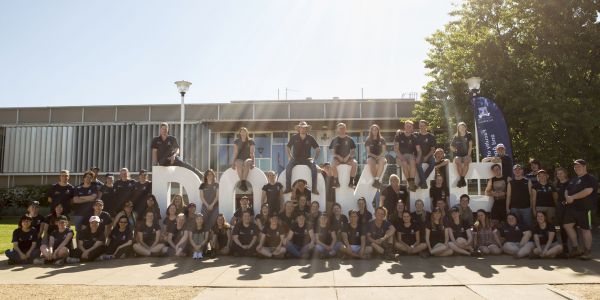
There are also plenty of opportunities to get to know your new friends including:
- Get competitive at the trivia night and the Ag Society Games
- Enjoy the DJ at the annual Dookie Social
- Relax with your new friends at movie night
- Play sport on the courts, or relax at the pool
- Build connections for your future at the industry panel
- Learn about the student groups and activities on offer at the University of Melbourne
- Enjoy dinner from a choice of food trucks and the Dookie Dining Hall.
A full schedule of activities will be posted soon – check back closer to the date for more information.
Do I have to go?
Yes. This week has timetabled classes which contribute to your attendance hurdle. There are also assessments within and associated with classes and workshops run during this week. If you are having trouble attending, see Special Consideration information on what to do.
What should I bring?
Dookie campus is situated some distance from the nearest towns, so we strongly recommend you arrive prepared with everything you’ll need for the week.
-
- Laptop or tablet, chargers, writing materials, notebook (as you would take to any class)
- Strong footwear that covers your feet completely, is good for walking, and which can get wet and muddy – ballet flats and sandals aren’t appropriate for Dookie as it’s a working farm, and you’ll also be in the laboratory
-
-
- All toiletries
- Pillow, pillowcase & sleeping bag or sheet & doona (single bottom sheet provided)
- Chargers for all devices
- Clothes suitable for both cool days and extreme heat during the day and cool nights, including a warm, waterproof jacket
- Driver’s licence or proof of age card – you will not be allowed to purchase alcohol without this
- Medications, if necessary
- Snacks for five days
- Sunglasses
-
- Keep cup to make yourself a coffee or tea
- Mosquito repellent
- Reusable water bottle
- Small backpack or satchel to carry with you throughout the day
- Sun protection (hat and sunscreen)
- Raincoat with a hood
Discover Agriculture Research Project Preferences
Agriculture is a broad discipline, with many different areas you can get involved in. Part of your time at Discover Agriculture will involve you participating in a Research Project of your preference, where you will be able to learn more about a particular agricultural discipline. Please read the 2026 Research Project descriptions below. You will register your project preferences through the registration form linked at the top of the page.
Which Whey to go?
Producing quality dairy products relies on the quality of milk produced from cows. But, not all milk is the same. In this project you will investigate the properties of milk that are important in dairy production. You will see our Robotic dairy and learn more about Australia’s dairy industry and in our new lab space conduct an analysis of milk to determine its quality.
Raising the Baa: Understanding Wool Market Needs
Australia has a strong reputation for producing high-quality wool where we produce some of the best in the world. Determining what wool goes into what sector of the market is a function of a number of parameters that together ultimately determine the value of a sample of wool. In this exercise as a wool buyer you will be required to follow a brief from a client to fulfil their order. You will be provided with Merino wool samples from a number of different lots and it will be your job to evaluate these different lots using a number of production parameters and come up with your recommendation to the client of which wool you have decided to purchase.
Kitchen Table Conversations: An Introduction to Social Science for Agriculture
When we think about what is involved in agriculture our first thoughts might be about crops, or farm animals, or soils, or tractors. Our thoughts often don’t turn first to farm people. But in fact it is people who make farms tick. It is usually farm families who decide what it is that they want to achieve on their farm and in their business, and it is farm families and farm employees who navigate the myriad challenges and opportunities that agriculture presents. That is why social science – learning about people – is as important for the future of agriculture as soil science, animal science or plant science. In this project you’ll learn some fundamental social science skills, and apply them in a live research interview with a local farmer.
Climate Trends & Truths: what does the data say about Victoria's climate?
Agriculture is directly and profoundly influenced by both climate variability and climate change. Farmers often bear the brunt of extreme weather events, especially drought, floods and heatwaves. The Australian landscape has been affected by climate variability and extreme events long before human emissions of greenhouse gases made substantial impacts on the climate system. The famous poem by Dorothea MacKellar, published in 1908, comes to mind. Yet we know that climate change is having an impact and will continue to do so. But to what extent are the extreme events we’ve seen so far in Victoria due to climate change, and to what extent are they due to natural variability? In this project, we will delve into the evidence with a hands-on activity which will equip students with key skills to answer this question.
Check Yourself: Experiencing an Animal Welfare Assessment
Understanding how to measure animal welfare is essential for those working in agriculture, as it drives continuous improvements in animal care and quality of life, supporting ethical practices and sustainable food production. Reliable indicators of welfare offer valuable insights into an animal’s physical and mental well-being, upholding high standards and justifying responsible practices within the industry. In this interactive workshop, you’ll step into the role of welfare subjects to experience firsthand the complexities of welfare assessment. Through hands-on activities, you’ll learn to critically evaluate welfare indicators, navigate scientific and practical challenges, and start building your own welfare “toolbox” for real-world applications.
Biodiversity on Farm: Nature's Variety, our heritage, our future
The grazing and agricultural lands which cover almost three-quarters of Australia aren’t just important for our food and resource needs. They are also a living reservoir of biodiversity and need to be managed to protect it. Agriculture in turn is totally dependent on ecosystem processes and the biodiversity that drives them. Without the natural biodiversity which lives in rural ecosystems there would be less soil formation, nutrient cycling, natural water purification and pollination of crops. Just one gram of soil – about the size of two aspirins – may contain up to 100 million bacteria and other microorganisms. Labouring away in secret darkness, these tiny creatures literally move mountains. They are only about one-thousandth of a millimetre in size yet they are responsible for fixing nitrogen, preventing erosion by binding soil particles together and helping plant roots take up water and phosphorous. Farming practices which lead to increased acidity or salinity in the soil can kill this valuable micro-biodiversity, halting the important work it does. Come to this session and learn some of the skills that you as a science/agriculture student can apply to assess biodiversity on-farm.
Hot Spots and Cool Canopies: Mapping Microclimate in the Orchard
Climate change is increasing the frequency and intensity of extreme heat events, which pose a significant threat to crop productivity. Plants respond to these stresses through various physiological mechanisms, but a major issue for Victoria is fruit burning, which affects colour, quality, and marketability. In a dense orchard canopy, leaves at different vertical positions and on different sides (eastern vs. western) experience vastly different environments, creating distinct microclimates within the same plant structure. By measuring key climatic variables (temperature, light intensity, and humidity) across the canopy, you will gain hands-on understanding of how plant architecture acts as a natural defence mechanism against environmental extremes, a critical concept in climate-resilient agriculture. You will also compare microclimatic conditions in different canopy zones to identify which areas are most vulnerable to heat stress and fruit damage. Through this practical exercise, you will connect plant morphology, microclimate dynamics, and agricultural adaptation strategies, gaining insights into evidence-based approaches for maintaining fruit quality under increasingly challenging climatic conditions.
Digital Agriculture and Plants for Space
As we look to the stars and contemplate human expansion beyond Earth, one of the biggest challenges we face is how to sustainably grow food in extraterrestrial environments and how to apply these new technologies here on Earth. Enter the fascinating world of space agriculture, where cutting-edge digital technologies meet the age-old practice of cultivation. In this project, you'll work with state-of-the-art sensors and imaging systems developed by the Digital Agriculture, Food and Wine research group at the University of Melbourne. You'll learn how to monitor plant health, growth, and stress responses under simulated space conditions using non-invasive techniques. By analysing multispectral imagery and environmental data, you'll gain hands-on experience in assessing crop performance under extreme conditions. You'll also explore how artificial intelligence (AI) and machine learning are being used to optimise resource use and automate plant care in closed-loop systems. These approaches offer a unique opportunity to engage with the future of agriculture, combining elements of plant science, environmental control, and digital innovation. Whether you're interested in feeding future Moon (2030) and Mars (2040) human settlements or improving sustainable farming practices here on Earth, this session will provide valuable insights into the cutting-edge intersection of digital technology and agriculture in extreme environments.
All commencing students are to be enrolled into the subject AGRI10047 Discovering Agriculture in Australia (BAg) or MECM10005 Discover University (DiGS).
More ways to get ready for your course
Looking for more ways to get to know your degree in the meantime? Visit the Bachelor of Agriculture Getting Started page or Diploma in General Studies Getting Started page information.