Michael Lynch
His work, he says, is challenging and surprisingly satisfying for someone who initially wanted to work with free-range wildlife rather than practise medicine with animals in captivity. That was before he discovered that Zoos Victoria could provide him with the best of both worlds.

“The Zoo offered me the opportunity to work close to captive animals from around the world in all their magnificence, and I saw that I could actually make a difference to the lives of those animals,” he explains.
“But the Zoo also gave me the opportunity to get involved in veterinary aspects of free-ranging animals, and that also included working with the Zoo’s threatened species programs.”
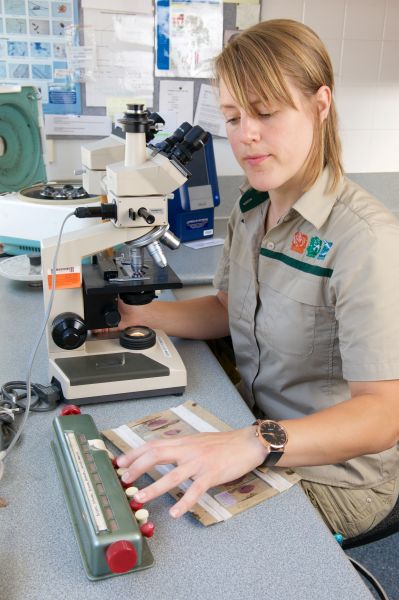
It was through one of these programs that Dr Lynch became a mentor to Dr Katherine Adriaanse (DVM 2014, MVSc 2019), now an Associate Veterinarian at Healesville Sanctuary. You might say they bonded professionally over the eastern barred bandicoot, saved from almost certain extinction by the Zoos’ captive-breeding program. Dr Lynch was deeply immersed in their conservation by the time Dr Adriaanse began investigating the risk of toxoplasmosis to the establishment of the bandicoots on Phillip Island as part of her Master’s project. The nocturnal marsupial captivated her.
“They’re little animals and they don’t really have many methods of self-protection,” she says. “But they are quite hardcore and will do well if you keep foxes away from them… They’re little fighters.”
They may be separated by 25 years of age and experience, but both vets began their careers on a similar path. Each completed a science degree first but for different reasons. When Dr Adriaanse, 32, graduated from the University of Adelaide with her first-class honours degree, she was unsure about what to do next. She was interested in medicine but keen to work in the conservation space.
A friend suggested veterinary science. She thought it was a great idea and was accepted into the first intake of students for the Doctor of Veterinary Medicine at the University of Melbourne.
If her trajectory was meteoric, Dr Lynch’s was on a slow burn. He did not do particularly well in his final year of high school and fell short for a tertiary place in veterinary science, settling instead for a science degree studying zoology. It sparked a passion. “I guess it was like getting a religion for me because I decided this was the important thing in the world – the natural world and its preservation is a really important thing.”
He never really looked back after that. He graduated with a Bachelor of Veterinary Science (Honours) from the University of Melbourne in 1989, completed his Masters five years later and his PhD in 2012. His achievements have not dulled his trademark modesty.
“I’m your example of a hard worker,” he says. “I have obviously some natural intelligence but I’m more your hard-worker type and your persevering type.”
Others considering a career in wildlife care and conservation might be encouraged by his journey. He thinks so, too. “These are all team efforts and there are lots of places in a team. There are lots of places you can be; just persist and do something you enjoy.”
No one listening to these vets would question their dedication to the job, their satisfaction in successful outcomes, their sadness in poor ones. And be in no doubt, there have been challenging moments. For Dr Adriaanse, it came during her 12-month stint with ‘Free the Bears’, working at a rescue centre in Luang Prabang in Laos.
She was on a team that was given rare permission to euthanise a bear because of a neurological disease, hydrocephalus, which was adversely affecting her quality of life.
“In Laos, bears are a protected species, so you need government permission to do anything with them,” she explains.
“She was the first bear to be euthanised in the organisation for 20 years but the whole team felt it was the right step for that animal … That experience has stayed with me a long time. While none of us want to be in that position, as professionals our primary focus is an animal’s quality of life. The decision to euthanase is never easy, but using a holistic welfare assessment framework to help reach that conclusion with the whole team is something I’m really proud of.”
The images that confronted Dr Lynch at the triage centre in Mallacoota, established to treat animals – many of them koalas that had been rescued from the Victorian bushfires early in 2020 – will not be easily erased.
“They were very long days,” he recalls. “But having that first-hand experience helped me give good advice and be a relevant leader… Seeing the trauma to the animals is quite confronting as is their suffering and, in that environment, it can be quite overwhelming.
“You want to be a good leader, but you are also trying to be a good vet and get across best ways of pain management, dressing choices, rehydration. It is an intensive-type medicine. Working in a team is really important because I’m not necessarily the best intensive care veterinarian in our team… but we all work together and share information and I’m certainly not so proud to be asking for advice to check what I’m doing is up to standard. As a vet, you always want to be doing better.”
While Zoos Victoria has provided a gateway to the world of wild animals, the focus is still firmly on the animals in the Zoo.
“When you work in a zoo, you have a responsibility to the animals in the zoo to do your best for them. Their lives and their welfare are very important, and I have never lost sight of the primary part of my job. It’s super important what happens out there in the wild, but the primary part of my job is looking after these animals right here in front of me – their welfare, their nutrition, their parasite control, doing all the veterinary care of those animals and do it to the best of my abilities.”
This story was first published in Horizon, the alumni magazine of the Faculty of Science. Read the complete magazine here.
Banner image: Dr Adriaanse dissects a stick insect. All images taken prior to restrictions in Melbourne due to COVID-19.