From sustainable food to the science of ageing: Newly conferred Honorary Doctorates take the public stage
Two internationally distinguished scientists have received Honorary Doctorates in Science from the University of Melbourne, recognising their outstanding contributions to research, education and global public life.
Professor Lindiwe Majele Sibanda, a globally recognised leader in food security, climate resilience and sustainable agriculture, and Professor Elizabeth Blackburn, a Nobel Laureate and pioneer of molecular biology, were conferred with the University’s highest honour on 12 December during Faculty of Science graduation celebrations. During their visit to Melbourne, both honorary doctorate recipients also delivered free public lectures.
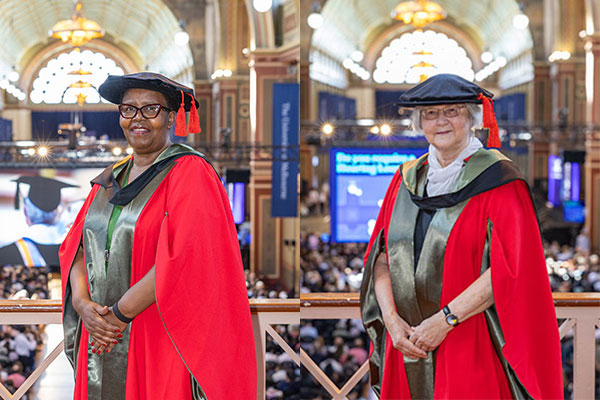 Professor Lindiwe Majele Sibanda (left) and Professor Elizabeth Blackburn (right).
Professor Sibanda has held senior leadership roles across Africa and internationally, including as Chair of the Board of the Consultative Group on International Agricultural Research (CGIAR) System, and has advised governments, multilateral organisations and global research bodies on food systems transformation and climate adaptation.
Her work focuses on strengthening agricultural systems to support livelihoods, equity and environmental sustainability, particularly in regions most vulnerable to climate change.
While in Melbourne, Professor Sibanda delivered a public lecture titled Seeds of change: cultivating tomorrow’s sustainable food leaders, exploring how future leaders can drive sustainable and equitable global food systems through education, collaboration and science-informed policy. Watch the recording below.
Professor Blackburn, a Nobel Laureate and University of Melbourne graduate, is renowned for her co-discovery of telomerase and her groundbreaking research on telomeres – the protective structures at the ends of chromosomes that play a key role in ageing and disease.
Her discoveries have reshaped understanding of cellular ageing and have had profound implications for human health, influencing research across biology, medicine and public health worldwide.
During her visit to Melbourne, Professor Blackburn presented a public lecture titled The science behind ageing: cells, stress and the power of connection. Nearly 400 in-person and online guests attended the lecture, which traced Professor Blackburn’s research journey and examined how biological ageing is influenced not only by genetics, but also by psychological, social and environmental factors across the life course. Watch the recording below.
While in Melbourne, Professor Blackburn also visited University High School to celebrate student achievements in the Elizabeth Blackburn Science Program, marking the release of VCE results and meeting with students pursuing pathways in science.
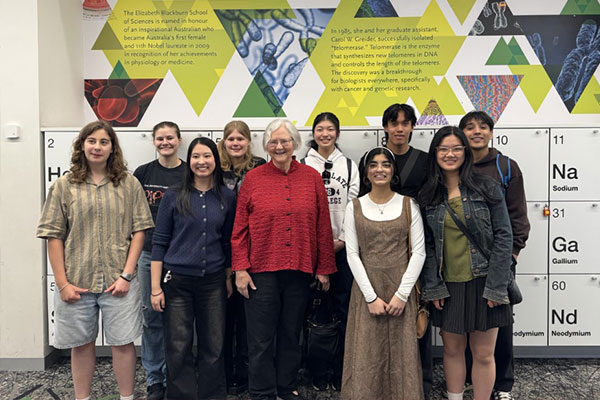 Professor Blackburn (centre) with students from University High's Elizabeth Blackburn Science Program
The Honorary Doctorate of Science recognises individuals who have made exceptional contributions to scientific knowledge and its application for the benefit of society. Professors Sibanda and Blackburn join a distinguished group of scholars honoured by the University for their global impact and leadership.