New research-industry collaborations to reduce fire risks, commercialise quantum sensors, and use eucalypts to fight microbes
The Faculty of Science has been awarded four out of 25 Australian Research Council (ARC) Mid-Career Industry Fellowships to support research-industry collaborations that will help to build new Australian industries and mitigate bushfire risks.
The four funded University of Melbourne projects will develop quantum magnetic sensors for diverse applications, harvest new antimicrobial products from eucalypt trees, improve decision-making in bushfire risk management, and provide early warnings of poor air quality during forest fires.
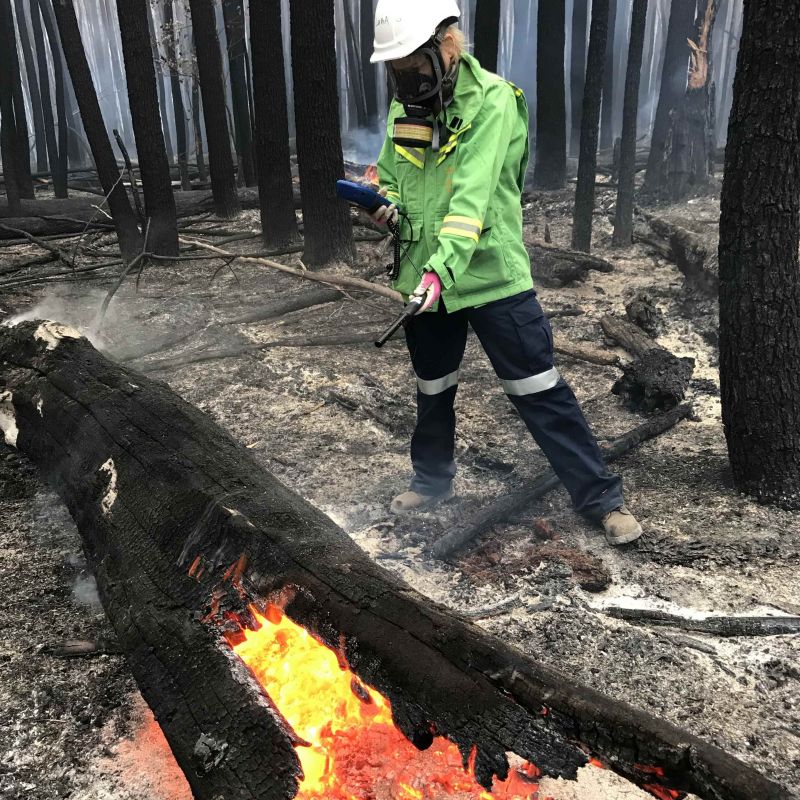
Dr Liubov Volkova measures emissions from smouldering debris during a prescribed burn.
Together, these projects received more than $3.9M from the ARC, which awarded a total of $25.7M for 2024 in the second annual round of funding under this program.
The ARC Acting Chief Executive Officer, Dr Richard Johnson, said the Mid-Career Industry Fellowships Program has created pathways for academic researchers to establish careers in industry and industry-based researchers to work in university settings.
“Through these collaborations, the ARC supports the transfer of skills, knowledge and ideas as a basis for securing commercial and other benefits of research, and delivering significant outcomes for industry partners and end-users,” Dr Johnson said.
Dean of Science, Professor Moira O’Bryan, said the faculty had performed extremely well in this competitive funding round.
“This reflects a prime focus on real-world impact in our research strategy, and our consequent proactive engagement with industry around Australia and overseas,” Professor O’Bryan said.
“Our research is driven by curiosity, the pursuit of excellence, and solving big challenges facing our region and the world. Industry collaborations are key because finding solutions to complex problems requires input from diverse experts and multiple perspectives.”
 A quantum sensor for detecting magnetic fields
The funded projects:
Decision support for climate-adapted bushfire risk mitigation, led by Dr Hamish Clarke. This project will support the delivery and development of fire management tools that are effective in a warming world. It will enable Australia’s fire agencies to embed climate change into their decision-making, set a global standard for climate-adapted fire management, and improve outcomes for human health, the economy and the environment.
Beneficial flavonoids from eucalypt plantations, led by Dr Jason Goodger. This project will improve plant selection and develop new tools for commercial production of valuable antimicrobial flavonoids – organic, aromatic chemicals – from eucalypts. This will help expand an industry based on a largely untapped property of Australian trees, providing significant benefits to regional communities operating plantations, and ultimately addressing microbial pathogen resistance.
Next generation diamond quantum sensors for future industries, led by Associate Professor David Simpson. This project aims to commercialise a highly stable and accurate diamond-based magnetic field sensor – a quantum device – pioneered in Australia with applications in industry sectors including healthcare, mining, space, defence, automation, and manufacturing.
Smouldering coarse woody debris and air quality, led by Dr Liubov Volkova. This project aims to develop and translate the first continental-scale tool to address the dynamics of coarse woody debris (logs, branches and stumps) – a major source of smoke and fine particle emissions from bushfires. The new tool will provide early warning of smoke emissions risk during bushfires and prescribed burns, delivering health, economic, and environmental benefits.
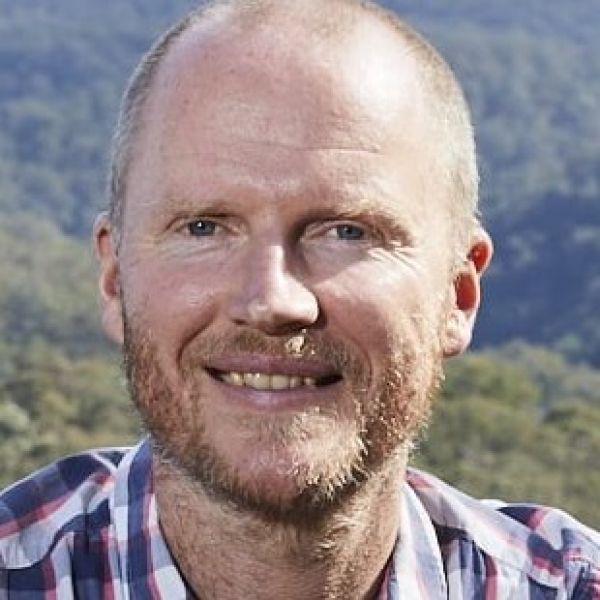
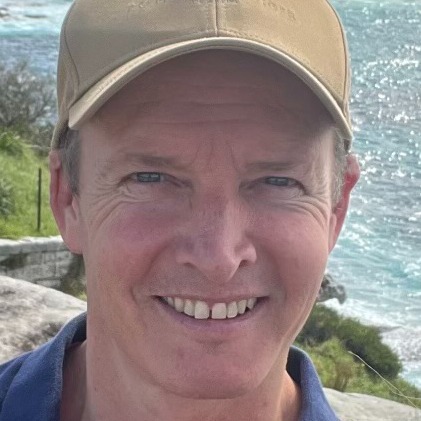
Below: Dr Clarke (left) and Dr Goodger
Below: A/Prof Simpson (left) and Dr Volkova