Seminar room named in honour of “grandmother” of mathematical optimisation
The University of Melbourne has honoured pioneering 95-year-old mathematician and statistician Alison Harcourt (nee Doig) AO by naming a seminar room after her.
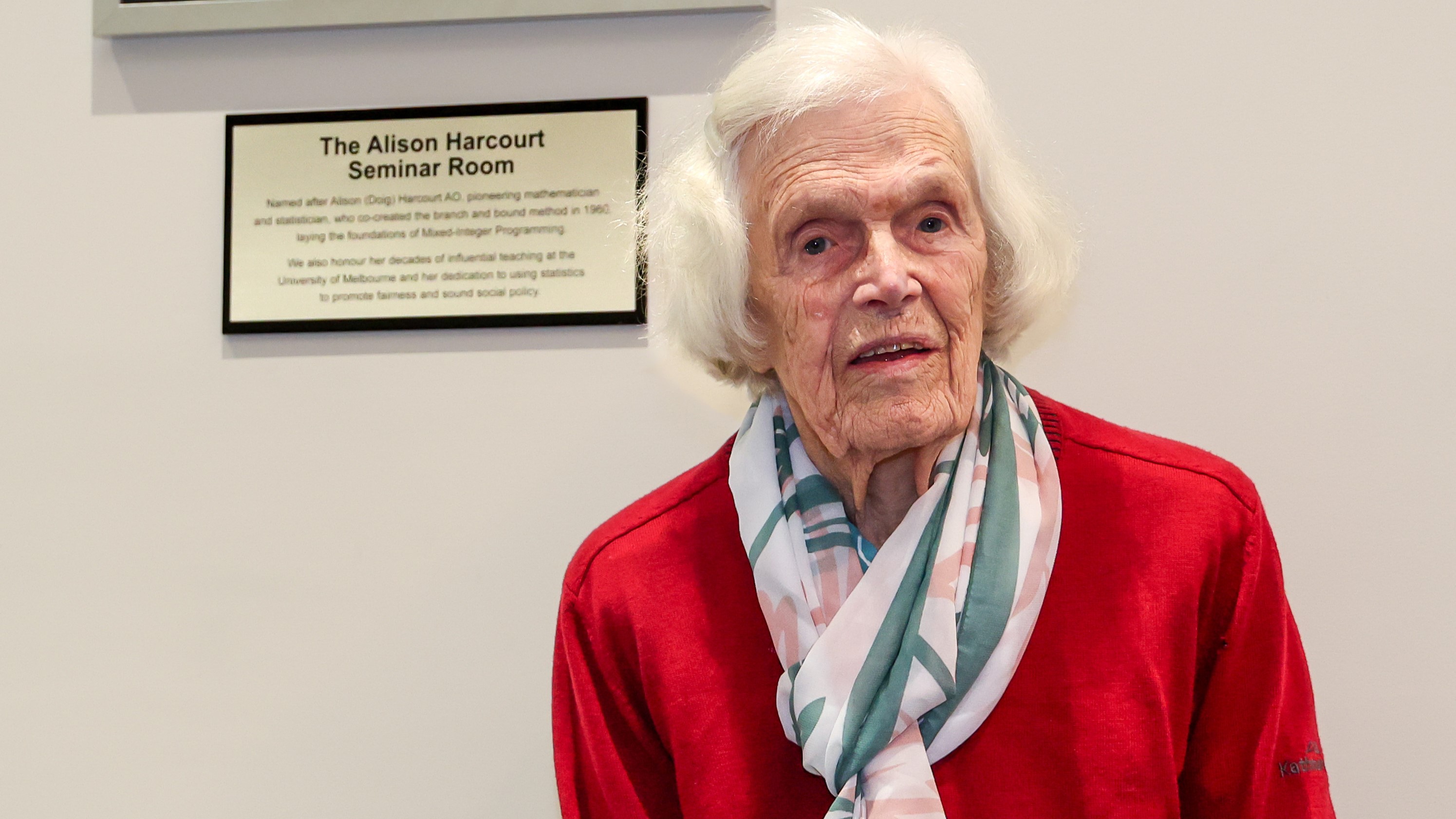
Ms Harcourt (pictured above) started her maths degree at the University in 1947, as just one of two women in the subject.
She went on to co-author a ground-breaking paper in 1960 while she was working at the London School of Economics as a research assistant. It proposed an optimal method to solve complex decision problems involving integer values. This method later became known as ‘branch-and-bound’.
Branch-and-bound underpins modern optimisation software that powers solutions in logistics, transportation, scheduling, telecommunications, and even cancer radiotherapy treatment planning.
Returning to the University of Melbourne in the 1960s, Ms Harcourt joined as a Senior Lecturer in Statistics, continuing her trailblazing academic career.
Despite never enrolling in a PhD and facing career interruptions due to child-raising in the 1970s and 1980s, her work remained influential and far-reaching.
In the late 1960s, Ms Harcourt worked with Professors Ronald Henderson and John Harper at the University of Melbourne Institute of Applied Economic and Social Research (now the Melbourne Institute) to measure the extent of poverty in Melbourne and to develop an Australian poverty line.
This important social research has been cited as the “first systematic attempt to estimate the extent of poverty in Australia”, and formed the basis for the Henderson Inquiry into Poverty launched by the Commonwealth Government in 1972.
In the early 1980s, Ms Harcourt also contributed to electoral fairness in Australia. Working with Dr Malcolm Clark from Monash University, she co-developed a double randomisation method for allocating candidate positions on ballot papers – a practice still used in Australian elections.
Professor Howard Bondell, Head of the School of Mathematics and Statistics, said the seminar room naming not only honours her lasting impact on mathematical science but also celebrates her role as a quiet revolutionary whose work continues to shape Australian society.
“Alison has had a profound impact on the field of mathematics and statistics, as well as the students and academics who have had the privilege of working with her,” Professor Bondell said.
“I’m delighted we can name this space after her and remind future staff and students of her legacy for years to come.”
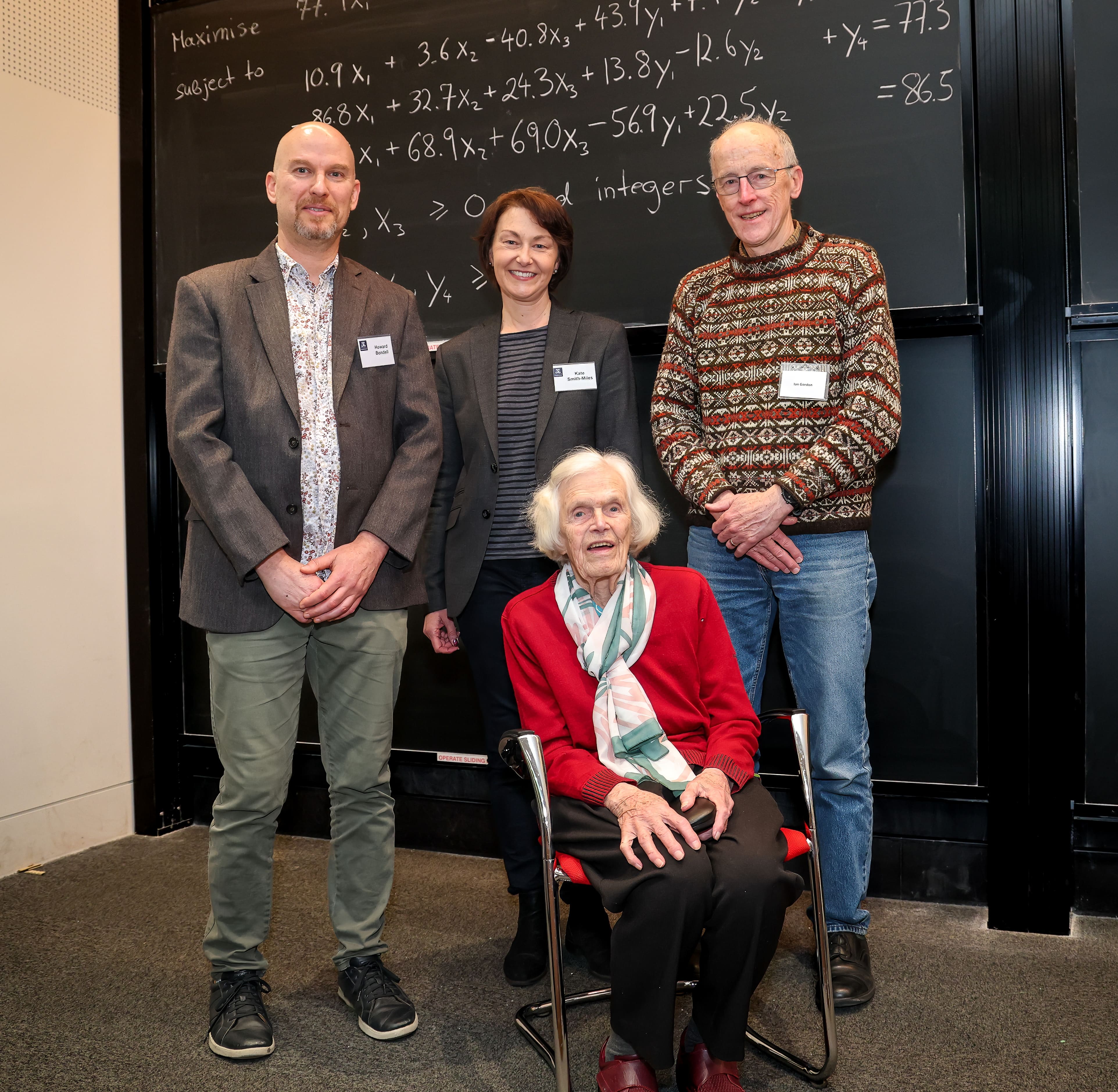
Ms Harcourt (seated) with (left to right) Professor Howard Bondell, Professor Kate Smith-Miles and Professor Ian Gordon, members of the School of Mathematics and Statistics, at the special room naming event.