STEM career mentoring program connects generations to build the future of science
The 2026 STEM Career Mentoring program has launched with a record number of 989 participants and more than 400 alumni who have volunteered as mentors.
Launching with a panel discussion, “Generations at work: Bridging the gap”, attendees explored how different generations can work together more effectively in today's STEM workplaces.
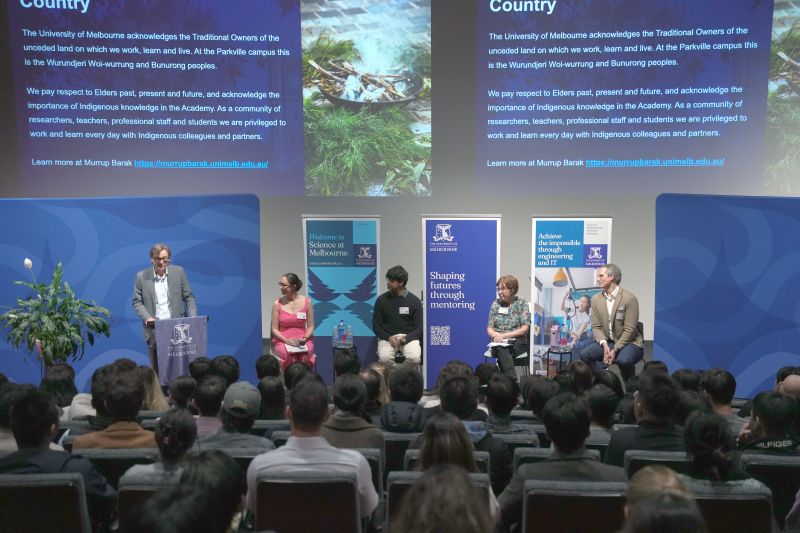
Left to right: Professor Todd Lane, Dr Catriona Nguyen-Robertson, Gurshan Singh Nanda, Professor Michelle Brown and Chris Farley.
Bringing together students, alumni and industry leaders from science, engineering and information technology, the program reflects the collaborative and multigenerational nature of modern STEM careers and workplaces.
The event gave this year’s mentors and mentees an opportunity to connect before beginning their one-on-one mentoring partnerships, helping to build relationships and a sense of community across the cohort.
Dr Catriona Nguyen-Robertson from the School of Biosciences moderated an insightful conversation with panelists Professor Michelle Brown from the Faculty of Business and Economics, alumni mentor Chris Farley and recent graduate from the Bachelor of Science Gurshan Singh Nanda, who shared insights on working across generations and the value of exchanging perspectives at different career stages.
Professor Todd Lane, Deputy Dean of Science said the program provides students with valuable preparation for life beyond university.
"At the University of Melbourne, we are fortunate to offer students many opportunities to prepare for the workforce, and programs such as this are among the most impactful," Professor Lane said.
"Understanding how to collaborate across generations is becoming an increasingly important capability for both established professionals and those just beginning their careers.
“Tonight’s panel discussion explores this crucial and timely topic and the opportunities and challenges of building successful multigenerational teams."
The scale of the program, which has been running for almost 20 years, highlights the strength of the University’s STEM community.
In 2026, 989 participants have formed 583 mentoring partnerships, while more than 400 alumni have volunteered as mentors, including 62 who have supported the program for more than five years. Another 89 mentors are joining from around the world, demonstrating the global reach of the University’s alumni network.
For many mentors, participation is as much about learning as it is about giving back. Long-time mentor Nicholas McKay said he continues to return because of the impact the experience has had on him.
"I found it really rewarding over the years, and it certainly helped me throughout my career as well," he said.
Fellow mentor Seema Karki agreed, describing the value of learning from students’ fresh perspectives.
"Young energy! It’s not just me giving back to the community, I learn from my mentee as well," Seema said.
As the 2026 cohort begins its mentoring journey, Professor Lane said the program is demonstrating that bridging generational divides is not simply a workplace challenge.
“It is an opportunity to strengthen the future of science through connection, curiosity, and shared experiences,” he said.