University of Melbourne scientists win Royal Society of Chemistry Horizon Prize
An international collaboration involving the University of Melbourne has won the Royal Society of Chemistry’s prestigious Horizon Prize, which celebrates discoveries and innovations that push the boundaries of science.
The Biosulfur Recyclers team comprises researchers from the University of Melbourne, Walter and Eliza Hall Medical Institute, University of York, Meiji University, Kyoto University, and Hosei University.
Based at the University of Melbourne and led by Professor Spencer Williams, the Biosulfur Recyclers received the prize for increasing understanding of how microorganisms break down sulfur-containing sugars (sulfosugars) – a crucial recycling process that sustains life on Earth.
Plants, algae and bacteria that gain their energy from photosynthesis use sulfosugars to help them capture sunlight. They produce 10 billion tonnes of sulfosugars each year that are naturally recycled. Despite the enormous scale and importance of this recycling process, its mechanisms were poorly understood until the prize-winning team discovered new enzymes and pathways of biosulfur recycling.
Professor Williams said he was delighted the team’s efforts were recognised by this prestigious award.
“The work could not have been done without the breadth of skills in this brilliant group of dedicated scientists,” Professor Williams said.
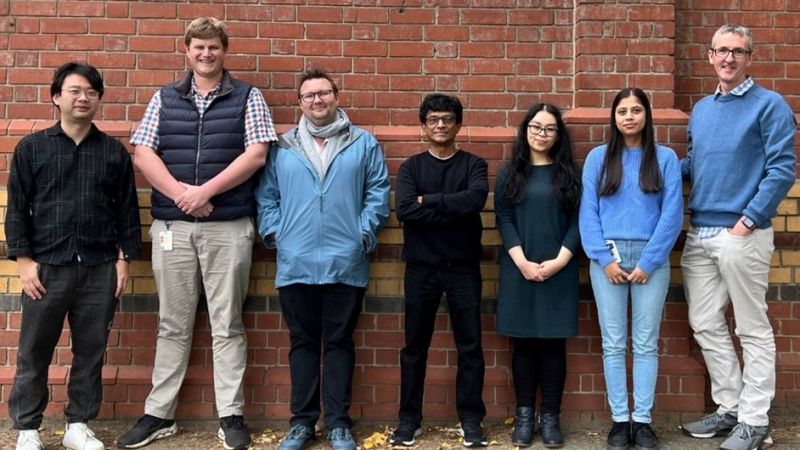
Left to right: Yunyan (Eric) Zhang (University of Melbourne), Ethan Goddard (Walter and Eliza Hall Medical Institute), and Nichollas Scott, Ruwan Epa, Janice Mui, Arashdeep Kaur and Spencer Williams (University of Melbourne)
The Biosulfur Recyclers team has made three major contributions:
- Improved understanding of the sulfoglycolysis pathway by which a sulfosugar called sulfoquinovose is broken down.
- Discovery of another breakdown pathway for sulfoquinovose that – unlike sulfoglycolysis – directly targets the unique carbon-sulfur bond in sulfoquinovose.
- Discovery of a new family of enzymes that release sulfoquinovose from sulfolipids (sulfur-containing lipids) to enable its breakdown.
Associate Professor Nichollas Scott from the University’s Faculty of Medicine, Dentistry and Health Sciences shared in the prize and said the project has been a rewarding collaborative effort over many years.
“We have employed cutting-edge approaches to unravel how nature breaks down a vast amount of biomass. I’m thrilled it’s been recognised with this award,” Associate Professor Scott said.

Dr Helen Pain, Chief Executive of the Royal Society of Chemistry, congratulated this year’s prize winners.
“By working together across borders and disciplines, chemists are finding solutions to some of the world’s most pressing challenge,” Dr Pain said.
“Our prize winners come from a vast array of backgrounds, all contributing in different ways to our knowledge base and bringing fresh ideas and innovations. I extend my warmest congratulations to all.”
The Royal Society of Chemistry’s prizes have recognised excellence in the chemical sciences for more than 150 years.