A food systems approach
A food systems approach considers interactions between different parts of a food system (drivers, activities and outcomes) when planning interventions to strengthen the resilience of food systems to shocks and stresses.
A food systems approach involves taking action from farm to fork across food supply chains. It promotes co-benefits of interventions across multiple domains of food system outcomes (equity, health, environment and economy), and it considers potential synergies and trade-offs between outcomes in different domains [1].

Why take a food systems approach to planning resilient food systems?
Shocks and stresses have impacts throughout food supply chains from food production to consumption and the generation of food waste. They also disrupt other systems that food systems depend on, such as energy, telecommunications and banking [2]. A food systems approach provides a framework to consider these interactions and helps with planning actions across all stages of food supply chains to strengthen resilience.
A food systems approach supports a coordinated ‘whole of government’ view of opportunities to strengthen resilience. Many government departments take actions and make decisions that affect the resilience of food systems. If policies are developed in silos, their impacts on food system resilience can be overlooked or policy conflicts can arise.
A food systems approach considers policy objectives related to multiple food system outcomes (health, equity, environment and economy) together, so that tensions and trade-offs can be managed [3]. It helps to:
- identify effective points to intervene in a food system to strengthen resilience to shocks and stresses
- maximise the benefits of interventions across multiple domains of outcomes
- minimise the possibility of unintended and adverse outcomes on food systems
How to implement a food systems approach
The complex interactions between different parts of a food system can make it challenging to understand how to adopt a food systems approach to building resilience.
Two key steps can support ‘food systems thinking’ when planning resilient food systems:
-
Consider each stage of the food supply chain – from production to waste resources – when planning resilient food systems.
- Collaborate - with partners and stakeholders from all stages of the food supply chain throughout the process
- Assessing and mapping - gather data about activities, organisations and infrastructure across all stages of the food supply chain to identify food system assets and vulnerabilities
- Visioning and planning – consider activities across the whole food supply chain when developing a shared vision and objectives
- Taking action – plan actions that can be taken across multiple stages of the food supply chain to build resilience
- Monitoring and evaluation – establish indicators and measures for activities implemented across the food supply chain

-
Consider outcomes across four key domains of food systems - equity, health, environment and economy - in addition to food security, when planning resilient food systems.
- Collaborate - with partners and stakeholders that influence or are affected by food system outcomes across the four key domains
- Assessing and mapping – gather data that relate to the four key domains in developing a food systems profile
- Visioning and planning – develop a vision and objectives that consider outcomes across all four key domains
- Taking action – plan actions that deliver co-benefits across the four key domains of outcomes
- Monitoring and evaluation – establish indicators and track progress towards outcomes across all four key domains
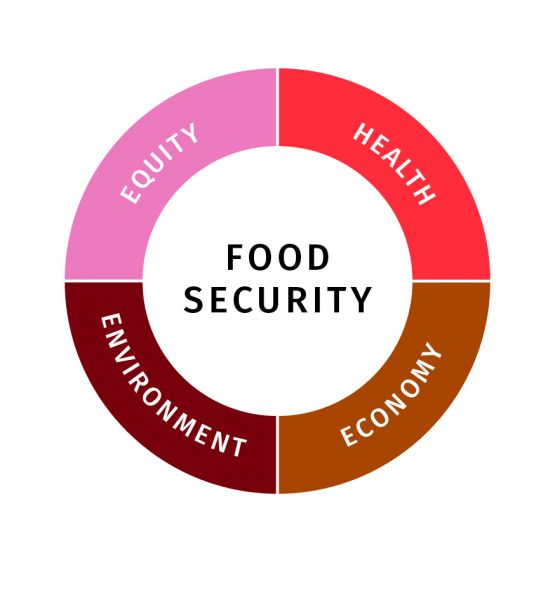
Also consider potential synergies across these four outcome domains when planning actions to strengthen resilience and the trade-offs between them. In food policy development, economic outcomes are often prioritised over other outcomes [4]. Aim to achieve balanced food system outcomes for health, equity, and environment, as well as economy.
Food system domain
Consider outcomes related to…
Health
- Diverse supply of nutritious foods
- Availability of fruit and vegetables
- Consumption of fruit and vegetables
Equity
- Food security (dignified access)
- Access to culturally diverse foods
- Aboriginal self-determination in food availability, access and livelihoods
Environment
- Agricultural land – availability, use and quality
- Water - availability, use and quality
- Greenhouse gas emissions
- Biodiversity
Economy
- Employment
- Diversity of food enterprises – small, medium and large
- Sustainable livelihoods for food and farm workers
-
[1] van Berkum, S., Dengerink, J. and Ruben, R. (2018) The food systems approach: sustainable solutions for a sufficient supply of healthy food. Wageningen, Wageningen Economic Research, Memorandum 2018-064.
[2] Murphy, M., Carey, R., and Alexandra, L. (2022) The resilience of Melbourne’s food system to climate and pandemic shocks. University of Melbourne, Australia. https://doi.org/10.46580/124370
[3] Lang, T., Barling, D. and Caraher, M. (2009) Food policy: Integrating health, environment and society. Oxford, Earthscan.
[4] Carey, R., Caraher, M., Lawrence, M. and Friel, S. (2015) Opportunities and challenges in developing a whole-of-government national food and nutrition policy: lessons from Australia’s National Food Plan. Public Health Nutrition 19 (1), p3-14. doi: 10.1017/S1368980015001834
Related key concepts
Sign up for the Foodprint Melbourne newsletter for project updates