
Learn how to take action to build resilient food systems
Identify actions that deliver multiple co-benefits and support an integrated vision for a resilient food system
Key steps and tools
-
Food systems are being affected by multiple shocks and stresses related to climate change and geopolitical conflicts. It is uncertain which shocks and stresses Victoria’s food system will face in future and in what combination, so consider prioritising actions that will build the long-term resilience of food systems to any potential shock or stress [1].
Develop an action plan to implement your vision for a resilient local or regional food system:
- Identify actions across food supply chains in the region to achieve the vision, considering food system vulnerabilities and assets identified in assessing and mapping
- Identify actions needed across sectors to achieve the vision. Consider food system stakeholders identified in collaborating with partners and co-designing solutions
- Consider how actions can achieve co-benefits across multiple food system outcomes - equity, health, environment, economy. Focus on dignified approaches to addressing food insecurity
Consider these resilience framing questions to establish the scope and timeframes of the action plan [2].
- Resilience of what? Where are you trying to build resilience? Are you developing a food system resilience strategy or a specific initiative? Is it a local or regional initiative?
- Resilience to what? What are you building resilience against?
- Resilience for whom? Who will benefit from increased resilience? Who is most affected? How can you apply an equity and justice lens?
- Resilience for how long? Over what time frame are you aiming to build resilience?
-
Shocks and stresses have impacts across food supply chains, so actions that build resilience are required across all stages of supply chains i.e. production through to waste resources. Targeted action may be required for vulnerable food system activities, locations or population groups. Food system assets in the region can also be leveraged to build resilience.
Identify actions to strengthen resilience across food supply chains in the region. The table below shows example actions to build the resilience of Melbourne's food system, co-developed with stakeholders as part of the Foodprint Melbourne project [3]. Also consider actions to address food insecurity through food with dignity approaches.
Consider how actions will achieve the overarching vision for a resilient food system in the region and how they will lead to short, medium and long-term outcomes (see monitoring and evaluation)
Example actions to build resilience across food supply chains [3]
Food supply chain stage Example actions Production - Protect agricultural land
- Provide diverse learning and training pathways, particularly for young people, to enter farming
- Provide learning opportunities, funding and resources to support farmers in adopting regenerative and agroecological practices
- Support new and aspiring farmers to access land, training and capital
Processing - Invest in shared, decentralised infrastructure for small-medium scale local food processing
- Support small-medium scale farmers and food processors to develop alternative sales channels
Distribution - Establish a regional food hub for small-medium scale producers and processors
- Encourage the decentralisation and diversification of food distribution hubs and warehouses across many locations and organisations
Retail - Support diverse ways to access and purchase healthy and sustainable food through farmgate stalls, farmers markets, social supermarkets and food box schemes
- Fund and support First Peoples’ food enterprises
Consumption - Facilitate community food growing initiatives though community gardens and school kitchen gardens
- Pilot a universal free school meals initiative
Waste resource recovery - Develop a community composting initiative
- Collect rainwater and recycle wastewater for use in food production
- Recycle food waste organics for use on farms
Tools and templates
- The Foodprint Melbourne resilient food supply chain infographic shows potential actions to build resilience across food supply chains
- The Foodprint Melbourne Human right to adequate food infographic suggests actions to implement this right
Recommended external resources
Building better food systems for healthier communities from VicHealth suggests a range of actions that local governments can take
Food-sensitive planning and urban design (FSPUD) from the National Heart Foundation of Australia (Victorian Division) suggests actions to plan sustainable and healthy food systems
-
Civil society, community, industry and government stakeholders across a range of sectors can take action to build resilient food systems. This includes sectors such as planning, transportation, urban development, emergency management and health. Collaborate with partners across sectors to co-design solutions. Identify which partners might be involved in implementing actions and the resources and timeframes required.
Example actions across sectors to build resilience
Sector Example actions Health - Promote dignified access to healthy, sustainable and culturally appropriate food
- Create healthy and sustainable food environments
Environment - Protect biodiversity
- Promote strategies to mitigate and adapt to climate change
- Support farmers to implement regenerative and agroecological agricultural practices
Water - Encourage sustainable use of water resources for agriculture that maintains environmental and cultural water flows
- Increase use of recycled water and treated stormwater for food production in urban and peri-urban areas
Waste and recycling - Prevent and recycle food waste throughout food supply chains
- Build circular food economies that retain valuable nutrients such as phosphorous and nitrogen in the food system
Emergency management - Promote dignified access to healthy and culturally appropriate food during emergencies
- Build community food resilience to prepare for emergencies
Community - Support dignified access to healthy, sustainable and culturally appropriate food
- Enable citizens to participate in shaping their food systems
Planning - Protecting agricultural land
- Prevent development of unhealthy food outlets at incompatible locations
- Promote development of diverse food retail, including independent stores and public markets
- Increase availability of urban land for food production and spaces for community food growing in new developments
Urban development - Include spaces for community food growing in new developments
- Integrate community orchards into new developments
Transportation - Support diverse food transportation routes into regions
- Provide infrastructure for public transport to access healthy food sources
Tools and templates
- The Foodprint Melbourne Making our food systems more resilient to shocks infographic visualises actions to build resilience
Recommended external resources
Building Sustainable and Resilient City Region Food Systems Assessment and Planning Handbook from the Food and Agriculture Organization (FAO) of the United Nations, Chapter 2.5: Action Planning, p103-133
-
Actions to build food system resilience can deliver multiple co-benefits across the domains of equity, health, environment, and economy.
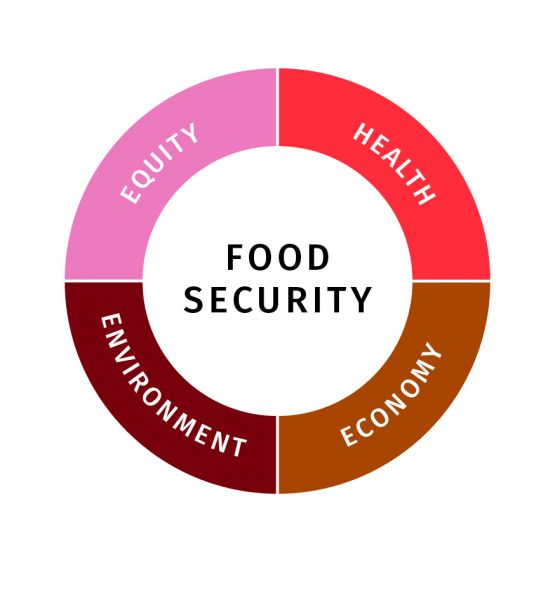
As you plan actions to build resilience across food supply chains and sectors, consider how the actions could be designed in ways that achieve outcomes in other domains.
Example actions across food supply chains to achieve multiple co-benefits
Example food resilience action
Food supply chain stage
Outcome domain
Equity
Health
Environment
Economy
Support new and aspiring farmers to access land, training and capital
Production
Farmer incubator programs support migrant, refugee and female farmers
Food and nutrition security for participants increased
Mental health and wellbeing and social connections enhanced
Regenerative farming practices are promoted
Organic waste is reused on farm
Employment and training pathways are supported
Establish a regional food hub for small and medium scale producers and processors
Distribution and retail
Farmers receive a fair price for produce
Consumers have access to diverse sources of fresh food at a fair price
Seasonal, fresh food is available for locally communities
Food sourced from farmers using regenerative and agroecological approaches
Food and farming enterprises and jobs are supported
Regional food economy grows
Pilot a universal free school meals initiative
Consumption
All students receive a free meal
Food is healthy and meets nutrition guidelines
Meals are linked to food studies education
Food is seasonal and sustainable
Food waste is prevented and recycled
Food packaging is avoided
Food is procured direct from local producers and processors
Develop a community composting initiative
Waste resource recovery
Provides equitable access for all
Builds community connections
Builds soil health
Fertiliser costs are reduced
Tools and templates
- Template to identify co-benefits of actions across multiple food system domains
- Logic model template to identify actions that achieve outcomes across food system domains
-
[1] Murphy, M., Carey, R., and Alexandra, L. (2022) The resilience of Melbourne’s food system to climate and pandemic shocks. University of Melbourne, Australia. https://doi.org/10.46580/124370
[2] Zurek, M., Ingram, J., Sanderson Bellamy, A., Goold, C., Lyon, C., Alexander, P., et al. (2022) Food System Resilience: Concepts, Issues, and Challenges. Annual Review of Environment and Resources. 47(1):511-34. https://doi.org/10.1146/annurev-environ-112320-050744
[3] Carey, R., Murphy, M., Alexandra, L., Sheridan, J., Larsen, K. and McGill, E. (2022) Building the resilience of Melbourne’s food system – a roadmap. University of Melbourne, Australia. https://doi.org/10.46580/124371
Urban planners are building food system resilience
- Urban planning can strengthen the resilience of food systems
- Resources have been developed in the UK, Canada and the USA to help planners promote healthy and resilient food environments
- Urban planners are leveraging opportunities to use land use planning policy to promote food security
Sign up for the Foodprint Melbourne newsletter for project updates