
Learn who to involve and how when planning resilient food systems
Collaborating with partners and stakeholders to build food system resilience can lead to integrated solutions with multiple co-benefits
Key steps and tools
-
Government (local, state and federal), communities, First Peoples, civil society and industry all have a role in planning resilient food systems. Understanding their roles can highlight who to collaborate with and why in planning initiatives to strengthen food system resilience.
Stakeholder group Roles and responsibilities in food resilience planning Why engage? Community Communities are affected by the impacts of food system disruption due to shocks and stresses, and should be at the centre of solutions - can help shape solutions that meet community needs
- can inform dignified approaches to address food insecurity through lived experience
- community participation strengthens community networks and builds resilience
First Peoples First Peoples in Victoria are establishing businesses and initiatives to reclaim ownership of the native foods industry and knowledge of Aboriginal agricultural practices - First Peoples have the right to self-determination in economic, social and cultural development
- First Peoples’ agricultural and food practices contribute to resilient food systems
Civil society Civil society groups work with communities to deliver place-based initiatives and advocate for diverse needs - represent the interests of communities, providing a collective voice
- leverage local knowledge to meet community needs
Local Government Local governments develop municipal strategies, advocate to state and federal governments and provide resources and support to communities - collect municipal level data
- level of government closest to the community
- engage with the community to develop initiatives that respond to local needs
State Government State governments set policy and legislative frameworks for state and local government, provide guidance and resources for implementation, and advocate to federal government - influence the policy environment for local government
- collect state level data
- provide finance, guidance and resources for implementation of initiatives related to food resilience planning
Federal government Federal government departments develop and implement legislation and policy that influences the resilience of all stages of food supply chains from production to waste resources - set the policy environment for state and local government
- provide finance and resources for implementation of food resilience planning initiatives
Industry Industry stakeholders carry out activities and maintain networks and infrastructure across food supply chains - responsible for activities and infrastructure that is critical to food system resilience and food security
- industry peak organisations provide a collective industry voice in some sectors
-
Placing equity at the centre of collaboration and engagement with stakeholders is important in food resilience planning, because food systems are highly inequitable. Collaborative processes are an opportunity to promote equitable food system outcomes by addressing power imbalances and elevating the voices of stakeholders who might not typically have a seat at the table.
Power is concentrated in food supply chains in a small number of very large corporations that exert significant influence over other actors, including farmers, consumers and other smaller companies. [1]. Low rates of pay and insecure employment throughout food supply chains exacerbate inequity and undermine the resilience of food systems [2][3].
In 2022, around 8% of Victorians ran out of food in the previous 12 months and were unable to afford to buy more [4]. Prevalence of severe food insecurity is much higher in some population groups, including low-income households, people who are unemployed or unable to work, Aboriginal and Torres Strait Islander Peoples, and refugees and asylum seekers [4-6].
The food systems of First Peoples in Victoria have been significantly undermined by ongoing processes of colonisation. Colonisation has denied First Peoples access to land, water and economic resources to practice agriculture and grow Aboriginal foods, and it has led to high rates of food insecurity in Aboriginal communities [7].
-
Place equity at the centre of collaboration and stakeholder engagement in planning who to involve and how to involve them.
Who to involve
- People most affected - have you included the communities, organisations and people likely to be most affected by the impacts of shocks and stresses on food systems?
- People with lived experience – have you included people with lived experience of food insecurity or other impacts of food system disruption?
- Diverse groups – have you included people from diverse groups across the community, including people from migrant communities, young people, people with diverse genders?
- First Peoples – have you included First Peoples in the region? Have you considered how the involvement of First Peoples will generate reciprocal benefits that support self-determination? Have you established processes for culturally safe collaboration?
- Small scale actors – have you included small as well as large scale actors across food supply chains e.g. small-scale farmers and independent retailers?
How to make collaboration inclusive
- Establish project timelines and budgets that allow for inclusion
- Co-develop projects that are reciprocal and deliver meaningful benefits to communities
- Build relationships and trust with communities before engaging
- Reimburse participants for the time and costs of involvement
- Address power imbalances
- Be transparent in communication
- Undertake self-education about equity and injustice and explore your assumptions as a team
Recommended external resources
Climate justice and resilience toolkit from Western Australia, which includes guidance on engaging First Peoples and people with lived experience
Maggolee website developed by Reconciliation Victoria to support engagement and partnerships between local government and Aboriginal communities
A guide to supporting equity in engagement from researchers at McMaster University in Canada
-
Co-design is a process for collaborating with people who are affected by problems to develop solutions that meet their needs. It is grounded in design thinking and it focuses on designing with rather than for people [8] [9].
Co-design processes have many advantages for designing initiatives to strengthen the resilience of food systems:
- Creative ‘design thinking’ processes can open up new ways of thinking about the challenge of building resilient food systems to generate transformative solutions
- Co-design workshops can involve a wide range of stakeholders from across food supply chains to develop integrated ‘food systems’ solutions to address the challenges
- Co-design can promote more equitable food systems through the inclusion of diverse groups of people in generating solutions to build resilience
- Co-design can support participatory governance by including citizens in the design of decisions and actions that shape food systems
- Co-design can address power imbalances in food systems by grounding solutions in inclusive processes that shift power dynamics between stakeholders
- Food with dignity approaches can be co-designed with people who have lived experience of food insecurity to develop solutions that meet their needs
Co-designing solutions to address food insecurity with people who have lived experience supports dignified approaches that are grounded in the human right to food. Hunger and food insecurity have been recognised as forms of social trauma [10], and a trauma-informed framework can support the development of inclusive strategies to address food insecurity. The principles of a trauma-informed approach include safety, trustworthiness and transparency, collaboration, empowerment, choice and intersectionality [11].
Recommended external resources
Advice on equity and co-design from Metro North Health in Queensland
Human-centred design tools from the Victorian Government’s human-centred design playbook
Guide to co-design a food hub with community from the Open Food Network
-
Actions are needed across food supply chains from farm to fork to strengthen resilience, so collaborate with stakeholders from across the local or regional food system to develop solutions at all stages of food supply chains. Consider involving stakeholders from outside the immediate region to include more stages of food supply chains e.g. in an urban area, consider including food producers from surrounding peri-urban or regional areas.
Map food system stakeholders across the local or regional food system. Include organisations and people from:
- Multiple stakeholder groups - communities, civil society, First Peoples, government and industry
- All stages of food supply chains – from production to consumption and waste resources
- Across sectors - including environment, health, planning, community development, emergency management, waste and recycling, and economic development
For more information about potential local and state government partners, see making the case
Potential stakeholders to involve across civil society, community and industry
Food supply chain Stage Industry Civil society and community Production Farmers Community gardens Industry groups Schools Processing Manufacturers and processors Community food enterprises Distribution
Transport and logistics Food hubs Wholesalers Food co-operatives Retail
Supermarkets Public markets Independent retailers Farmers markets Restaurants and cafes Social supermarkets Consumption
Workplace catering and procurement Community food initiatives Food relief providers Hospitals, schools and aged care People with lived experience of food insecurity Waste resource recovery Food rescue organisations Community composters Food and organics recyclers Tools and templates
- A template for identifying food system stakeholders
-
Governance models that support collaboration across local and regional food systems can strengthen food system resilience. They can facilitate co-ordinated action across food supply chains and establish relationships across sectors that enable quick responses in the event of a food system shock [12].
Co-ordination across sectors and policy portfolios is an important part of a food systems approach to food resilience planning. A range of different models have emerged that promote multi-sector governance for local and regional food systems.
Food system governance models
Governance model
Function
Scale
Examples
Steering group, taskforce or reference group
Lead the development and/or ongoing planning of a food partnership, action plan or strategy
Local (within a municipality) or regional (across several municipalities)
Food policy council
Coordinate joint strategies across food systems actors and sectors
City, state or territory
Vancouver Food Policy Council, Canada
Food alliances, networks or coalitions
Provide a framework uniting diverse organisations that collaborate to address food system issues, often across sectors
City, state, territory or national
Food Resilience Network, Christchurch, Aotearoa New Zealand
Bristol Good Food Alliance, Bristol, United Kingdom
Recommended external resources
Food partnership structures resource in the Sustainable Food Places Toolkit (UK)
-
[1] Clapp, J. (2021) The problem with growing corporate concentration and power in the food system. Nature Food 2: 404-408.
[2] Underhill, E. and M. Rimmer (2015) Itinerant Foreign Harvest Workers in Australia: The Impact of Precarious Employment on Occupational Safety and Health. Policy and Practice in Health and Safety 13 (2): 25-46.
[3] Jones, N., Bellamy, J., Bellotti, W., Ross, H., van Bommel, S. and Lu, Y. (2022) A shock to the system: What the COVID-19 pandemic reveals about Australia’s food systems and their resilience. Frontiers in Sustainable Food Systems 5: 790694
[4] VAHI (2024) Victorian Population Health Survey 2022. Victorian Agency for Health Information Available: https://vahi.vic.gov.au/reports/victorian-population-health-survey-2022
[5] Department of Health. Victorian public health and wellbeing outcomes dashboard. Available: https://www.health.vic.gov.au/victorian-public-health-and-wellbeing-outcomes-dashboard
[6] Wood, J., Leech, R. and Margerison, C. (2024) The prevalence of food insecurity amongst refugees and asylum seekers during, and prior to, their early resettlement period in Australia: A cross-sectional analysis of the 'Building a New Life in Australia' data. Appetite 107273. doi: 10.1016/j.appet.2024.107273.
[7] Carey, R., Murphy, M. and Behen, T. (2024) Planning a resilient food system for Victoria. The University of Melbourne. https://doi.org/10.46580/124375
[8] Blomkamp, E. (2018) The promise of co-design for public policy. Australian Journal of Public Administration 77 (4), pp. 729-743).
[9] Baxter, K., Kerr, J., Nambiar, S., Gallegos, D., Penny, R., Laws, R. (2024) A design thinking-led approach to develop a responsive feeding intervention for Australian families vulnerable to food insecurity: Eat, Learn, Grow. Health Expectations 27 (2) https://doi.org/10.1111/hex.14051
[10] Walker, C., Schan, H., Devlin, B., Plowman, D. and Wise, M. (2022) Hunger trauma: Understanding experiences of food insecurity and emergency food support. September 2022. University of Brighton.
[11] Hecht, A., Biehl, E., Buzogany, S. and Neff, R. (2018) Using a trauma-informed policy approach to create a resilient urban food system. Public Health Nutrition 21 (10): 1961-1970.
[12] Murphy, M., Carey, R., and Alexandra, L. (2022) The resilience of Melbourne’s food system to climate and pandemic shocks. University of Melbourne, Australia. https://doi.org/10.46580/124370
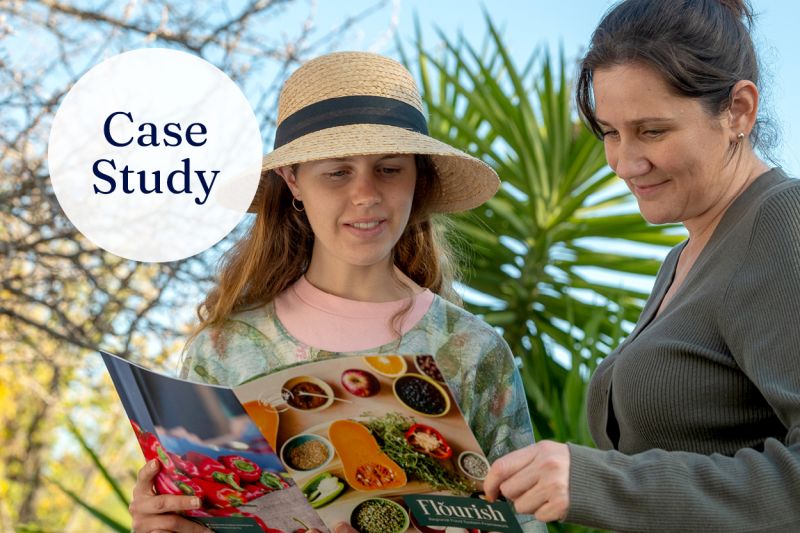
Engaging community in food partnerships
- Community-led networks and partnerships play a leading role in building more resilient food systems
- In the Latrobe Valley and Loddon Campaspe regions of Victoria, food partnerships have been established to drive action toward food system resilience
- Participatory governance is a core feature of food systems that are resilient to shocks and stresses
Key concepts
Other toolkit sections
Sign up for the Foodprint Melbourne newsletter for project updates