
Learn how to develop a shared vision for a resilient food system
Establish a shared purpose with diverse stakeholders for a resilient food future
Key steps and tools
-
The development of a shared vision for a resilient food system is grounded in engagement and collaboration with key stakeholders. Include a range of perspectives from government, civil society, community and industry stakeholders across the food system from farm to fork. Consider involving stakeholders from portfolios such as public health, climate adaptation, environment, emergency management, economic development and waste and resource recovery.
Potential stakeholders to involve across industry and community sectors
Food supply chain Stage Industry Civil society and community Production Farmers Community gardens Industry groups Schools Processing Manufacturers and processors Community food enterprises Distribution Transport and logistics Food hubs Wholesalers Food co-operatives Retail Supermarkets Public markets Independent retailers Farmers markets Restaurants and cafes Social supermarkets Consumption Workplace catering and procurement Community food initiatives Food relief providers Hospitals, schools and aged care Waste resource recovery Food rescue organisations Community composters Food and organics recyclers Community gardens Tools and templates
-
Conduct a visioning workshop to gather ideas from stakeholders about the kind of resilient food system they want to see in the future. Use collaborative activities such as brainstorming and scenario planning to understand their perspectives and priorities.
Before the workshop, understand the potential shocks and stresses that may affect the local or regional food system, and identify food system vulnerabilities and assets. Share highlights from this assessment with workshop participants.
Suggested approach for facilitating a visioning workshop
- Ask participants to brainstorm what a resilient food system in the region would look like in 5, 10 or 20 years (depending on the project or strategy timeframe). Collect ideas on post it notes (if in person) or using virtual post it notes on an online platform such as Miro or Teams
- Work together in groups to cluster ideas that share common themes. Consider how themes relate to the food system outcome domains of equity, health, environment and economy in addition to resilience
- Ask participants to prioritise their top 3 ideas
- Wrap up the workshop by summarising some of the priorities for the group
- Review the ideas that emerged from the workshop and use them to draft a vision that captures long term objectives for a food system that is resilient to shocks and stresses. In the vision consider:
- All stages of food supply chains from production to consumption and waste resources
- How objectives align with food system outcomes related to equity, health, environment and economy, as well as resilience
- Share the vision that is developed with workshop participants. If time and resources allow, involve the group in reviewing and refining the draft vision
Recommended external resources
Developing a vision and food charter tool in the Sustainable Food Places (SFP) Toolkit (UK)
Visioning future-proof food systems tool in the Fit4Food2030 Knowledge Hub (EU)
-
A vision and objectives for food system resilience can form the basis of a new standalone policy (e.g. a local or regional food resilience policy) or can be integrated into an existing policy. It’s useful to map relevant policies, their objectives and scope to assist in this process. Identify links between objectives for food system resilience and existing policies in your organisation or at relevant levels of government.
A range of policies across portfolios in local, state and federal government influence the resilience of food systems. This includes policy portfolios such as health, climate adaptation, planning, agriculture, economic development, water and community development. Policies across industry and civil society also influence food system resilience.

Tools and templates
- A template to map policies that are relevant to food system resilience
- Food system resilience and local government policy in Victoria diagram
Recommended external resources
Food policy mapping tool in the Sustainable Food Places (SFP) Toolkit (UK)
Food system resilience: A planning guide for local governments from the John Hopkins Center for a Liveable Future and the Bloomberg Center for Government Excellence, Policy plan and scan tool, p53-55
-
There are multiple ways to present a vision for a resilient food system. It can take the form of a short narrative that describes a future resilient food system, a visual diagram or a series of statements that capture objectives for a resilient food system.
A narrative vision for a resilient Melbourne food system in 2050:
"In 2050, Melbourne’s population is living with the impacts of a warming climate. While climate mitigation efforts ramped up over the preceding decades, the food system is under constant strain from shocks and stresses. However, the city’s food supply is proving resilient. Everyone enjoys dignified access to nutritious and culturally appropriate food. During the 2020s and 30s, stakeholders collaborated to transform Melbourne’s city region food system, so that sustainable and healthy food is accessible to everyone. Government legislated to strengthen protection for agricultural land in Melbourne’s city region and invested in increasing the diversity of food supply chains. Communities mobilised to strengthen the resilience of the city’s food supply. Melbournians have increased their consumption of locally produced, seasonal foods and Melbourne has a thriving food culture. Foods produced by Victoria’s First Nations peoples are also an important part of the region’s sustainable and resilient food supply [1]."
Vision statements in local government and civil society food system policies
Organisation Strategy or declaration Food system resilience vision statement Merri-bek City Council Food System Strategy 2024-2027 Our vision is a food system that is: - Sustainable – Supports a healthy environment, healthy people and a resilient community
- Just – Makes nutritious and culturally appropriate food accessible and affordable for everyone
- Vibrant – Protects and nurtures food culture, celebrates diversity and builds a sense of community
City of Melbourne Food City 2024-2034 Food City 2024–34 will improve community health and wellbeing by strengthening and promoting a food system that is secure, healthy, sustainable, socially inclusive, equitable and resilient. Healthy Loddon Campaspe
Flourish Regional Food System Framework
A vibrant and sustainable regional food system that puts community and Country at its heart to promote health, equity, and resilience for all.
Christchurch City Council Food Resilience Policy 2014 Vision: Christchurch is the best edible garden city in the world. Objective: A food-resilient Christchurch with thriving social, economic and physical environments providing healthy, affordable and locally grown food for all people.
Victorian Food Security and Food Systems Working Group Towards a Healthy, Regenerative and Equitable Food System in Victoria: A Consensus Statement An equitable, regenerative, prosperous and resilient food system that ensures access to healthy and culturally appropriate food for all Victorians; a system that values nourishment, fairness, dignity, democracy, participation, inclusivity and stewardship of the natural environment. Latrobe Valley Food For All Coalition Latrobe Valley Food Declaration - A local food system that supports the social and physical wellbeing of all community members
- Recognise that access to nutritious, affordable food without the need for emergency food relief is a basic human right
- Recognise the need to conserve local ecosystems, biodiversity and protect fertile agricultural lands
- Local government policies should include strategies to support food access. These policies may relate to income, employment, housing, health and transport
- Prioritise strategies and initiatives that promote food security and a sustainable food system
-
[1] Carey, R., Murphy, M., Alexandra, L., Sheridan, J., Larsen, K. and McGill, E. (2022) Building the resilience of Melbourne’s food system – a roadmap. University of Melbourne, Australia. https://doi.org/10.46580/124371
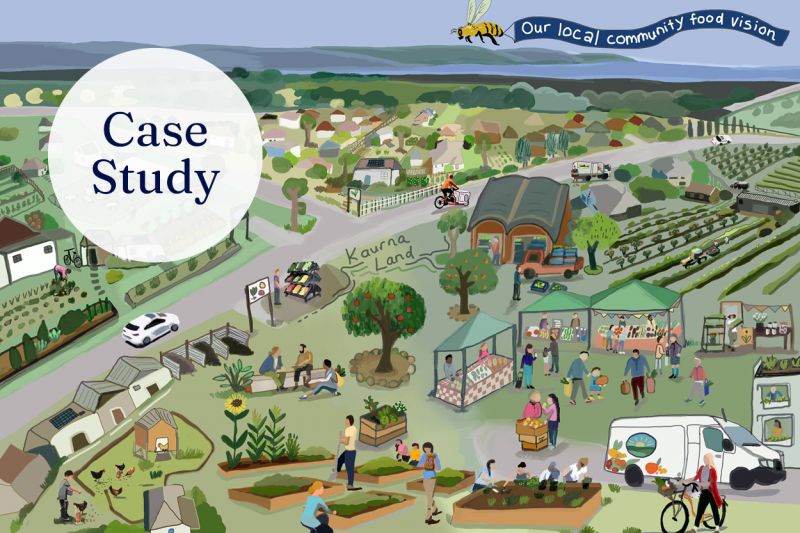
Envisioning resilient food systems in South Australia
- Four local governments in South Australia have developed unique visions for a resilient food system
- The visioning process involved collaboration between stakeholders from government, community organisations and residents
- An Enabling Resilient Food Systems toolbox has been developed to support the development of community visions for resilient food systems and to build food systems literacy
Key concepts
Sign up for the Foodprint Melbourne newsletter for project updates