
Learn about dignified approaches to address food insecurity
Dignified approaches to address food insecurity give people control over food choices and are grounded in the human right to food
Key steps and tools
-
Food with dignity approaches to addressing food insecurity empower people by giving them control over their own food choices – about what they eat, where, when and with whom - and by enabling them to participate in the community [1].
The main approach to addressing food insecurity in Victoria is emergency food relief, which does not generally provide people with control over their food choices [2]. People who use food relief services can experience feelings of shame and embarrassment, which may act as a barrier to accessing services [3].
Food with dignity approaches provide access to nutritious food that meets people’s cultural food preferences. They are grounded in the right to food, which is a human right under international law [4].
Tools and templates
- A presentation to make the case for food with dignity and rights-based approaches to address food insecurity
Recommended external resources
Dignity in Practice guidance, tools and case studies from Nourish Scotland
-
"A truly dignified system would be one where everyone is food secure, with access to adequate, nutritious and culturally appropriate food, without the need of emergency food aid. It is one where the right to food is understood as a matter of justice rather than charity" [1]
Principles for implementing food with dignity approaches have been developed by civil society groups in Scotland [4] and England [5]. The principles were developed with people who have lived experience of food insecurity. The Dignity Principles developed by Nourish Scotland focus on what ‘food with dignity’ feels like to recipients when implemented in practice [4]:
- A sense of control
- Able to take part in community life
- Nourished and supported
- Involved in decision-making
- Valued and able to contribute
Dignified approaches to addressing food insecurity give people a sense of control by giving them choice over what they eat, where and how. They enable people to take part in community life regardless of their financial circumstances, and they provide fresh and nutritious food they can enjoy in a way that meets their needs [4].
Dignified approaches to address food insecurity
Approach Summary Examples Cash first Access to emergency cash payments that people can choose how to spend, often with wrap around services Aberdeen Cash First Network, Scotland Shopping vouchers Vouchers that people can use to buy food at markets or supermarkets Open Food Network’s Food Subsidy Pilot Project, VIC Low-cost fresh food markets Low-cost fresh food in a market setting that creates social connections The Community Grocer, VIC Social supermarkets Low-cost food and groceries in a retail setting, often with wrap around services The Food Centre, SA Community cafes Low-cost nutritious meals in a café setting that provides community connections One World Everybody Eats cafes, USA Universal free school meals Free meals for all school students, sometimes across particular year levels or in certain regions Free school meal programs in the UK The right to grow The right to have a space to grow food in communities Right to grow in city of Hull, UK Recommended external resources
Dignity toolkit from the Alliance for Dignified Food Support (UK)
Victorian healthy food relief guidelines from the Victorian Government which have an emphasis on dignity
-
"Involving people with experience of food insecurity in the process is where we will find the solution" [6]
Co-design is a collaborative approach to designing solutions to problems with rather than for the people who are affected by them [7]. It is well-suited to designing dignified solutions to food insecurity with people who have lived experience, and it supports an underlying principle of ‘food with dignity’ approaches to involve people in decision-making [4].
Co-design uses ‘design thinking’ processes that aim to understand people’s experiences and co-develop solutions that meet their needs [8]. Following dignity principles, focus on understanding how delivery of food insecurity initiatives makes people feel [4].
Food insecurity and hunger have been recognised as forms of social trauma [9], so approach co-design with people who have lived experience of food insecurity with care and consider adopting trauma-informed principles in co-design.
These principles include safety, trustworthiness and transparency, peer support, collaboration empowerment and choice [10] [11]. Identify the forms of support that people will need to participate and renumerate people for their participation.
Recommended external resources
Advice on equity and co-design from Metro North Health in Queensland
-
"The right to food is not a right to be fed but primarily the right to feed oneself in dignity…To be able to do this, a person must live in conditions that allow him or her to produce food or to buy it" [12]
The human right to adequate food is recognised as a human right in international law. It is included in the International Covenant on Economic, Social and Cultural Rights (ICESCR) (1966) as part of the right to an adequate standard of living [13]. Countries that have ratified the ICESCR, such as Australia, have binding obligations to respect, protect and fulfil the right to adequate food [12] [14].
The right to food emphasises dignified access to adequate food by having the means to buy or produce it. Adequate food has been defined as food that meets dietary needs for health, is safe and culturally acceptable. It is also sustainably produced, so that food is accessible over the long term to present and future generations [12][14].
Tools and templates
- Foodprint Melbourne infographic visualising approaches to implementing the human right to adequate food
Recommended external resources
The right to food defined from the United Nations Special Rapporteur on the right to food
Fact Sheet No. 34 The Right to Adequate Food from the United Nations Office of the High Commissioner for Human Rights
-
The Australian Government has obligations under the International Covenant on Economic, Social and Cultural Rights (ICESCR) (1966) to respect, protect and fulfil the right to adequate food [15]. These obligations cannot currently be enforced under Australian law because the human right to food has not been legislated in Australia [16].
No state or territory in Australia has legislated the human right to food. However, the Committee report from the parliamentary Inquiry into food security in Victoria recommended amending the Victorian Charter of Human Rights and Responsibilities to include the right to adequate food in 2024 [17].
Some local governments in Victoria have acknowledged the human right to food as a principle underpinning their food strategies and policies.
Acknowledgement of the human right to food in Victorian local government food strategies [2]
Local government Policy document Policy extract Cardinia Shire Council Cardinia Shire Community Food Strategy 2018-26 “Food security is a human right. The 1948 Universal Declaration of Human Rights includes the right of every person ‘to an adequate standard of living for himself and his family, including adequate food, clothing and housing’. The International Covenant on Economic, Social and Cultural Rights 1966 was ratified by Australia in 1975, and requires that all state parties take immediate steps to guarantee the right to freedom from hunger for all persons in their jurisdiction; and to take appropriate steps towards the ‘progressive realization’ of the right to adequate food.” (p 20) Merri-bek City Council Moreland Food System Strategy Extension 2020-2024 “Apply human rights and equity principles to all actions and initiatives, recognising that access to nutritious and culturally appropriate food is a fundamental and universal human right.” (p 5) City of Melbourne Draft Food Policy: Food City 2024-2034 “Food City 2024–34 reflects our commitment to actively work towards the fundamental and universal human right to safe, nutritionally adequate and culturally appropriate food for all people. We will engage with all levels of government and stakeholders across the food system to secure these basic rights as set out in the United Nations Universal Declaration of Human Rights and the International Covenant on Economic, Social and Cultural Rights, which Australia ratified in 1975.” (p 7) City of Darebin Urban Food Production Strategy 2014-2018 “Access to adequate nutritious and safe food is a basic human right.” (p 14) Banyule City Council Urban Food Strategy 2023-2027 “Access to good food is a basic necessity and a fundamental human right. Food is also a tool for connection, celebration and inclusion of diverse cultural identities. Banyule residents value food as central to their social lives and connection to community. They wish to see food recognised and valued for its unique role in community building.” (p 25) Recommended external resources
Advice from the Australian Attorney-General to federal public servants on considering the human right to food as part of the right to an adequate standard of living
-
The human right to food is linked to the realisation of other rights, including the rights of First Peoples. The UN Declaration on the Rights of Indigenous Peoples (UNDRIP) includes the right to self-determination for First Peoples (article 3) and the right of First Peoples to, “own, use develop and control” lands that they have traditionally owned or occupied (article 26.2) [18]. Realisation of the right to food for First Peoples therefore depends on access to land, water and other resources to produce food [19].
One important aspect of the right to self-determination is economic development. First Peoples in Victoria are establishing businesses and initiatives to reclaim their leadership of the native foods industry and their knowledge of Aboriginal agricultural practices [20]. Another important aspect of self-determination is the right of First Peoples to participate in decisions on issues that affect their rights, including the human right to food [18].
Recommended external resources
Victorian Traditional Owner Native Food and Botanicals Strategy and cultural protocols fact sheet from the Federation of Victorian Traditional Owner Corporations
Guidelines on the right to food and Indigenous Peoples from the Food and Agriculture Organization of the United Nations (FAO)
-
[1] Nourish Scotland/The Poverty Truth Commission (2018) Dignity in practice: Tools for community food providers. Nourish Scotland and The Poverty and Truth Commission. January 2018.
[2] Carey, R., Murphy, M. and Behen, T. (2024) Planning a resilient food system for Victoria. The University of Melbourne. https://doi.org/10.46580/124375
[3] Foodbank/Ipsos (2023) Foodbank hunger report 2023: National findings key report. Foodbank Australia.
[4] Nourish Scotland/Poverty Truth Community (2022) Dignity Principles. Dignity in Practice toolkit. https://dignityinpractice.org/principles
[5] Alliance for Dignified Food Support (2024) Dignity charter. https://www.alliancefordignifiedfoodsupport.org.uk/dignity-charter
[6] Independent Working Group on Food Poverty (2016) Dignity: Ending hunger together in Scotland. The report of the Independent Working Group on Food Poverty. June 2016. Edinburgh, The Scottish Government.
[7] Baxter, K., Kerr, J., Nambiar, S., Gallegos, D., Penny, R., Laws, R. (2024) A design thinking-led approach to develop a responsive feeding intervention for Australian families vulnerable to food insecurity: Eat, Learn, Grow. Health Expectations 27 (2) https://doi.org/10.1111/hex.14051
[8] Hasso Plattner School of Design at Stanford. An introduction to design thinking: Process guide. https://web.stanford.edu/~mshanks/MichaelShanks/files/509554.pdf
[9] Walker, C., Schan, H., Devlin, B., Plowman, D. and Wise, M. (2022) Hunger trauma: Understanding experiences of food insecurity and emergency food support. September 2022. University of Brighton.
[10] Hecht, A., Biehl, E., Buzogany, S. and Neff, R. (2018) Using a trauma-informed policy approach to create a resilient urban food system. Public Health Nutrition 21 (10): 1961-1970.
[11] Substance Abuse and Mental Health Services Administration. SAMHSA’s Concept of Trauma and Guidance for a Trauma-Informed Approach. HHS Publication No. (SMA) 14-4884. Rockville, MD: Substance Abuse and Mental Health Services Administration, 2014.
[12] Officer of the High Commission for Human Rights (2010) The right to adequate food. Fact sheet No. 34. Paris: Office of the United Nations High Commissioner for Human Rights.
[13] International Covenant on Economic, Social and Cultural Rights, opened for signature 16 December 1966, 993 UNTS 3 (entered into force 3 January 1976) Art 1.
[14] Committee on Economic, Social and Cultural Rights (1999) Substantive issues arising in the implementation of the International Covenant on Economic, Social and Cultural Rights. General Comment 12. The right to adequate food (art. 11). 12 May 1999. United Nations Economic and Social Council.
[15] Australian Human Rights Commission (AHRC) (2019) Discussion paper: Ensuring effective national accountability for human rights. Free and Equal, An Australian conversation on human rights. Australian Human Rights Commission.
[16] Parliamentary Joint Committee on Human Rights (2015) Guide to human rights. June 2015. Commonwealth of Australia.
[17] Legislative Council Legal and Social Issues Committee (2024) Inquiry into food security in Victoria final Committee report. November 2024. https://www.parliament.vic.gov.au/get-involved/inquiries/foodsecurityinquiry/reports
[18] United Nations (General Assembly). Declaration on the Rights of Indigenous People. 2007.
[19] FAO (2009) The right to food guidelines and Indigenous Peoples: An operational guide. Rome: Food and Agriculture Organization of the United Nations.
[20] Federation of Victorian Traditional Owner Corporations (FVTOC) (2021) Victorian Traditional Owner native food and botanicals strategy. https://www.fvtoc.com.au/native-foods-and-botanicals
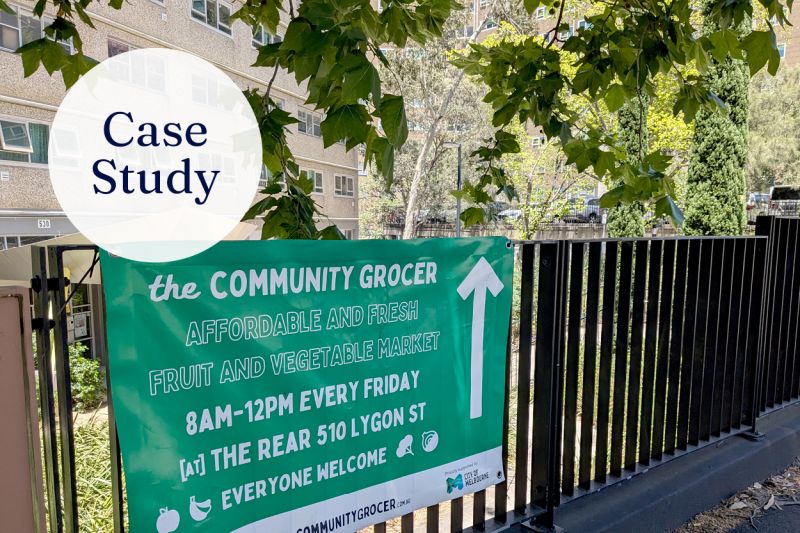
The Community Grocer
- Community-based markets increase social, economic and physical access to healthy food
- The Community Grocer reaches around 400 households at its weekly markets across six locations in Melbourne
- The majority of customers are unemployed or living on low incomes
Universal free school meals
- Universal school meal programs provide a free nutritious meal to all children. While a child’s age may determine eligibility, a free nutritious meal is available regardless of the family’s income or the community’s socio-economic status.
- Universal school meals support health and learning, and can deliver environmental and economic outcomes through local food procurement.
- Universal school meal programs are common throughout the world, and have been in existence for more than a century.

Key concepts
Sign up for the Foodprint Melbourne newsletter for project updates