What makes cities liveable?
On Wednesday 18 March, almost 400 in-person and online guests gathered at Burnley Campus for the first Science at Melbourne Conversation for 2026 on 'What makes cities liveable?'.
As well as launching this year’s public event series, the evening celebrated Burnley’s 135th anniversary – Australia’s oldest horticulture school.
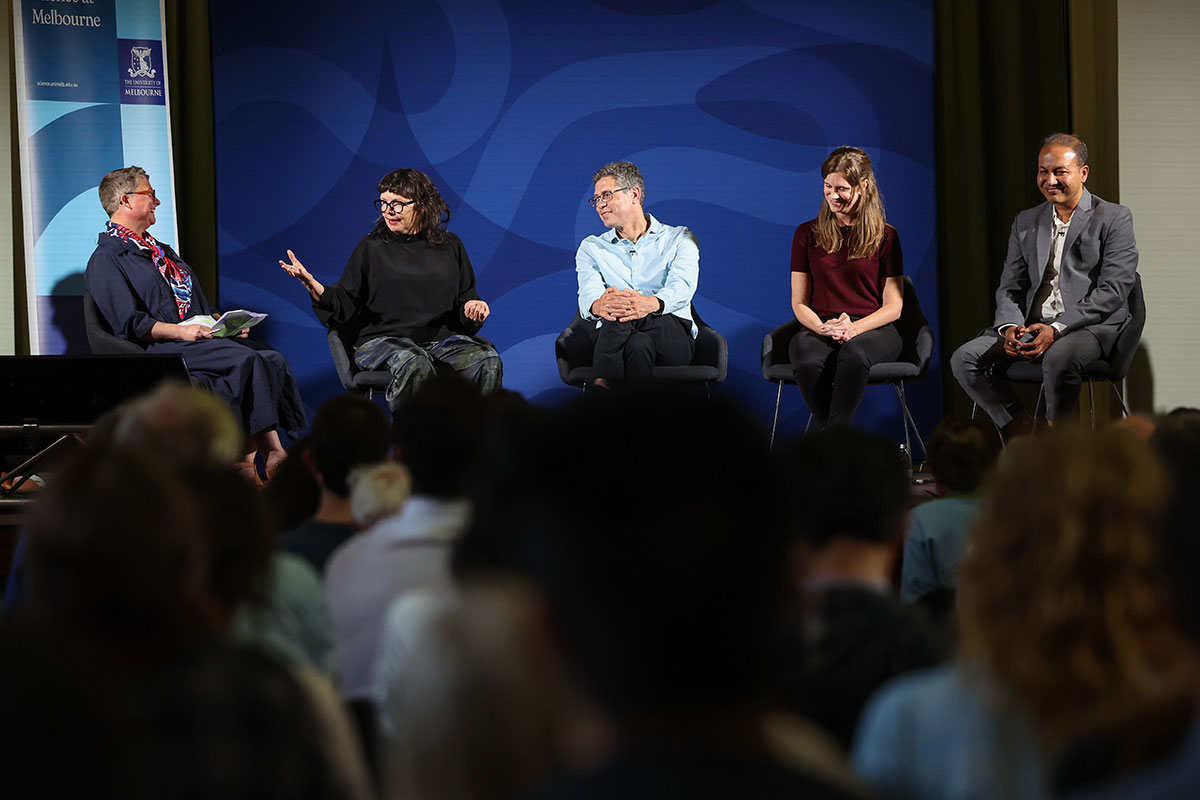
Left to right: Associate Professor Claire Farrell, Katrina Sedgwick OAM, Professor Ilan Wiesel, Dr Marie Dade and Dr Mohammad Rahman.
For in-person guests, the evening began with a guided tour of the Woody Meadow and Melbourne Arts Precinct Plant Trials – living research sites demonstrating how urban planting can cool cities and support biodiversity.
Burnley Campus Director and green infrastructure expert Associate Professor Claire Farrell then moderated a thought-provoking panel discussion that featured:
- Professor Ilan Wiesel, Professor in Urban Planning, School of Geography, Earth and Atmospheric Sciences
- Dr Marie Dade, Lecturer in Urban Greening, School of Agriculture, Food and Ecosystem Sciences
- Dr Mohammad Rahman, Senior Lecturer in Urban Horticulture, School of Agriculture, Food and Ecosystem Sciences
- Katrina Sedgwick OAM, Director & CEO, Melbourne Arts Precinct Corporation.
Panellists explored how cities can balance social, environmental and economic priorities to create communities that are not only functional, but inclusive, sustainable and connected.
Discussion ranged from the role of green infrastructure in cooling urban environments and supporting biodiversity, to the importance of equitable access to housing, transport and public space.
Panellists also reflected on Melbourne’s global reputation as one of the world’s most liveable cities – and where there is still work to do to ensure all communities benefit from that liveability.
Watch the full event recording below.