Early Career Research Summit
Science Early Career Academic Network (SECAN)
4th June 2026
Melbourne Connect
Description
Speakers will give 15-minute oral presentations (12 + 3 for questions), or 3-minute Flash talks. Oral presentations will run in multiple concurrent streams with a mix from all the schools in the Faculty of Science: School of Agriculture, Food, and Ecosystem Sciences; School of Biosciences; School of Chemistry; School of Geography, Earth and Atmospheric Sciences; School of Mathematics and Statistics; School of Physics; and Melbourne Veterinary School. Please target your presentation for a general scientific audience.
Abstract Submission
Abstract submission has now closed
Questions
If you have specific questions about the Research Summit, please contact the organising committee. If you'd like to learn about other SECAN events, our SharePoint page is the place to go.
Accessing the venue
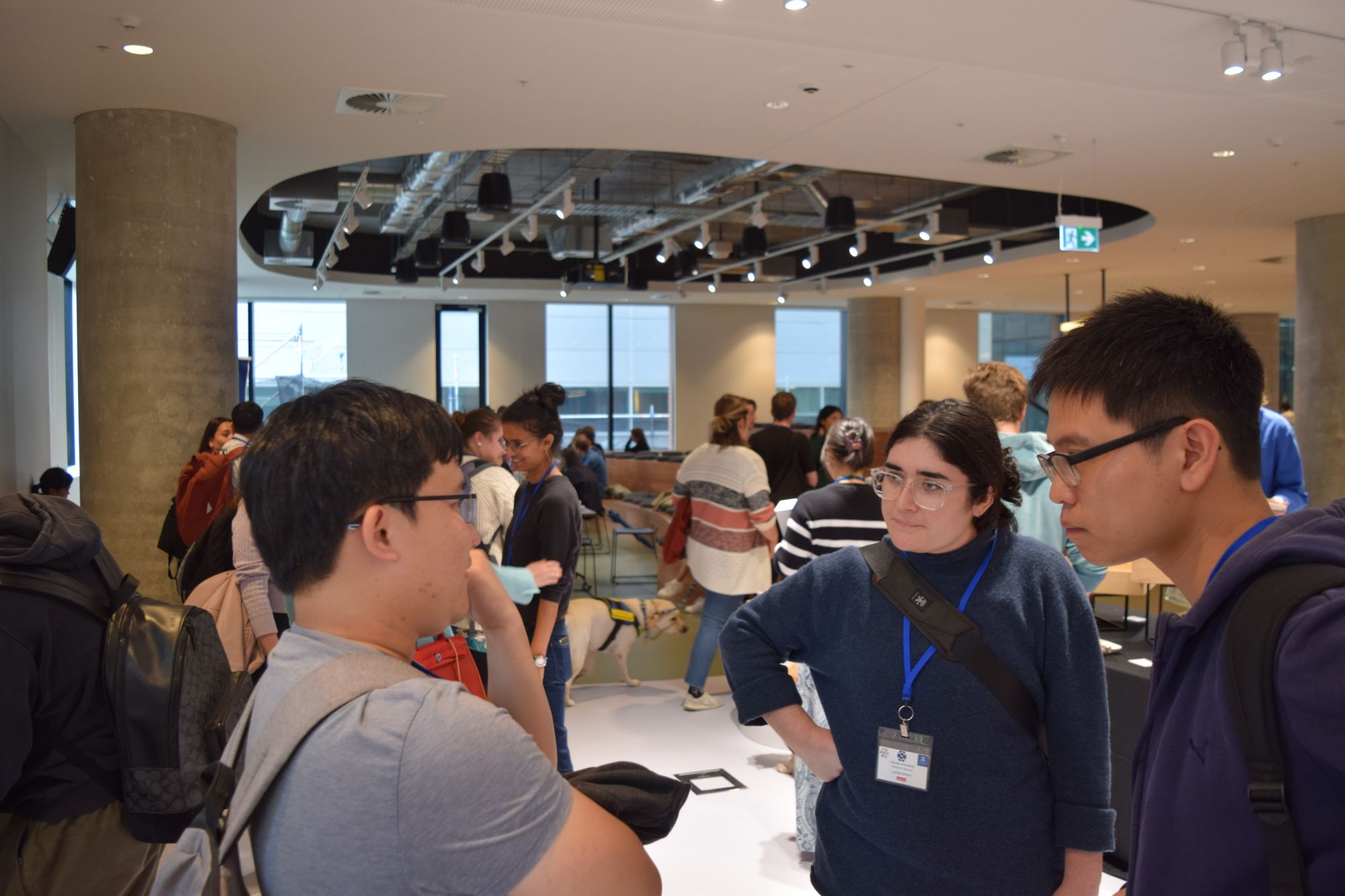
The research summit will take place in The Forum on the first floor. Look out for signs around the Swanston St entrance.
Plenary Speaker
Prof. Michael-Shawn Fletcher is a Wiradjuri scholar and geographer whose research examines long-term relationships between people, plants and fire on the Australian continent. His work integrates Indigenous knowledge systems, ethnobotany and deep-time palaeoecology to understand how cultural practice has shaped vegetation patterns for tens of thousands of years.
Michael-Shawn’s research challenges the framing of Australia as “wilderness,” demonstrating that many landscapes commonly regarded as natural were actively structured through cultural burning, seasonal movement and reciprocal plant management. Using sedimentary records, fire history reconstruction and collaborative research with Indigenous Nations, he shows how the disruption of plant–people relationships following colonisation has altered vegetation structure, fuel dynamics and biodiversity outcomes.
His work sits at the intersection of ethnobiology, geography and Indigenous sovereignty, advancing approaches that reconnect ecological health with Indigenous governance and care for Country.
Dr Hayden Dalton is a Lecturer in Geoscience in the School of Geography, Earth and Atmospheric Sciences.
His research has focused on the origin and timing of volcanic eruptions across our planet. For his PhD, he focused on kimberlites, the deepest derived magmas on Earth and the volcanoes responsible for transporting diamonds from the deep Earth to the surface. He uses these rocks as a means to probe the geochemical evolution of the physically inaccessible parts of the planet. More recently, he has been investigating hundreds of past volcanic events in east Africa to understand when these eruptions occurred, where they came from, and the insights these can yield into the timing of human evolution.
Dr Jason Jung is a Research Fellow in Neuroscience in the School of Physics.
Jason is a systems neuroscientist in the Department of Physics at the University of Melbourne, specialising in brain–machine interface research. He completed his PhD in 2021 and was previously awarded the prestigious Lions Vision Research Fellowship at the National Vision Research Institute. Jason has also held a Research Fellow position in Biomedical Engineering and currently serves as a sessional Lecturer in the discipline. His research focuses on high-resolution neural implants and real-time brain-state tracking to understand how large neuronal populations shift excitability and transition between functional states. Working at the intersection of neural technology, circuit dynamics, and biophysics, he develops advanced, translational approaches for the treatment of neurological disorders.
Dr Jamie Burton is a Research Fellow in Landscape Flammability in the School of Agriculture, Food & Ecosystem Sciences.
Jamie is a fire scientist with a strong interest in landscape flammability and the processes that drive flammability across spatial scales. Her PhD research (submitted in 2022) focused on identifying the factors influencing litter bed flammability, integrating existing datasets with laboratory and field experiments. She is currently using large climate and fire history datasets to evaluate which moisture indices best predict wildfire risk at weekly to seasonal timescales across Australia’s heterogeneous landscapes. Looking ahead, Jamie aims to continue integrating laboratory experiments, field observations, and landscape-scale analyses to support improved fire management and decision-making.
Dr Kristoffer Wild is a DECRA Fellow in Biophysical Ecology in the School of BioSciences.
Kris is an evolutionary physiologist interested in how animals function across variable environments, and how individual traits scale up to population outcomes. His research focuses on Australian arid-zone reptiles, integrating long-term field observations with physiological experiments, genomic analyses, and mechanistic modelling. His goal is to use these tools to separate natural population fluctuations from disturbance-driven change (e.g., climate extremes, fire, grazing) and improve our ability to forecast resilience under rapid environmental change.
Dr Tessa Toumbourou is an Environmental Social Science Postdoctoral Research Fellow in the School of Agriculture, Food & Ecosystem Sciences.
Dr Tessa D. Toumbourou is a postdoctoral research fellow in environmental social science at the University of Melbourne’s School of Agriculture, Food, and Ecosystem Sciences. Grounded in feminist political ecology, her research focuses on the intersections of social and environmental change, land and resource governance, and changing livelihood responses and strategies, particularly in Indonesia.
Dr Joses Nathanael is a Postdoctoral Research Fellow at the ARC Research Hub for Smart Fertilisers in the School of Chemistry.
With a research background in organic synthesis and chemical kinetics, he has explored the fundamental reactivity of air pollutants with biomolecules, including peptides, amino acids and lipids. Currently, his work focuses on molecular design and its implementation in soil studies to address environmental challenges through chemistry-based approaches. In addition to his research, he is passionate about education and has successfully taught numerous undergraduate chemistry students. He is dedicated to advancing sustainable agricultural practices through both his research and educational efforts.
Dr Mia Cobb is a Chaser Innovation Research Fellow (Canine Welfare Science) at the University of Melbourne's Animal Welfare Science Centre in the Melbourne Veterinary School.
Mia's research spans the welfare of working and companion dogs, with a focus on welfare assessment, public attitudes, and the role of transparency in maintaining social licence for animal-reliant industries. Past work has examined kennel management practices, physiological welfare indicators, and perceptions of canine welfare across diverse contexts. Current research investigates what constitutes meaningful welfare assurance for stakeholder and public trust, with a view to developing evidence-based digital surveillance platforms for proactive, transparent welfare monitoring. Looking ahead, she is building a Happy Dog Science focus within the Animal Welfare Science Centre, bringing together rigorous methods and positive welfare frameworks to understand and promote the conditions under which dogs can live their best lives with us.
Dr Ritu Taneja is a Lecturer in the School of Mathematics and Statistics.
Ritu Taneja’s research has focused on upscaling terrestrial laser scanning data to landscape-scale models to improve wildfire behaviour prediction, in collaboration with CSIRO. Her current work extends this by integrating real-time data streams to enhance the accuracy and adaptability of fire simulation models across diverse vegetation types in Victoria. Alongside her research, she serves as the subject coordinator and lecturer for Bridging Mathematics A and B, where she leads the development of curriculum, assessments, and comprehensive support materials for students who do not meet standard mathematics prerequisites. With over 13 years of teaching experience across first- and second-year subjects, she is passionate about designing learning pathways that ease the transition from secondary to tertiary education and improve student confidence and success in mathematics.
Dr Nisha Mehta is McKenzie Fellow at the School of Chemistry, The University of Melbourne.
Her research aims at developing robust, transferable and computationally efficient quantum and classical simulation tools for metal-containing systems, addressing a critical bottleneck and long-standing gap in modelling these systems—key targets in drug discovery, catalysis, and biotechnology. Nisha is recipient of numerous prestegipus awards and hohours, including Sir Charles Clore Fellowship, the Dean of Faculty Fellowship, and the Weizmann Postdoctoral Excellence Fellowship, QSCP Promising Scientist Award and the Haworth Early Career Award, among others.
The First Year Chemistry Teaching Team is made up of passionate educators from diverse chemistry backgrounds, each having completed a PhD in different areas of the field. United by their love for chemistry and teaching, they are dedicated to inspiring students through engaging and supportive learning experiences. Their work spans teaching both theoretical and practical chemistry, developing interactive and innovative teaching approaches, contributing to curriculum design and assessments, and continuously improving these to meet evolving educational needs. Alongside their teaching contributions, the team led a major revamp of the first-year practical program, earning a Green Lab Certification from My Green Lab as well as two sustainability awards in 2025 in recognition of their efforts.
Contact
For enquiries regarding abstract submission, registration, and the research summit, please email stacey.rudd@unimelb.edu.au
For general enquiries regarding the SECAN, early career academics, and how to get involved, please email Science-SECAN@unimelb.edu.au.
Organising committee
Get the Schedule or Abstract Book
Schedule at a glance
| 08:30-09:00 Registration |
| Opening Session |
| 09:00-09:05 Welcome and Acknowledgement of Country |
| 09:00-09:35 Plenary Speaker: Michael-Shawn Fletcher |
| 09:35-09:55 Invited Speaker(s): Teaching ECAs: 1st Year Chemistry Team |
| Morning Session |
| 10:00-10:50 15-minute talks (Forums 1-3) |
| 10:50-11:20 Morning tea |
| Midday Session |
| 11:20-12:55 15-minute and lightning talks |
| 12:55-14:00 Lunch |
| Afternoon Session |
| 14:00-15:35 15-minute and lightning talks |
| 15:35-16:00 Afternoon tea |
| Closing Session |
| 16:00-16:15 Christina Ward (Science Library) |
| 16:15-16:30 Nathan Dorey, Ellie Freeman, Rebecca Colless (Science Media Team) |
| 16:30-16:45 Andrew Dunstan (RDU) |
| 16:45-17:00 Closing address by Prof. Moira O'Bryan (Dean - Faculty of Science) and Presentation of Awards |