AVPG - Cattle and horses flipbook
The Australian Veterinary Prescribing Guidelines cattle and horse flipbook, detailing antimicrobials for use in cattle and horses.
This page will outline guidelines for antimicrobial use for the following bovine calf diseases:

Rapid (patient-side) diagnostics, performed on faeces, are available and should be utilised to confirm bacterial origin, as most are not. E. coli (< 3 days of age) and Salmonella are possible bacterial causes.
Antimicrobial therapy is not indicated for diarrhoea caused by viruses or crytosporidia. Systemic antimicrobials are indicated when:
Trimethoprim/sulphonamide or oxytetracycline are suitable choices.
5 days is generally considered adequate.
Diagnosis is usually based on clinical signs.
Consider underlying disease (persistently infected with BVD) or foreign body.
Procaine penicillin is preferred. Oxytetracycline is a suitable alternative.
Severe cases may require tracheotomy.
5 days of procaine penicillin or 2 doses of long-acting oxytetracycline (3 days apart) is generally sufficient.
Diagnosis is generally made from clinical signs.
Consider bacterial aetiology (enteritis, omphalophlebitis/naval ill) or failure of passive transfer
Oxytetracycline can be used, but care should be taken with hypovolaemic animals as renal toxicity can occur. Trimethoprim/sulphonamide is a suitable alternative.
5-7 days may be sufficient in uncomplicated disease. Longer durations are necessary when omphalophlebitis or septic arthritis develop. Up to 2 weeks may be necessary.
The Australian Veterinary Prescribing Guidelines cattle and horse flipbook, detailing antimicrobials for use in cattle and horses.
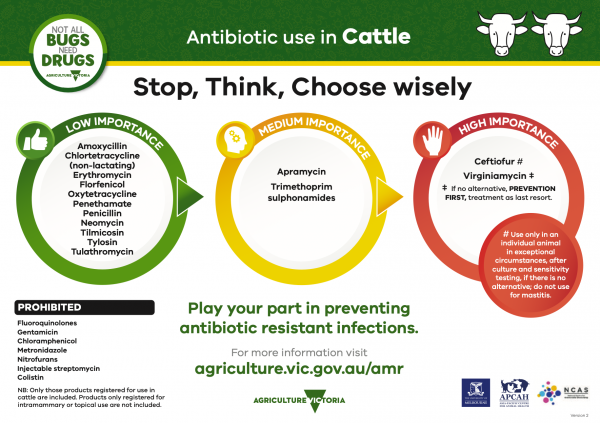
A document that outlines via a traffic light system, the different importance level of antimicrobials for use in cattle.
Suggest a disease, syndrome or key evidence you think we should include.