
Traffic light - Horses
A document that outlines via a traffic light system, the different importance level of antimicrobials for use in horses.
There are two physical barriers, the vulval and the vestibulo-vaginal seal, in addition to the humoral mucosal immune defence system, which protects the vagina against these attacks (16). The vaginal mucosa is most vulnerable in the post-foaling mare, when inflammation of the caudal reproductive tract is a normal part of the puerperal period. Other predisposing factors may include dystocia, poor perineal/vulval conformation, insertion of an intravaginal device, or contagious equine metritis (CEM), resulting from the transmission of Taylorella equigenitalis, a disease currently exotic to Australia.
Post-foaling vaginitis may occur following the delivery of a large foal or a dystocia, which can cause vaginal contusions, haematomas or lacerations. Whilst the caudal reproductive tract of the mare usually has a rapid healing response in the puerperal period, extensive damage to the vaginal mucosa during delivery may result in abscess formation, necrotic vaginitis and subsequent stricture formation (114). Poor perineal and vulval conformation may result in aspiration of air and subsequent contamination of the reproductive tract. The resulting vaginitis may progress through the cervix, resulting in an endometritis, which may, in turn, affect the future fertility of the mare (115). These conformational changes are usually acquired following foaling trauma or age-related changes, resulting in poor muscular tone of the perineal body and labia. Intravaginal devices, such as off-label use of progesterone-releasing devices, can initiate a localised vaginitis, which usually resolves within 24 h of removal (116). However, cases of severe necrotising vaginitis and perivaginal abscessation have been reported following insertion of CIDR-B devices into the mare, so these devices should be used with care (Clulow, pers comm).
The most common endemic pathogens associated with vaginitis are beta-haemolytic streptococci or E. coli (114). In cases of severe contamination and necrotic vaginitis, other organisms, such as clostridia or Gram-negative anaerobes, may also be involved.
Treatment of the vaginal mucosa can be effectively performed topically in most circumstances. If vaginal lacerations/bruising is noted in the post-partum examination, a topical broad-spectrum antibacterial/anti-inflammatory cream can be applied to the area to promote healing and prevent the formation of adhesions. Treatment should continue daily until the area appears to be healing appropriately – usually 3-5 days of treatment is sufficient. A vaginoscopic examination should be performed around 10 days post-partum to ensure there has been no adhesion formation.
Correction of the conformational defect should be addressed in these cases. A simple Caslick’s operation may be the first surgical line of defence, followed by perineal body repair, urethral extension or uteropexy to correct the conformation and prevent further disease of the reproductive tract. If a profound vaginitis is present, culture and sensitivity testing should be performed to direct therapy.
Diagnosis of vaginitis can be achieved via manual palpation and vaginoscopy using a vaginal speculum or video endoscope. A sample of the vaginal mucosa for culture can be obtained through a speculum using a double-guarded swab technique, taking care not to swab the vestibule. In the immediate post-partum period, care should be taken to wear appropriate personal protective equipment, especially in areas where infection of horses with Chlamydia psittaci is endemic.
Vaginoscopy or manual palpation of the vagina should be performed as part of the routine post-partum examination of the mare. Identification of damaged tissues or excessive bruising/haematomas may prompt the clinician to closely monitor the area or initiate treatment to prevent necrotic vaginitis. Use of video endoscopy is useful to monitor progress and the response to treatment.
Early identification of the severity of any severe vaginal trauma and appropriate treatment will help to improve prognosis. Severe vaginal trauma may lead to the formation of perivaginal haematomas or peritonitis, which can be life threatening. Careful examination of these mares in the post-partum period may help to identify lesions early and prevent overwhelming sepsis. Superficial vaginal lacerations usually heal within the first 3 days post-partum. However, more severe lacerations may require therapy for a longer duration to prevent formation of adhesions. A vaginoscopic examination can be performed 10 days post-partum and again at 30 days post-partum to ensure that vaginal adhesion formation has not occurred, and to enable adhesions to be broken down and treated.
The prognosis in these mares relies on the correction of the conformational defect. Whilst the vaginitis may be treated directly in these cases, the recurrence rate is high unless the inciting cause is addressed. A Caslick’s operation may be sufficient to prevent aspiration of air and debris through the vulva and into the vagina. If the perineal body is weak, the mare is experiencing urine pooling or she has a pendulous uterus, further surgical intervention may be required. Repairing the structural integrity of the caudal reproductive tract by perineal body repair, urethral extension and uteropexy should prevent further episodes of pneumovagina-associated vaginitis. A uteropexy should not be considered a last resort technique in mares. Performing this surgery earlier in the mare’s career may help to restore the normal position of the reproductive tract, thereby preventing both vaginitis and endometritis. This in turn may help to prolong the mare’s reproductive life without ongoing reliance on antimicrobial treatment.
A document that outlines via a traffic light system, the different importance level of antimicrobials for use in horses.
The Australian Veterinary Prescribing Guidelines cattle and horse flipbook, detailing antimicrobials for use in cattle and horses.
The equine Australian Veterinary Prescribing Guidelines for antimicrobial use as a pocket guide booklet.
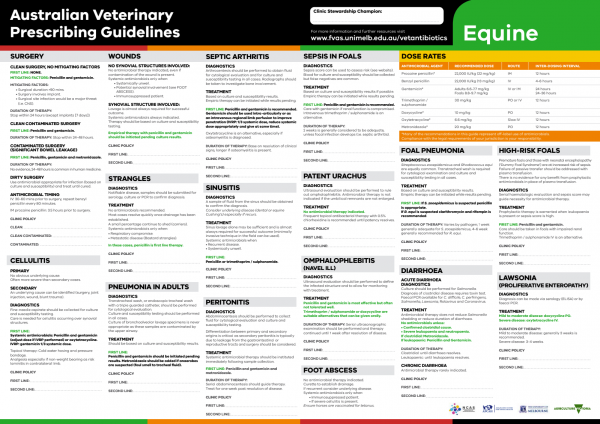
The equine Australian Veterinary Prescribing Guidelines poster. This document that outlines different antimicrobials for use in horses according to different diseases.
Suggest a disease, syndrome or key evidence you think we should include.