
Traffic light - Horses
A document that outlines via a traffic light system, the different importance level of antimicrobials for use in horses.
Different serotypes have been identified in Australia, including Salmonella Typhimurium, Salmonella Montevideo, Salmonella Welikade (37) and Salmonella Bovismorbificans, with Salmonella Muenster being found more recently (unpublished research). Transmission is faecal-oral, typically through ingestion of contaminated material, with contamination of pastures by intermittently shedding, sub-clinically infected horses (estimated to be approximately 1% of the equine population). Salmonellae can persist in the environment for years, can withstand freezing temperatures and drying, and can replicate at a wide range of temperatures (7-45 oC).
Salmonella infection can result in a range of diseases from asymptomatic shedding to diarrhoea and septicaemia (mainly in foals). Horses with colic, however, seem to have an increased risk of acquiring and shedding salmonellae, with a prevalence of 3.5% detected in a recent study of horses presenting with colic to a veterinary teaching hospital (38). Older studies have reported shedding rates of 9-20%. In a 2023 study (38), admission during summer months, fever, leukopaenia, and an elevated blood lactate were more likely to be found in horses shedding salmonellae.
Horses treated with antimicrobials can also develop acute diarrhoea and become culture positive for Salmonella spp. (see Chapter 1 Part I: Antimicrobial-associated diarrhoea in this section).
Salmonella spp. also pose a biosecurity risk within equine facilities. Horses can be shedding Salmonella spp. on admission to hospitals (~7%) or acquire Salmonella while hospitalised. Clinically normal horses can shed salmonellae, with shedding more common during concurrent illness, especially if there is antimicrobial usage or the primary disease is gastrointestinal. Stress due to transportation, changes in herd dynamics and changes in diet also predispose to shedding. Shedding can be intermittent.
Salmonella spp. are among the aetiological agents associated with sepsis in foals (see Section 8).
Salmonellosis is potentially zoonotic, with young children and immunosuppressed people at the highest risk.
Faecal PCR is often used as a screening test, but Salmonella culture is required to confirm infection and for serotyping.
Salmonellaeare shed intermittently in low numbers, necessitating repeated sample collection. There are no reference protocols for detecting Salmonella shedding but the most common is 3-5 samples collected at 12-24 h intervals and cultured using enrichment media. Salmonella culture should be requested specifically, along with serotyping and susceptibility testing.
Samples can be pooled using the following protocol: 5 samples (10 g each) collected at 8-24 h intervals and stored at 4 °C and submitted for culture as 1 sample (50 g total) (39).
PCR assays are also available for the detection of Salmonella spp. but enrichment culture is still required, so results are still delayed by 1-2 days (compared to 2-5 days for culture). PCR assays are extremely sensitive and can detect non-viable organisms and degraded DNA, so a positive test may not indicate an infectious risk in clinically normal animals or in environmental samples. However, in animals with colitis, a positive PCR result is probably a reliable indicator of salmonellosis.
Therapy should be the same as for any acute colitis (see Chapter 1 in this section). Antimicrobial drugs are not indicated and adult horses that have been exposed to antimicrobials are more likely to shed salmonellae than adult horses without exposure to antimicrobials.
Quarantine horses that have 2 of the 3 classical signs of colitis (fever, diarrhoea, and leukopaenia). If isolation facilities are not available, establish barrier precautions at the current location.
Isolate horses after significant colic episodes and colic surgery. Ideally, hospital facilities should be organised into zones, so that low-risk cases (i.e. day patients and outpatients) do not come into contact with high-risk patients (colic cases and other critically ill patients).
Stalls from high-risk and known positive cases should have all organic material removed and disposed of in a manner that reduces the risk of re-exposure. Disinfection should follow. Pressure washers and hoses should be avoided as they can aerosolise salmonellae.
Affected horses should be isolated from unaffected animals on the farm for 30 days and until 5 consecutive negative faecal cultures are obtained. If housed in a paddock, manure should be removed and appropriately disposed of to reduce contamination. Caretakers should wear personal protective equipment.
Protocols for disinfection and environmental screening are outside the scope of these guidelines, but excellent recommendations have been developed by the AAEP (https://aaep.org/document/general-biosecurity-guidelines).
The prognosis is guarded, similar to that of undifferentiated colitis (see Chapter 1 for details). Early identification and appropriate treatment may reduce complications and improve the prognosis.
Shedding has not been associated with increased long-term risk of mortality or colic. Salmonella-positive horses should be isolated with barrier precautions until proven to be negative in, ideally, five consecutive faecal cultures. The duration of shedding is highly variable, from days to > 1 month.
A document that outlines via a traffic light system, the different importance level of antimicrobials for use in horses.
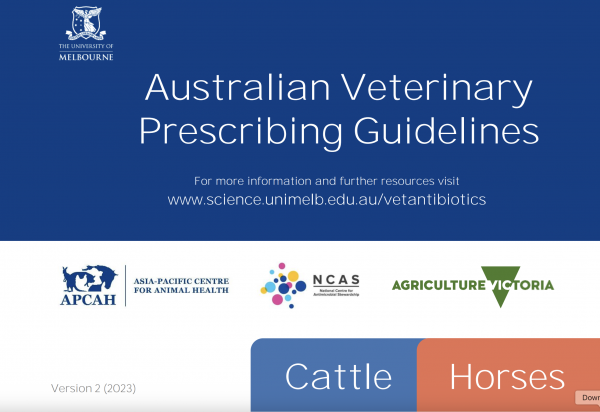
The Australian Veterinary Prescribing Guidelines cattle and horse flipbook, detailing antimicrobials for use in cattle and horses.
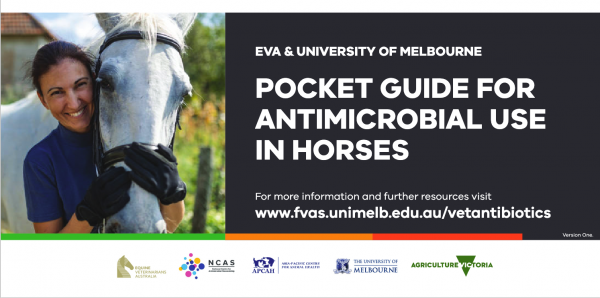
The equine Australian Veterinary Prescribing Guidelines for antimicrobial use as a pocket guide booklet.
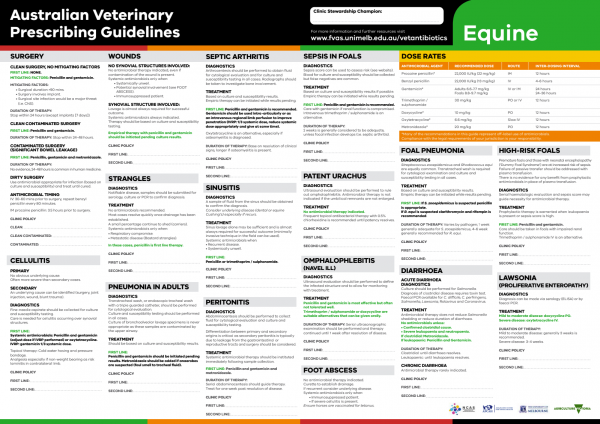
The equine Australian Veterinary Prescribing Guidelines poster. This document that outlines different antimicrobials for use in horses according to different diseases.
Funding for these guidelines was provided by the Australian Veterinary Association (AVA), Animal Medicines Australia (AMA) and AgriFutures Australia.
These guidelines would not have been possible without the considerable expertise and efforts of the Expert Panel: Associate Professor Laura Hardefeldt, Dr. Leanne Begg, Dr. Stephen Page, Professor Glenn Browning, and Professor Jacqueline Norris. We are also extremely grateful to the additional contributing authors.
The dedicated and skilled work of Project Manager Dr. Kellie Thomas is gratefully acknowledged, as are the contributions of the Project Steering Committee: Dr. Phillip McDonagh, Dr. John Messer, Professor James Gilkerson, and Dr. Melanie Latter. Open access publishing facilitated by The University of Melbourne, as part of the Wiley - The University of Melbourne agreement via the Council of Australian University Librarians.


Suggest a disease, syndrome or key evidence you think we should include.