
Traffic light - Horses
A document that outlines via a traffic light system, the different importance level of antimicrobials for use in horses.
The following page will outline antimicrobial use guidelines for endotoxaemia.

Endotoxaemia refers to a syndrome of acute, systemic activation of the innate immune system in response to bacteria or bacterial toxins, also referred to as the systemic inflammatory response syndrome (SIRS), or sepsis when it occurs in response to bacterial infection. It is a common cause of morbidity, mortality and economic loss in horses. Endotoxaemia is commonly associated with disorders such as strangulating intestinal lesions, pleuropneumonia, peritonitis, enterocolitis, retained foetal membranes and foal sepsis.
Lipopolysaccharide (LPS) is a component of the outer cell membrane of Gram-negative bacteria. Other bacterial cell wall components, such as lipoteichoic acid (from Gram-positive bacteria) and peptidoglycan, can also be involved. When present in the circulation, bacterial toxins interact with toll-like receptors to stimulate release of cytokines that cause further release of inflammatory mediators, including prostaglandins, histamine, serotonin, kinins and others. Massive systemic inflammation results, which in turn is responsible for cardiovascular depression and arterial hypoxaemia. This leads to decreased tissue perfusion and peripheral hypoxia, and, in severe or untreated cases, multiple organ dysfunction (including laminitis) and death. Coagulation is also upregulated, often leading to thrombus formation, or development of microthrombi (more commonly in foals).
Endotoxaemia can also lead to an alteration in vascular tone and permeability, which might contribute to development of detectable oedema, particularly in septic foals receiving intravenous fluid therapy. In adults, oedema often results from the protein loss that mainly occurs secondarily to vascular leakage at the site of the primary disease (for example in colitis).
Clinical signs of endotoxaemia include fever, hypothermia or normothermia, dull mentation, congested mucous membranes, injected sclera, tachycardia, and tachypnoea (although sometimes the respiratory rate is normal or reduced), and, sometimes, muscle fasciculations.
Blood lactate concentration is often increased, reflecting mainly hypovolaemia and reduced perfusion. White blood cell concentrations are initially reduced (leukopaenia, due primarily to neutropaenia) but often rebound after systemic inflammation has resolved, to a transient neutrophilic leukocytosis. Lymphopaenia and haemoconcentration (increased PCV) are also present. Platelet counts can be reduced, and PT and APTT prolonged, if coagulation has been upregulated, resulting in consumption of platelets and coagulation factors. Effects on haematological function reflect the severity of the disease. Pre-renal azotaemia, with or without renal azotaemia, is often present.
The blood glucose concentration is often low in foals.
Many treatments have been used and examined to counteract the adverse effects of endotoxin on horses. Few have evidence supporting their efficacy. This section discusses proven treatment strategies, but is not exhaustive – there are several reviews in the literature (e.g. Kelmer, 2009 (1)). Overarching treatment goals have been aimed at:
Counteracting the inflammatory cascade is the mainstay of therapy, as almost all cases have activation of the inflammatory cascade on presentation. The main aim of treatment is to provide supportive therapy - treating cardiovascular shock with fluid therapy, preventing laminitis, and suppressing inflammation. Prevention of laminitis is not included here, but there are several reviews published (e.g. Belkap & Durham, 2017(2)).
Fluid therapy is the mainstay, non-specific, supportive therapeutic strategy to combat cardiovascular shock. All endotoxaemic patients are at least moderately, if not severely, hypovolaemic, and thus the use of balanced crystalloid solutions (i.e. Hartmann’s solution) is essential. Hypertonic saline (7% NaCl at 2-4 mL/kg) is a useful therapy to rapidly expand blood volume in adults, especially in the field, and especially in cases where drinking is not contraindicated. Even if drinking is contraindicated, isotonic IV fluid therapy can often be delayed following hypertonic saline administration, while the horse is transported to a hospital provided the trip is not too long. Hypertonic saline is usually unsuitable in foals because of its impact on electrolyte balance and acid-base abnormalities, but it is also less necessary in foals, as bolus isotonic fluids can be rapidly administered to achieve the same outcome. Commercially available plasma (2-8 L per horse) is also commonly administered to endotoxaemic patients. Hyperimmune plasma is typically used as there is some evidence of survival benefit in septic foals. While theoretically beneficial, evidence of efficacy in endotoxaemic adult horses is lacking and the cost is substantial. Synthetic colloids (such as Hetastarch) have also been administered to endotoxaemic horses with hypoproteinaemia and low colloid oncotic pressure, although evidence to support their use is lacking and they have fallen out of favour in other species because of the risk of complications.
Flunixin meglumine is a potent NSAID and the most common anti-inflammatory and antiendotoxic treatment administered other than fluid therapy. Flunixin inhibits the COX breakdown of arachidonic acid to prostaglandins, which are important mediators in the inflammatory pathway of endotoxaemia and lead to clinical features such as vasodilation and cardiovascular shock. Low doses of flunixin (0.25 mg/kg IV q 8 h) have been shown to be effective in experimental models and have been used clinically to avoid the gastrointestinal and nephrotoxic side-effects of higher doses. However, these lower doses usually do not prevent the clinical signs associated with endotoxaemia, such as colic, fever and dull mentation. In the authors’ experience, doses of 0.5 mg/kg IV q 12 h are effective for anti-inflammatory effects and combating clinical signs and are less likely to be associated with adverse effects, but this may be variable depending on the underlying cause and the severity of disease.
Most cases with endotoxaemia require antimicrobials to address the primary disease or for surgical prophylaxis. Cases associated with colitis and anterior enteritis are the exception where most do not require antimicrobial therapy. The choice of antimicrobials should be made carefully, as, theoretically, rapid killing of Gram-negative bacteria may result in release of more endotoxin and exacerbation of clinical signs. Aminoglycosides cause minimal release of LPS (3) so gentamicin is a good choice in many patients, if renal function is normal.
Dimethyl sulfoxide (DMSO) is an oxygen free-radical scavenger and anti-inflammatory agent that is widely used for treating endotoxaemia. However, evidence to support its use is lacking and there are substantial occupational health and safety risks in humans, so its use is not recommended. Where it is used, low doses (20 mg/kg IV) should be used, as higher doses have been associated with gastrointestinal mucosal damage and haemolysis.
Pentoxifylline has been widely used as an adjunctive therapy for equine endotoxaemia based on experimental evidence of inhibition of inflammatory cytokine and tissue factor activity. However, absorption following oral administration is poor and erratic, and an intravenous formulation is not commercially available. In addition, responses after exposure to endotoxin have been less promising than administration before endotoxin exposure. Clinical trials are needed before its use can be recommended.
Low doses of corticosteroids have been shown to be beneficial in experimental endotoxaemia in horses and foals, but their use is controversial in clinical cases. Physiological doses of corticosteroids may provide benefit in some cases where there is dysfunction of the hypothalamic-pituitary-adrenal (HPA) axis and inadequate cortisol release in response to illness – a syndrome called critical illness-related corticosteroid insufficiency (CIRCI). Hypotensive animals that are unresponsive to fluid therapy and vasopressors may have CIRCI and might benefit from corticosteroid administration, but in cases with hypotension that do respond to fluid therapy or vasopressors, corticosteroids are probably contraindicated. Hydrocortisone doses of 1.3 mg/kg/day IV divided and administered every 4 hours have been recommended for use in foals. For adults, the dose is 0.16-0.3 mg/kg IV q 4 h (4). A dose of 0.3 mg/kg did not have an impact on clinical signs or proinflammatory cytokine production, but did appear to protect against LPS-induced neutrophil depletion in an experimental model of endotoxaemia (5). As for many other adjunctive therapies, clinical trials are lacking and are needed before this therapy can be recommended.
Elimination of the source of endotoxin involves treatment of the primary disease – strangulating intestinal lesions should be treated surgically without delay. Similarly, antimicrobial therapy should be implemented promptly where the primary disease is likely to be bacterial infection (for example, retained foetal membranes, foal sepsis or pleuropneumonia) but preferably following collection of samples for culture and susceptibility testing, if possible.
Blocking or eliminating endotoxin before it interacts with the horse’s immune system can be achieved by neutralising LPS with plasma rich in anti-LPS antibodies (hyperimmune plasma) (Equiplas E) or, potentially, polymyxin B. In a clinical trial of septic foals, foals treated with anti-LPS enriched plasma were more likely to survive than foals treated with regular plasma (6). However, other studies have only shown a small difference, and some have found no difference at all. A randomised controlled clinical trial is needed, but difficult to perform.
Polymyxin B has been shown to be effective in reducing the clinical signs associated with endotoxaemia in experimental scenarios, but it is nephrotoxic and the reduced perfusion and dehydration present in clinical cases means it is often contraindicated. In this author’s experience there is no benefit to the administration of polymyxin B in clinical cases. In addition, the availability of this drug in Australia is variable.
A document that outlines via a traffic light system, the different importance level of antimicrobials for use in horses.
The Australian Veterinary Prescribing Guidelines cattle and horse flipbook, detailing antimicrobials for use in cattle and horses.
The equine Australian Veterinary Prescribing Guidelines for antimicrobial use as a pocket guide booklet.
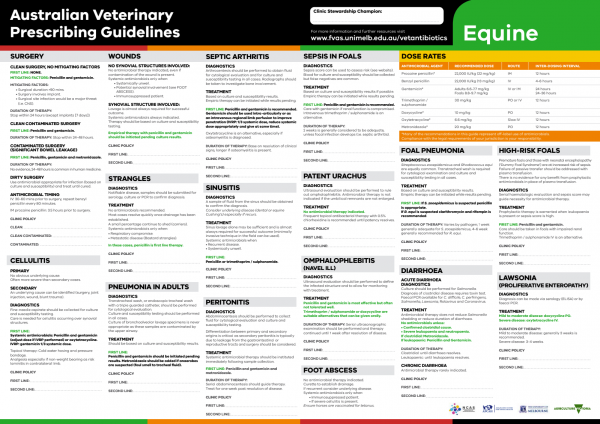
The equine Australian Veterinary Prescribing Guidelines poster. This document that outlines different antimicrobials for use in horses according to different diseases.
Funding for these guidelines was provided by the Australian Veterinary Association (AVA), Animal Medicines Australia (AMA) and AgriFutures Australia.
These guidelines would not have been possible without the considerable expertise and efforts of the Expert Panel: Associate Professor Laura Hardefeldt, Dr. Leanne Begg, Dr. Stephen Page, Professor Glenn Browning, and Professor Jacqueline Norris. We are also extremely grateful to the additional contributing authors.
The dedicated and skilled work of Project Manager Dr. Kellie Thomas is gratefully acknowledged, as are the contributions of the Project Steering Committee: Dr. Phillip McDonagh, Dr. John Messer, Professor James Gilkerson, and Dr. Melanie Latter. Open access publishing facilitated by The University of Melbourne, as part of the Wiley - The University of Melbourne agreement via the Council of Australian University Librarians.



Suggest a disease, syndrome or key evidence you think we should include.