
Traffic light - Horses
A document that outlines via a traffic light system, the different importance level of antimicrobials for use in horses.
The three main pathogens implicated as transmissible venereal pathogens of the clitoris are Taylorella equigenitalis, the organism responsible for contagious equine metritis (CEM), Pseudomonas aeruginosa and Klebsiella pneumoniae.
CEM is characterised by a thick muco-purulent vulvar discharge in the mare, while the stallion usually remains asymptomatic. The organism may reside in asymptomatic carriers in the urethra, urethral fossa and prepuce of the stallion or in the clitoral fossa or clitoral sinus of the mare (2). Venereal transmission occurs during natural mating, artificial insemination with semen from an affected carrier, or indirectly via contaminated equipment. CEM is a disease of international significance because of its highly contagious nature and its impact on fertility. As it is not present in Australia, the remainder of this section will focus on Pseudomonas aeruginosa and Klebsiella pneumoniae
While Pseudomonas aeruginosa and Klebsiella pneumoniae have long been considered pathogens of the equine reproductive tract, their role as a venereal pathogen has recently been questioned (3, 4). In many countries, including Australia, these organisms are included in routine pre-breeding microbiological assessments of the mare’s reproductive tract. Results from endometrial cultures should be examined in association with cytology results and the clinical presentation (Please see Chapter 2 of this section for further details). Mares with clitoral cultures positive for Pseudomonas aeruginosa or Klebsiella pneumoniae are usually excluded from the breeding shed until a negative swab can be obtained. In many cases, these are multi-drug resistant (MDR) organisms that may require treatment with antimicrobials of high importance to eliminate them from the clitoris. Furthermore, once isolated, these organisms are rarely typed to determine their pathogenicity for the reproductive tract. In a recent study examining 117 isolates of Klebsiella pneumoniae from routine mare reproductive cultures in Australia, only five isolates had capsule types known to be associated with pathogenicity for the equine reproductive tract (Hardefeldt pers comm). Multi-drug resistance was present in 59% of isolates; 52% in isolates from clitoral swabs, 62.5% in isolates from uterine swabs and 83% in isolates from uterine lavages. Furthermore, as the breeding season progressed, the proportion of MDR isolates increased from 22% in August to 69% by November (Hardefeldt pers comm), presumably a result of increased selection pressure from antimicrobial treatment during the relatively brief breeding season. This increase in MDR is concerning, particularly without conclusive evidence identifying the organism as a venereally transmitted pathogen (3, 4).
In the absence of clinical endometritis, the requirement for routine culture and treatment of the equine clitoris in Australia should be re-evaluated. Furthermore, these organisms are environmental contaminants, highlighting the role of minimal contamination techniques in the breeding shed, as well as routine testing of water used to clean mares prior to service or insemination (4).

Figure 15.1: Thick, muco-purulent vulvar discharge associated with CEM caused by Taylorella equigenitalis. (Image courtesy of J. Norris.)
Treatment of the clitoris is difficult and controversial. Initial thorough cleaning of the clitoris is important to remove smegma and reduce bacterial loads. Cleaning with a chlorhexidine scrub is recommended with particular attention to the removal of smegma within the clitoral fossa and clitoral sinuses. This can be facilitated with the use of a 14 gauge catheter to flush the clitoral sinuses. The clitoris should then be flushed with sterile saline to remove detergent residues, as these will further irritate the tissues. The authors recommend treating with an appropriate antimicrobial (following culture and susceptibility testing) using an ophthalmic preparation of the drug. This helps to mitigate (but usually does not eliminate) the local tissue irritation and pain associated with treatment. If an ophthalmic preparation is not available or local tissue inflammation is severe, packing the clitoris with silver sulfadiazine is recommended. Treatment is usually performed for 3 - 5 days. Smegma should be removed daily prior to topical treatment. Transfaunation should be considered following the final antimicrobial treatment. The mare should be swabbed 1 - 2 weeks after treatment, thereby allowing the normal population of microflora to recolonise the area.
If the organism is MDR, then transfaunation can be attempted using clitoral smegma from a mare with a normal clitoral microflora. Clitorectomy has been advocated in the past with recalcitrant organisms. Considering the questionable implication of these organisms in venereal transmission, clitorectomy can no longer be a recommended as first-line therapy.
A routine swab of the clitoris can be performed using a sterile collection swab in Amies medium. A swab of the clitoral fossa is performed by separating the labia to expose and evert the clitoris to visualise the clitoral fossa. The clitoris should not be cleaned prior to sample collection. Swabs should be kept refrigerated and submitted to the laboratory as soon as practically possible, ideally within 48 h of collection. Clitoral cultures to identify Pseudomonas aeruginosa and Klebsiella pneumoniae can be performed on blood agar or MacConkey agar. Organism-specific media are also available. Isolates should be confirmed by biochemical typing and, in the case of Klebsiella pneumoniae, further differentiation should be performed to identify the capsule type.
If collecting a clitoral swab for Taylorella equigenitalis, which may be required for import/export purposes, the swab needs to be transported in Amies medium with charcoal and a swab of the clitoral sinuses needs to be performed using a narrow-tipped swab. It is important to note that this procedure can create discomfort in mares, so appropriate analgesia, sedation and restraint is advised.
The prognosis for response to treatment is varied. Thorough cleaning is required prior to the application of antimicrobials for resolution of the bacterial overload. The prognosis is poor for mares with MDR organisms. However, these infections do tend to clear with time.
Mares found to have a heavy growth of Pseudomonas aeruginosa and Klebsiella pneumoniae in their clitoris may be considered immunocompromised, as this often occurs following prolonged exposure to antimicrobials or a period of stress. Therefore, addressing overall health and nutrition may help to re-establish a normal microflora.
A document that outlines via a traffic light system, the different importance level of antimicrobials for use in horses.
The Australian Veterinary Prescribing Guidelines cattle and horse flipbook, detailing antimicrobials for use in cattle and horses.
The equine Australian Veterinary Prescribing Guidelines for antimicrobial use as a pocket guide booklet.
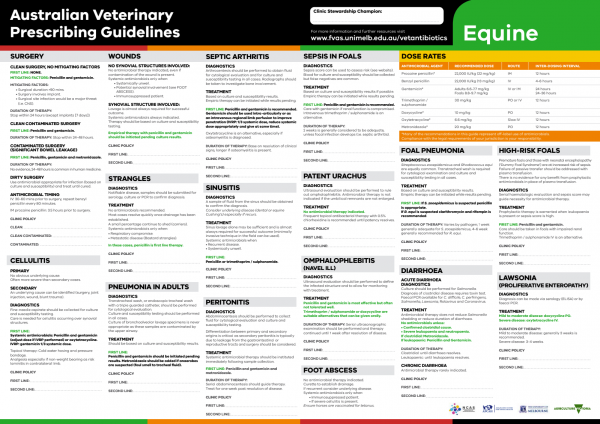
The equine Australian Veterinary Prescribing Guidelines poster. This document that outlines different antimicrobials for use in horses according to different diseases.
Suggest a disease, syndrome or key evidence you think we should include.