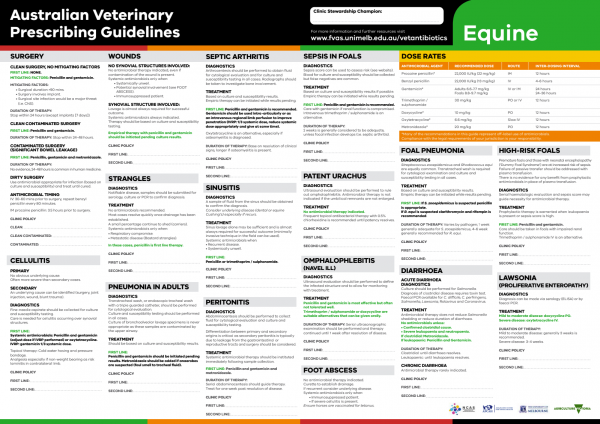
These guidelines are taken from the "Antimicrobial prescribing guidelines for horses in Australia” published in the Australian Veterinary Journal.
Click here (https://doi.org//10.1111/avj.70003) to view the guidelines in their entirety.
Scholtz M, Guthrie AJ, Newton R, Schulman ML. Review of Pseudomonas aeruginosa and Klebsiella pneumoniae as venereal pathogens in horses. Equine Veterinary Journal. 2024;n/a(n/a):1-11.
Storme J, Brookes VJ, Gunn A. Is there evidence demonstrating venereal transmission of clitoral Pseudomonas aeruginosa in horses? Veterinary record. 2023;192(11):444-6.
Morris LHA, McCue PM, Aurich C. Equine endometritis: a review of challenges and new approaches. Reproduction (Cambridge, England). 2020;160(5):R95-R110.
Canisso IF, Segabinazzi LGTM, Fedorka CE. Persistent Breeding-Induced Endometritis in Mares—A Multifaceted Challenge: From Clinical Aspects to Immunopathogenesis and Pathobiology. International Journal of Molecular Sciences. 2020;21(4):1432.
Troedsson MHT. Uterine clearance and resistance to persistent endometritis in the mare. Theriogenology. 1999;52(3):461-71.
Frontoso R, De Carlo E, Pasolini MP, van der Meulen K, Pagnini U, Iovane G, et al. Retrospective study of bacterial isolates and their antimicrobial susceptibilities in equine uteri during fertility problems. Research in Veterinary Science. 2008;84(1):1-6.
Ferris RA. Current understanding of bacterial biofilms and latent infections: A clinical perspective. Rev Bras Reprod Anim. 2017;41:74-80.
Davis HA, Stanton MB, Thungrat K, Boothe DM. Uterine bacterial isolates from mares and their resistance to antimicrobials: 8,296 cases (2003–2008). Journal of the American Veterinary Medical Association. 2013;242(7):977-83.
Olsen I. Biofilm-specific antibiotic tolerance and resistance. European Journal of Clinical Microbiology & Infectious Diseases. 2015;34(5):877-86.
Petersen MR, Rosenbrock A, Osborne M, Bojesen AM. High Prevalence of Subclinical Endometritis in Problem Mares– Effect of Activation and Treatment on Fertility. Journal of Equine Veterinary Science. 2018;66:117.
Hoffmann C, Ellenberger C, Mattos RC, Aupperle H, Dhein S, Stief B, et al. The equine endometrosis: new insights into the pathogenesis. Anim Reprod Sci. 2009;111(2-4):261-78.
Snider TA, Sepoy C, Holyoak GR. Equine endometrial biopsy reviewed: Observation, interpretation, and application of histopathologic data. Theriogenology. 2011;75(9):1567-81.
Pascoe RR. CHAPTER 23 - Vulvar Conformation. In: Samper JC, Pycock JF, McKinnon AO, editors. Current Therapy in Equine Reproduction. Saint Louis: W.B. Saunders; 2007. p. 140-5.
Scoggin CF. Not just a number: effect of age on fertility, pregnancy and offspring vigour in thoroughbred brood-mares. Reprod Fertil Dev. 2015;27(6):872-9.
Katila T. Evaluation of diagnostic methods in equine endometritis. Reproductive Biology. 2016;16:189-96.
Heil BA, van Heule M, Thompson SK, Kearns TA, Oberhaus EL, King G, et al. Effect of Sampling Method on Detection of the Equine Uterine Microbiome during Estrus. Veterinary Sciences. 2023;10(11):644.
LeBlanc MM. How to Perform and Interpret Findings From a Low-Volume Uterine Flush. AAEP Proceedings. 2011;57:32-6.
Riddle WT, LeBlanc MM, Stromberg AJ. Relationships between uterine culture, cytology and pregnancy rates in a Thoroughbred practice. Theriogenology. 2007;68(3):395-402.
Petersen MR, Skive B, Christoffersen M, Lu K, Nielsen JM, Troedsson MHT, et al. Activation of persistent Streptococcus equi subspecies zooepidemicus in mares with subclinical endometritis. Veterinary Microbiology. 2015;179(1):119-25.
LeBlanc M. Advances in the Diagnosis and Treatment of Chronic Infectious and Post–Mating-Induced Endometritis in the Mare. Reproduction in Domestic Animals. 2010;45(s2):21-7.
Ferris RA, Wittstock SM, McCue PM, Borlee BR. Evaluation of biofilms in gram-negative bacteria isolated from the equine uterus. Journal of Equine Veterinary Science. 2014;34(1):121.
Katila T. Onset and Duration of Uterine Inflammatory Response of Mares after Insemination with Fresh Semen. Biology of Reproduction. 2018;52(monograph_series1):515-7.
Scoggin CF, Burden CA, Schnobrich MR, Bradecamp EA. A single post-mating infusion of penicillin does not improve pregnancy rates in maiden Thoroughbred broodmares. Clinical Theriogenology. 2017;9(1):53-8.
Karam KM, Alebady AS, Alhilfi HO, Al-Delemi DH. Comparative study utilizing different post-breeding treatment regimens in cyclic Arabian mares. Vet World. 2021;14(11):2863-8.
Rose BV, Firth M, Morris B, Roach JM, Wathes DC, Verheyen KLP, et al. Descriptive study of current therapeutic practices, clinical reproductive findings and incidence of pregnancy loss in intensively managed thoroughbred mares. Animal reproduction science. 2018;188:74-84.
LeBlanc MM. The current status of antibiotic use in equine reproduction. Equine Veterinary Education. 2009;21(3):156-67.
Ferris RA, McCue PM, Borlee GI, Loncar KD, Hennet ML, Borlee BR. In Vitro Efficacy of Nonantibiotic Treatments on Biofilm Disruption of Gram-Negative Pathogens and an In Vivo Model of Infectious Endometritis Utilizing Isolates from the Equine Uterus. J Clin Microbiol. 2016;54(3):631-9.
Rogan D, Fumuso E, Rodríguez E, Wade J, Sánchez Bruni SF. Use of a Mycobacterial Cell Wall Extract (MCWE) in Susceptible Mares to Clear Experimentally Induced Endometritis With Streptococcus zooepidemicus. Journal of Equine Veterinary Science. 2007;27(3):112-7.
Perkins N, Threlfall W. Mastitis in the mare. Equine Veterinary Education. 2010;5:192-5.
McCUE PM, WILSON WD. Equine mastitis - a review of 28 cases. Equine Veterinary Journal. 1989;21(5):351-3.
McCue P, Sitters, S. Lactation. In: McKinnon AO SE, Vaala WE, et al, editor. Equine Reproduction Second Edition. 2: Wiley-Blackwell; 2011. p. 2277-90.
Ginther O. How ultrasound technologies have expanded and revolutionized research in reproduction in large animals. Theriogenology. 2014;81(1):112-25.
Pugh DG, Magnusson RA, Modransky PD, Darnton KR. A case of mastitis in a young filly. Journal of Equine Veterinary Science. 1985;5(3):132-4.
Gee Erica K. MPM. Mastitis. In: McKinnon AO SE, Vaala WE, et al, editor. Equine Reproduction Second Edition. 2: Wiley-Blackwell; 2011. p. 2738-41.
McKenzie RA, Brown OP. Avocado (Persea americana) poisoning of horses. Aust Vet J. 1991;68(2):77-8.
Canisso IF, Podico G, Ellerbrock RE. Diagnosis and treatment of mastitis in mares. Equine Veterinary Education. 2021;33(6):320-6.
Trela M, Domańska D, Witkowska-Piłaszewicz O. Diagnostic Use of Serum Amyloid A in Dairy Cattle. Agriculture. 2022;12(4):459.
Schiemann V, Bartmann C. Mastectomia in the horse- Indication and surgical procedure. Pferdeheilkunde. 2004;20:506-10.
Blanchard TL, Elmore RG, Kinden DA, Berg JN, Mollett TA, Garcia MC. Effect of intrauterine infusion of Escherichia coli endotoxin in postpartum pony mares. Am J Vet Res. 1985;46(10):2157-62.
Ferrer MS, Palomares R. Aerobic uterine isolates and antimicrobial susceptibility in mares with post-partum metritis. Equine Veterinary Journal. 2018;50(2):202-7.
Ferrer MS, Pozor MA. How to Manage the Post-Partum Mare with Metritis—Lessons Learned from a Retrospective Bacteriological Study. Proceedings of the American Association of Equine Practitioners. 2018;64:236-9.
Crabtree J. Peripartum problems in mares 2. Postpartum problems. In Practice. 2012;34(8):462-71.
Tukia E, Wagner B, Vainio K, Mönki J, Kareskoski M. The Effect of Uterine Lavage on Soluble CD14, Chemokine Ligand 2, and Interleukin 10 Levels in Mares With Postpartum Metritis. Journal of Equine Veterinary Science. 2021;98:103365.
Carrick J, editor ASSESSMENT AND TREATMENT OF PLACENTITIS COLLEGE SCIENCE WEEK SCIENTIFIC MEETING, EQUINE CHAPTER PROCEEDINGS; 2007; Gold Coast.
Carrick JB, Perkins N, Zalucki MP. Causes of abortion in Australia (2005-2012) – proportion of cases due to Equine Amnionitis and Foetal Loss (EAFL). Journal of Equine Veterinary Science. 2014;34:212-4.
LeBlanc MM. Ascending placentitis in the mare: an update. Reprod Domest Anim. 2010;45 Suppl 2:28-34.
Troedsson MH MM. Placentitis. In: McKinnon AO SE, Vaala WE, Varner DD, editor. Equine Reproduction, 2nd ed. 2. Hoboken NJ2011. p. 2359–67.
R. L. Abnormalities of pregnancy. In: McKinnon AO SE, Vaala WE, Varner DD, editor. eds Equine Reproduction, Vol 2 2nd ed. Hoboken NJ: Wiley-Blackwell; 2011. p. 2441–53.
Troedsson M, Miller L. Equine placentitis. Pferdeheilkunde. 2016;32:49-53.
Macpherson ML. Treatment strategies for mares with placentitis. Theriogenology. 2005;64(3):528-34.
Hong CB, Donahue JM, Giles RC, Jr., Petrites-Murphy MB, Poonacha KB, Roberts AW, et al. Etiology and pathology of equine placentitis. J Vet Diagn Invest. 1993;5(1):56-63.
Erol E, Sells SF, Williams NM, Kennedy L, Locke SJ, Labeda DP, et al. An investigation of a recent outbreak of nocardioform placentitis caused abortions in horses. Vet Microbiol. 2012;158(3-4):425-30.
El-Sheikh Ali H, Ball B, Carleigh, Fedorka C, Scoggin K, Schnobrich M, et al. Nocardioform Placentitis: A Continuing Question. 2021.
Todhunter K, Perkins N, Wylie R, Chicken C, Blishen A, Racklyeft D, et al. Equine amnionitis and fetal loss: The case definition for an unrecognised cause of abortion in mares. Australian Veterinary Journal. 2009;87(1-2):35-8.
Begg AP, Carrick J, Chicken C, Blishen A, Todhunter K, Eamens K, et al. Fetoplacental pathology of equine abortion, premature birth, and neonatal loss due to Chlamydia psittaci. Vet Pathol. 2022;59(6):983-96.
El-Hage C, Legione A, Devlin J, Hughes K, Jenkins C, Gilkerson J. Equine Psittacosis and the Emergence of Chlamydia psittaci as an Equine Abortigenic Pathogen in Southeastern Australia: A Retrospective Data Analysis. Animals (Basel). 2023;13(15).
Renaudin CD, Troedsson MHT, Gillis CL, King VL, Bodena A. Ultrasonographic evaluation of the equine placenta by transrectal and transabdominal approach in the normal pregnant mare. Theriogenology. 1997;47 2:559-73.
Reef V, Vaala W, Worth L, Sertich P, Spencer P. Ultrasonographic assessment of fetal well-being during late gestation: Development of an equine biophysical profile. Equine Veterinary Journal. 2010;28:200-8.
Bucca S, Fogarty U, Collins A, Small V. Assessment of feto-placental well-being in the mare from mid-gestation to term: Transrectal and transabdominal ultrasonographic features. Theriogenology. 2005;64(3):542-57.
Ousey JC, Houghton E, Grainger L, Rossdale PD, Fowden AL. Progestagen profiles during the last trimester of gestation in Thoroughbred mares with normal or compromised pregnancies. Theriogenology. 2005;63(7):1844-56.
Santschi EM, LeBlanc MM, Weston PG. Progestagen, oestrone sulphate and cortisol concentrations in pregnant mares during medical and surgical disease. J Reprod Fertil Suppl. 1991;44:627-34.
Ryan PL, Christiansen DL, Hopper RM, Bagnell CA, Vaala WE, Leblanc MM. Evaluation of systemic relaxin blood profiles in horses as a means of assessing placental function in high-risk pregnancies and responsiveness to therapeutic strategies. Ann N Y Acad Sci. 2009;1160:169-78.
Canisso IF, Ball BA, Cray C, Williams NM, Scoggin KE, Davolli GM, et al. Serum amyloid A and haptoglobin concentrations are increased in plasma of mares with ascending placentitis in the absence of changes in peripheral leukocyte counts or fibrinogen concentration. Am J Reprod Immunol. 2014;72(4):376-85.
Coutinho da Silva MA, Canisso IF, MacPherson ML, Johnson AE, Divers TJ. Serum amyloid A concentration in healthy periparturient mares and mares with ascending placentitis. Equine Vet J. 2013;45(5):619-24.
Canisso IF, Ball BA, Scoggin KE, Squires EL, Williams NM, Troedsson MH. Alpha-fetoprotein is present in the fetal fluids and is increased in plasma of mares with experimentally induced ascending placentitis. Anim Reprod Sci. 2015;154:48-55.
LeBlanc MM, Giguère S, Lester GD, Brauer K, Paccamonti DL. Relationship between infection, inflammation and premature parturition in mares with experimentally induced placentitis. Equine Vet J Suppl. 2012(41):8-14.
Bailey CS, Macpherson ML, Pozor MA, Troedsson MH, Benson S, Giguere S, et al. Treatment efficacy of trimethoprim sulfamethoxazole, pentoxifylline and altrenogest in experimentally induced equine placentitis. Theriogenology. 2010;74(3):402-12.
Rebello SA, Macpherson ML, Murchie TA, LeBlanc MM, Vickroy TW. Placental transfer of trimethoprim sulfamethoxazole and pentoxifylline in pony mares. Animal Reproduction Science. 2006;94(1-4):432-3.
Murchie TA, Macpherson ML, LeBlanc MM, Luznar S, Vickroy TW. Continuous monitoring of penicillin G and gentamicin in allantoic fluid of pregnant pony mares by in vivo microdialysis. Equine Vet J. 2006;38(6):520-5.
Macpherson ML, Giguère S, Pozor MA, Burden CA, Berghaus LJ, Berghaus RD, et al. Evidence for anti-inflammatory effects of firocoxib administered to mares with experimentally induced placentitis. Am J Reprod Immunol. 2021;86(1):e13396.
Bailey CS, Sper RB, Schewmaker JL, Buchanan CN, Beachler TM, Pozor MA, et al. Uterine artery blood flow remains unchanged in pregnant mares in response to short-term administration of pentoxifylline. Theriogenology. 2012;77(2):430-6.
Palmer E, Chavatte-Palmer P, Duchamp G, Levy I. Lack of effect of clenbuterol for delaying parturition in late pregnant mares2002. 797-9 p.
Sielhorst J, Roggel-Buecker U, Neudeck KC, Kahler A, Rohn K, Luettgenau J, et al. Effect of Acetylsalicylic Acid on Uterine Blood Flow, Gestation Length, Foal Birth Weight and Placental Weight in Pregnant Thoroughbred Mares - A Clinical Pilot Study. J Equine Vet Sci. 2022;118:104107.
Bommana S, Polkinghorne A. Mini Review: Antimicrobial Control of Chlamydial Infections in Animals: Current Practices and Issues. Front Microbiol. 2019;10:113.
Fedorka CE, Scoggin KE, Ruby RE, Erol E, Ball BA. Clinical, pathologic, and epidemiologic features of nocardioform placentitis in the mare. Theriogenology. 2021;171:155-61.
Santschi EM, Adams SB, Robertson JT, DeBowes RM, Mitten LA, Sojka JE. Ovariohysterectomy in six mares. Vet Surg. 1995;24(2):165-71.
Lu KG. Pyometra. In: McKinnon AO SE, Vaala WE, et al, editor. Equine Reproduction Second Edition. 2: Wiley-Blackwell; 2011. p. 2652-4.
LeBlanc M, Causey R. Clinical and Subclinical Endometritis in the Mare: Both Threats to Fertility. Reproduction in Domestic Animals. 2009;44(s3):10-22.
Naguib M, Rais B, Adzahan N, Armiladiana M, Adamu L. Equine Pyometra: A Case Report. IOSR Journal of Agriculture and Veterinary Science (IOSR-JAVS) IMPACT FACTOR 1485. 2013;2:2319-72.
Köhne M, Tönissen A, Unruh C, Pruß D, Sieme H. Occurrence of Intrauterine Purulent Concrements in a Maiden Mare—A Case Report. Journal of Equine Veterinary Science. 2020;95:103278.
Cozens ER. Pyometra and complete vaginal adhesion in a miniature horse. Can Vet J. 2009;50(9):971-2.
Brinsko S, Act D. How to Perform Uterine Lavage: Indications and Practical Techniques. Proc Am Assoc Equine Pract. 2001;47.
McNaughten J, Pozor M, Macpherson M, Kelleman A, Woodward E, Troedsson M. Effects of topical application of misoprostol on cervical relaxation in mares. Reprod Domest Anim. 2014;49(6):1057-62.
Krohn J, Ennen S, Hospes R, Nieth J, Wehrend A. Use of a cervical stent for long-term treatment of pyometra in the mare: A report of three cases. Reprod Domest Anim. 2019;54(8):1155-9.
Sharma S, Thapak S. Chronic pyometra in a thoroughbred mare. Veterinary Practitioner. 2010;11:116-7.
Arnold CE, Brinsko SP, Varner DD. Cervical wedge resection for treatment of pyometra secondary to transluminal cervical adhesions in six mares. J Am Vet Med Assoc. 2015;246(12):1354-7.
Prestes NC, et al. . Total Hysterectomy as Treatment for Recurrent Chronic Pyometra in Mares With Total Cervical AdhesioneCase Report. Journal of Equine Veterinary Science - J EQUINE VET SCI. 2018;63:61-4.
P OB. Retained Fetal Membranes In: Sprayberry KAR, N.E., editor. Robertson’s Current Therapy In Equine Medicine 7th Edition: WB Saunders Co LTD; 2015. p. 713-6.
Asbury AC LM. The fetal membranes. In: McKinnon AO VJ, editor. Equine Reproduction. 1st Edition. Philadelphia: Lea & Febiger; 1992. p. 510-6.
Canisso I, Rodriguez J, Sanz M, Silva M. A Clinical Approach to the Diagnosis and Treatment of Retained Fetal Membranes with an Emphasis Placed on the Critically Ill Mare. Journal of Equine Veterinary Science. 2013;33.
Threlfall W. Retained Fetal Membranes. In: McKinnon AO SE, Valla WE, Varner DD, editor. Equine Reproduction. 2nd Edition: Blackwell Publishing LTD; 2011. p. 2520-9.
Provencher R, Threlfall WR, Murdick PW, Wearly WK. Retained fetal membranes in the mare: A retrospective study. Can Vet J. 1988;29(11):903-10.
Sevinga M, Barkema HW, Stryhn H, Hesselink JW. Retained placenta in Friesian mares: incidence, and potential risk factors with special emphasis on gestational length. Theriogenology. 2004;61(5):851-9.
Vandeplassche M, Spincemaille J, Bouters R. Aetiology, pathogenesis and treatment of retained placenta in the mare. Equine Vet J. 1971;3(4):144-7.
Pozor M. Equine placenta – A clinician's perspective. Part 1: Normal placenta – Physiology and evaluation. Equine Veterinary Education. 2015;28(6):327-34.
Pozor M. Equine placenta - A clinician's perspective. Part 2: Abnormalities. Equine Veterinary Education. 2016;28(7):396-404.
Brinsko SP. Common procedures in broodmare practice: what is the evidence? Vet Clin North Am Equine Pract. 2007;23(2):385-402.
Sevinga M, Barkema HW, Hesselink JW. Serum calcium and magnesium concentrations and the use of a calcium-magnesium-borogluconate solution in the treatment of Friesian mares with retained placenta. Theriogenology. 2002;57(2):941-7.
Burns SJ JN, Martin JE, et al, editor Management of retained placenta in mares. Am Assoc Equine Pract; 1977.
Samper JC PT, editor How to deal with dystocia and retained placenta in the field. Proceedings of the 58th annual convention of the AAEP; 2012; Anaheim CA.
Cuervo-Arango J, Newcombe J. The Effect of Manual Removal of Placenta Immediately after Foaling on Subsequent Fertility Parameters in the Mare. Journal of Equine Veterinary Science - J EQUINE VET SCI. 2009;29:771-4.
Burden CA, Meijer M, Pozor MA, Macpherson ML. Fetal Membrane Removal in the Mare: Proactive Versus Reactive Approaches. Vet Clin North Am Equine Pract. 2019;35(2):289-98.
Rapacz-Leonard A, Paździor-Czapula K, Raś A, Tadeusz R, Janowski T. Retained Fetal Membranes in Heavy Draft Mares Associated with Histological Abnormalities. Journal of Equine Veterinary Science - J EQUINE VET SCI. 2012;32.
Meijer MAJ, Macpherson ML, Dijkman R, editors. How to use umbilical vessel water infusion to treat retained fetal membranes in mares2015.
Warnakulasooriya DN, Marth CD, McLeod JA, Hanlon DW, Krekeler N. Treatment of Retained Fetal Membranes in the Mare-A Practitioner Survey. Front Vet Sci. 2018;5:128.
Frazer G. Post partum complications in the mare. Part 2: Fetal membrane retention and conditions of the gastrointestinal tract, bladder and vagina. Equine Veterinary Education. 2010;15:91-100.
Sevinga M, Hesselink JW, Barkema HW. Reproductive performance of Friesian mares after retained placenta and manual removal of the placenta. Theriogenology. 2002;57(2):923-30.
Malaluang P, Åkerholm T, Nyman G, Lindahl J, Hansson I, Morrell JM. Bacteria in the healthy equine vagina during the estrous cycle. Theriogenology. 2024;213:11-8.
LeBlanc MM. Common Peripartum Problems in the Mare. Journal of Equine Veterinary Science. 2008;28(11):709-15.
Papa FO, Melo CM, Monteiro GA, Papa PM, Guasti PN, Maziero RRD, et al. Equine Perineal and Vulvar Conformation Correction Using a Modification of Pouret's Technique. Journal of Equine Veterinary Science. 2014;34(3):459-64.
Newcombe JR. CHAPTER 2 - The Follicle: Practical Aspects of Follicle Control. In: Samper JC, Pycock JF, McKinnon AO, editors. Current Therapy in Equine Reproduction. Saint Louis: W.B. Saunders; 2007. p. 14-21.
Varner DD, Blanchard TL, Brinsko SP, Love CC, Taylor TS, Johnson L. Techniques for evaluating selected reproductive disorders of stallions. Animal reproduction science. 2000;60:493-509.
Hull BL, Vogel SR. Seminal Vesiculitis. Veterinary Clinics of North America: Food Animal Practice. 2008;24(2):267-72.
Scheeren VFC, Sancler-Silva YFR, El-Sheikh Ali H, Kastelic JP, Alvarenga MA, Papa FO. Update on Seminal Vesiculitis in Stallions. Journal of equine veterinary science. 2020;94:103234-.
Fennell LC, McKinnon AO, Savage CJ. Cryopreservation of semen from a stallion with seminal vesiculitis. Equine Veterinary Education. 2010;22(5):215-9.
Samper JC, Tibary A. Disease transmission in horses. Theriogenology. 2006;66(3):551-9.
Morrell JM, Rodriguez-Martinez H. Practical Applications of Sperm Selection Techniques as a Tool for Improving Reproductive Efficiency. Veterinary medicine international. 2010;2011:1-9.
Morrell JM, Geraghty RM. Effective removal of equine arteritis virus from stallion semen. Equine Veterinary Journal. 2006;38(3):224-9.
Morrell JM, Klein C, Lundeheim N, Erol E, Troedsson MHT. Removal of bacteria from stallion semen by colloid centrifugation. Animal reproduction science. 2014;145(1-2):47-53.
Sancler-Silva YFR, Monteiro GA, Ramires-Neto C, Freitas-Dell’aqua CP, Crespilho AM, Franco MMJ, et al. Does semen quality change after local treatment of seminal vesiculitis in stallions? Theriogenology. 2020;144:139-45.
Funding for these guidelines was provided by the Australian Veterinary Association (AVA), Animal Medicines Australia (AMA) and AgriFutures Australia.
These guidelines would not have been possible without the considerable expertise and efforts of the Expert Panel: Associate Professor Laura Hardefeldt, Dr. Leanne Begg, Dr. Stephen Page, Professor Glenn Browning, and Professor Jacqueline Norris. We are also extremely grateful to the additional contributing authors.
The dedicated and skilled work of Project Manager Dr. Kellie Thomas is gratefully acknowledged, as are the contributions of the Project Steering Committee: Dr. Phillip McDonagh, Dr. John Messer, Professor James Gilkerson, and Dr. Melanie Latter. Open access publishing facilitated by The University of Melbourne, as part of the Wiley - The University of Melbourne agreement via the Council of Australian University Librarians.
Help make the Guidelines better
Suggest a disease, syndrome or key evidence you think we should include.