AVPG - Cattle and horses flipbook
The Australian Veterinary Prescribing Guidelines cattle and horse flipbook, detailing antimicrobials for use in cattle and horses.
This page will outline guidelines for antimicrobial use for bovine mastitis of different severities:

Diagnosis is generally made from clinical signs alone. Milk samples should be obtained for culture and susceptibility testing.
Antimicrobial therapy should be initiated immediately following sample collection as the disease is rapidly progressing, and often fatal.
Oxytetracycline should be administered intravenously (10mg/kg q12h) as perfusion of the muscles is often poor so drug absorption is reduced. Intramammary therapy has poor penetration.
Supportive therapy is strongly recommended (fluid therapy and NSAIDS).
5-7 days generally required.
Milk samples should be obtained for somatic cell count and culture and susceptibility testing from all cases of mild mastitis. Treatment should be withheld until the results of culture and susceptibility is known. Mastitis quarters with cultures that result in “no growth” should not be treated unless clinical signs persist beyond 3 days or the cow becomes clinically unwell.
Training of farmers on aseptic milk collection techniques is critical.
Treatment should be withheld until the results of culture and susceptibility is known. Mild Gram negative mastitis caused by E. coli does not require treatment, self cure rates are high (Pyörälä et al., 1994). Mild Gram negative mastitis caused by Klebsiella spp. does require treatment however these appear rare in Australia (2013 survey in SE Australia, 2009 survey in NSW). Withholding treatment until culture results are known does not result in worse outcome for either cow health or milk production (Lago et.al, 2011).
Intramammary antimicrobials are preferred as they exert less pressure on resistance development at a farm level. Antimicrobial selection should be guided by culture and susceptibility results. Preparations containing cloxicillin or amoxicillin are generally effective against Streptococcus spp. (most frequently cultured organisms). Staphylococcus aureus is associated with biofilm formation, which worsens the prognosis. Treatment during lactation may not be successful and prolonged duration of therapy is required.
If indicated, preferred systemic antimicrobials are penethamate hydrochloride and trimethoprim / sulphonamide.
Treat until clinical signs resolve and milk somatic cell count is normal. 2-3 days may be sufficient for mild cases. Cases of Staphylococcus aureus often require 5-8 days of therapy.
The Australian Veterinary Prescribing Guidelines cattle and horse flipbook, detailing antimicrobials for use in cattle and horses.
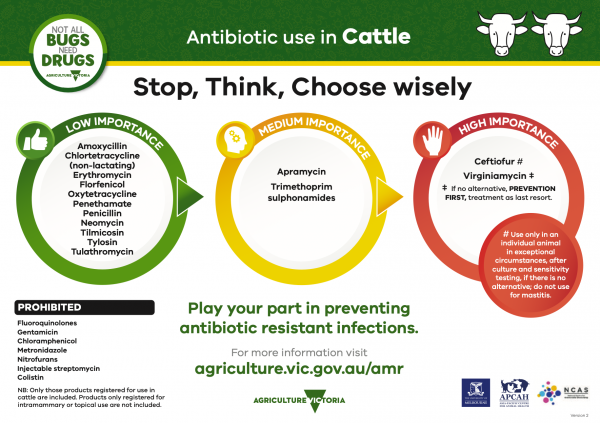
A document that outlines via a traffic light system, the different importance level of antimicrobials for use in cattle.
Suggest a disease, syndrome or key evidence you think we should include.