
Traffic light - Horses
A document that outlines via a traffic light system, the different importance level of antimicrobials for use in horses.
While the cause can be multifactorial, the accumulation of fluid and debris is generally associated with failure of the uterus to physiologically drain, in combination with poor perineal conformation (82). Drainage may be limited or completely impaired by the presence of cervical and/or vaginal adhesions, stenosis, or other irregularities of the cervical canal. Pyometra can also be considered a chronic inflammatory condition, developing from ongoing clinical endometritis (83). The tissue inflammation and associated fluid can be sterile or infectious.
Multiple organisms are associated with pyometra in the mare. The organisms most commonly isolated include Streptococcus equi subspecies zooepidemicus, E. coli, Actinomyces spp., Pasteurella spp., Pseudomonas spp., Propionibacterium spp. and Candidia spp.(82). Streptococcus dysgalactiae subspecies equisimilis and Serratia spp. have been isolated in cases associated with urine contamination (84).
A reproductive examination is warranted to differentiate pyometra from pregnancy, mucometra, hydrometra, pneumometra or haemorrhage prior to initiation of further diagnostic investigation and treatment.
In some cases, clinical signs of pyometra are completely absent. Other mares may present for examination because of vulval discharge, weight loss, abdominal distension, reduced performance, fever or colic (82).
Diagnosis is based on a complete reproductive examination, including transrectal palpation and ultrasonographic examination, a digital vaginal examination and a vaginoscopic examination. When possible, samples of any fluid exudate can be collected for cytological examination and culture and susceptibility testing. Hysteroscopy is another useful diagnostic aid in cases of atypical pyometra (85). An endometrial biopsy can also be considered for culture and to determine the prognosis for future fertility when considering treatment options.
In cases of pyometra, the uterus is often enlarged and atonic on palpation, with echogenic fluid detectable by transrectal ultrasonography. Some cases may have evidence of more solidified exudate (82, 85). In a case that occurred following dystocia, vaginal endoscopy and transrectal ultrasonography revealed a blind-ended vaginal cavity and distended uterus (86). In another case, masses evident on ultrasonography were identified as purulent concretions by hysteroscopy (85). Cytological examination enables confirmation of inflammation and aids in detection of the presence of bacteria, yeasts or fungi. In a case study, cytologica examination also revealed numerous calcium carbonate crystals in the sample. This case of pyometra was associated with urine pooling and persistent contamination of the uterine environment (84). Culture and antimicrobial susceptibility testing are used to determine whether infection is present and to direct antimicrobial treatment, if necessary.
Conservative therapy consists of draining and flushing the uterus, in combination with systemic anti-inflammatory and antimicrobial treatment (based on culture and susceptibility testing). If possible, a sample of the uterine exudate should be collected for cytology, culture and antimicrobial susceptibility testing. Many pyometra cases will improve after uterine fluid is siphoned and repeated lavage with large volumes of saline or 0.05% povidone-iodine solution (87). Depending on the case, this may initially require manual breakdown of adhesions or scar tissue in the vaginal and/or cervical canal (82) if drainage is compromised. Topical application of anti-inflammatory ointments may help to prevent further formation of adhesions.
If a corpus luteum is present, prostaglandin F2α (250 µg of cloprostenol IM or 2.5-10 mg of dinoprost tromethamine IM) should be administered to induce luteolysis and cervical relaxation. Oxytocin (10-20 IU IM or IV) is often used concurrently to promote uterine contractility. Misoprostol, a synthetic prostaglandin E1 analogue, can also be administered to promote cervical relaxation in cases where manual dilation is necessary to perform diagnostic testing and lavage (88). Hysteroscopy can be a useful therapeutic tool to assist lavage in clearing inspissated debris and concretions (85). The use of a permanent cervical stent for long-term drainage in cases of pyometra has been described (89). As many affected mares have conformational or anatomical abnormalities impairing uterine clearance, stent placement is often not a curative therapy. In many cases the stent was displaced, or removal was required, and pyometra was re-occurred after the stent was removed.
Complete recovery can be achieved in cases of pyometra (90), but is unlikely due to the anatomical limitations of affected mares. Correction of the primary cause is often necessary and may include an episiotomy or perineal body reconstruction for mares with abnormal perineal conformation, a urethral extension for mares with evidence of urine pooling, or surgical breakdown of advanced adhesions found in the reproductive tract.
Surgery is often necessary as a salvage procedure to resolve cases of pyometra. Cervical wedge resection is beneficial when cervical stenosis or adhesions of the os cervix limit uterine drainage. The uterus is lavaged prior to surgery and a full-thickness wedge-shaped cervical defect is created (91). This procedure results in a permanent opening that allows drainage and the mare is then managed medically as described above. Another surgical intervention used in cases of complete vaginal adhesion or unresolved pyometra is hysterectomy. Under general anaesthesia, the exudate is aspirated from the uterus and the uterus is removed. This procedure is not commonly practised because of the risk of post-operative peritonitis and the difficulty of surgical access to the uterus in a mature horse (81, 92).
Antimicrobial therapy is only warranted in cases of infectious (bacterial) pyometra. Treatment should be selected based on culture and susceptibility testing results. Whilst awaiting culture and susceptibility testing results, clinicians can implement uterine lavage and ecbolic treatment to improve the efficiency of antimicrobial therapy once an appropriate selection is possible. Systemic therapy is often used rather than intrauterine antimicrobial infusion because of the need to rid the uterine environment of fluid and the requirement for ongoing uterine lavage.
The prognosis for future fertility in mares with pyometra is poor. While it limits breeding capacity, adequate treatment can result in a good outcome for general health and performance.
A document that outlines via a traffic light system, the different importance level of antimicrobials for use in horses.
The Australian Veterinary Prescribing Guidelines cattle and horse flipbook, detailing antimicrobials for use in cattle and horses.
The equine Australian Veterinary Prescribing Guidelines for antimicrobial use as a pocket guide booklet.
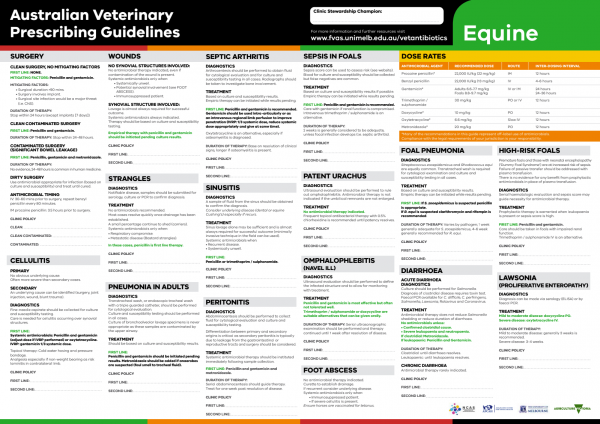
The equine Australian Veterinary Prescribing Guidelines poster. This document that outlines different antimicrobials for use in horses according to different diseases.
Suggest a disease, syndrome or key evidence you think we should include.