
Traffic light - Horses
A document that outlines via a traffic light system, the different importance level of antimicrobials for use in horses.
This page outlines the normal vital signs for foals before detailing management for the following foal diseases:

| Age | Temp | Pulse | Resp | Behavior |
|---|---|---|---|---|
| 0-1 min | 37.5 | 70-80 | 70 | Breaks amnion by limb/head movement. |
| 2-30 mins | 37.8 | 120-140 | 50 | Cord rupture, shivering, sternal, sucking movements, attempts to stand. |
| 1-12 hrs | 37.8 | 140-150 | 40 | Standing, nursing, passes meconium and urine. |
| 12-18 hrs | 37.8 | 110-120 | 35 | |
| 24-48 hrs | 37.8 | 90-100 | 30 | |
| 48-72 hrs | 37.8 | 60-80 | 20 |
Please note: The reliability of this scoring system has varied in populations outside of the hospital where it was designed.
| Cause | Age group affected | Notes | Antimicrobial choice |
|---|---|---|---|
| Foal heat diarrhea (coprophagy) | 5-14 days | Foals clinically well, no fever | None |
| Rotavirus | 3-10 days | Often dehydrate rapidly (malabsorptive diarrhoea) | Prophylactic antimicrobials to reduce the risk of sepsis. See below. |
| Coronavirus | Prophylactic antimicrobials to reduce the risk of sepsis. See below. | ||
| Salmonella | Any age | *Zoonoses | Prophylactic antimicrobials to reduce the risk of sepsis. See below. |
| Endotoxaemia | Any age | Foals with endotoxaemia due to sepsis or other conditions commonly have diarrhoea. | Treat sepsis, or other cause of endotoxaemia. |
| Cryptosporidium | 5-21 days | *Zoonoses Often self-limiting | None |
| Rhodococcus equi | 4-16 weeks | ~75% of foals with respiratory R. equi will have extrapulmonary lesions, of which the GI is most common (33%)72. | Clarithromycin & rifampin73 |
| Clostridium spp | Most common in very young foals, can occur at any age, especially associated with antimicrobial therapy | Metronidazole | |
Parasites – Strongyloides westeri (Threadworm) – Parascaris equorum (Round worm) | <14 days Infection from birth, clinical signs from 4-5 months of age | Uncommon Usually, other signs of ill-thrift are present. | None |
Prophylactic antimicrobial choice for neonatal foals with diarrhoea: broad spectrum coverage is required as sepsis in foals commonly involves either Gram-positive or Gram-negative pathogens74. In foals that are dehydrated and azotaemic, avoid nephrotoxic drugs such as gentamicin and oxytetracycline. Intravenous trimethoprim / sulphonamide is recommended in these cases.
In foals with normal hydration status, penicillin in combination with gentamicin, or trimethoprim / sulphonamide is recommended.
Foals born with neonatal encephalopathy are at high risk for sepsis as they often have failure of passive transfer, or failure to absorb antibodies even when colostrum is consumed in sufficient quantities. In addition, these foals are often recumbent and have higher exposure to environmental pathogens.
Prophylactic antimicrobial therapy is recommended. Broad spectrum coverage is required as sepsis in foals commonly involves either Gram-positive or Gram-negative pathogens74. In foals that are dehydrated and azotaemic, avoid nephrotoxic drugs such as gentamicin and oxytetracycline. Intravenous trimethoprim / sulphonamide is recommended in these cases.
In foals with normal hydration status, penicillin in combination with gentamicin, or trimethoprim sulphonamide is recommended.
Foal typically suffer from pneumonia not as neonates but at 1-4 months of age.
Streptococcus zooepidemicus and Rhodococcus equi are the most common pathogens and occur with equal frequency in most parts of Australia. Pneumonia because of these pathogens is impossible to differentiate clinically. Trans-tracheal wash is highly recommended.
| Common pathogens | Antimicrobial recommendation | Duration of therapy |
|---|---|---|
| Streptococcus zooepidemicus | Penicillin IM or IV | Typically 1 week |
| Rhodococcus equi | Clarithromycin and rifampin | Typically 4-6 weeks |
Note. There has been some recent controversy over the use of rifampin in combination with macrolides due to the findings of some studies, which show reduced plasma concentrations of macrolides. However, there is also evidence to support combination therapy. The combination is still preferred as it may reduce the emergence of resistance, there is no evidence of superiority of macrolide therapy alone in clinical studies and there is no patient-based studies indicating a detrimental effect of combination therapy.
Treat until clinical signs, haematological and diagnostic imaging abnormalities have resolved.
More information about R.equi can be found in the ACVIM consensus statement on Diagnosis, Treatment, Control, and Prevention of Infections Caused by Rhodococcus equi in Foals
Sepsis score can be used to assess risk (see website). Blood for culture and susceptibility should be collected, but false negatives are common.
Based on culture and susceptibility results if possible. Empiric therapy can be initiated while the results are pending.
Penicillin and gentamicin are recommended. Care with gentamicin if renal function is compromised. Intravenous trimethoprim / sulphonamide is alternate.
2 weeks is generally considered to be adequate, unless focal infection develops (i.e. septic arthritis).
Arthrocentesis should be performed to obtain fluid for cytological evaluation and for culture and susceptibility testing in all cases. Radiographs should be taken to investigate bone involvement. Ultrasound examination of the umbilical remnants should also be performed as this may be the source of the bacteraemia.
Based on culture and susceptibility results. Empiric therapy can be initiated while results pending. Penicillin and gentamicin is recommended. Oxytetracycline is an alternative, especially if osteomyelitis is diagnosed.
Treat for 1 week past resolution of clinical signs, longer if osteomyelitis is present.
Ultrasound evaluation should be performed to rule out omphalophlebitis. If no enlargement of the umbilical remnants is identified, antimicrobial therapy is not indicated.
No antimicrobial therapy indicated.
Frequent topical antibacterial therapy with chlorhexidine is recommended until patency resolves.
Ultrasound evaluation should be performed to define the infected structure and to allow for monitoring with treatment. Monitor closely for the development of septic synovial structures.
Penicillin and gentamicin are most effective but often not tolerated well. Trimethoprim / sulphonamide or doxycycline are suitable alternatives that can be given orally. Surgical excision can be considered, surgical site infections are common post-operatively.
Serial ultrasonographic examination should be performed, and therapy continued until 1 week after resolution of the disease.
Premature foal and those with neonatal encephalopathy (’Dummy Foal Syndrome’) are at increased risk of sepsis. Failure of passive transfer should be addressed with plasma transfusion. There is no evidence for any benefit from prophylactic antimicrobials in place of plasma transfusion.
Serial haematologic evaluation and sepsis score may guide the necessity for antimicrobial therapy.
Prophylactic therapy is warranted when leukopaenia is present or the sepsis score is high. Penicillin and gentamicin are most appropriate, but care should be taken in foals with impaired renal function. Trimethoprim / sulphonamide IV is an alternative.
A document that outlines via a traffic light system, the different importance level of antimicrobials for use in horses.

The Australian Veterinary Prescribing Guidelines cattle and horse flipbook, detailing antimicrobials for use in cattle and horses.
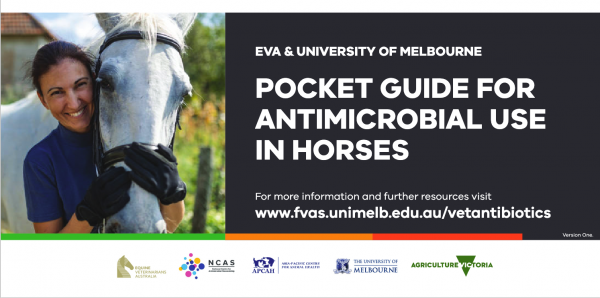
The equine Australian Veterinary Prescribing Guidelines for antimicrobial use as a pocket guide booklet.
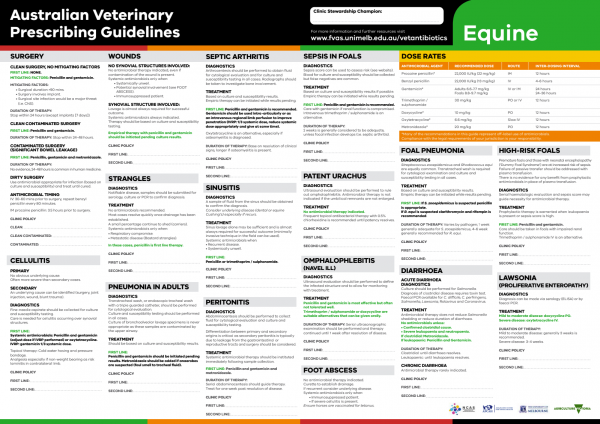
The equine Australian Veterinary Prescribing Guidelines poster. This document that outlines different antimicrobials for use in horses according to different diseases.
Funding for these guidelines was provided by the Australian Veterinary Association (AVA), Animal Medicines Australia (AMA) and AgriFutures Australia.
These guidelines would not have been possible without the considerable expertise and efforts of the Expert Panel: Associate Professor Laura Hardefeldt, Dr. Leanne Begg, Dr. Stephen Page, Professor Glenn Browning, and Professor Jacqueline Norris. We are also extremely grateful to the additional contributing authors.
The dedicated and skilled work of Project Manager Dr. Kellie Thomas is gratefully acknowledged, as are the contributions of the Project Steering Committee: Dr. Phillip McDonagh, Dr. John Messer, Professor James Gilkerson, and Dr. Melanie Latter. Open access publishing facilitated by The University of Melbourne, as part of the Wiley - The University of Melbourne agreement via the Council of Australian University Librarians.



Suggest a disease, syndrome or key evidence you think we should include.