
Traffic light - Horses
A document that outlines via a traffic light system, the different importance level of antimicrobials for use in horses.
Sand causes enteropathy by physical irritation to the mucosa of the colon, resulting in colitis, which can be present as acute or recurrent colitis, diarrhoea, and/or unexplained weight loss. For more information, see Chapter 1 in this section, Part VII: Sand-irritation diarrhoea.
Cyathostomins are a group of small strongyle parasites of which the larvae and not the adults are pathogenic. For more information, see Chapter 1 in this section, Part IV—parasite-associated diarrhoea (cyathostomins).
Alimentary lymphosarcoma is an uncommon disease, but infiltration of neoplastic lymphocytes into the colon can disrupt colonic function.
Inflammatory bowel disease is a broad diagnosis that describes several specific diseases - granulomatous enteritis, lymphocytic-plasmacytic enterocolitis and eosinophilic enterocolitis - and is due to infiltration of inflammatory cells into the mucosa.
Alimentary lymphosarcoma and chronic inflammatory bowel disease usually also cause weight loss and a protein-losing enteropathy.
Chronic salmonellosis is covered in Chapter 8 of this section.
History and clinical examination findings are critical. Diet, treatment history, including with drugs used to treat or prevent parasites or other infectious agents, are all important, as is assessment for dental diseases.
Faecal PCR and/or culture are indicated to rule out salmonellosis. Serial samples are required (see Chapter 8 in this section).
Haematology and serum biochemistry are important to assess hydration, electrolyte losses and renal function. Fibrinogen and serum amyloid A concentrations will help to assess the degree of inflammation present. Hypoalbuminaemia due to a protein-losing enteropathy is common.
The presence of sand can be diagnosed with abdominal radiographs, and suspension of the faeces in water, to observe sedimentation of the sand, is also a crude method of diagnosis.
When malabsorption is suspected, a glucose absorption test is also valuable, simple to perform and doesn’t require specialised equipment. In healthy horses, the plasma glucose level should rise to higher than 85% over the baseline between 60 and 120 min after the oral administration of glucose (1 g/kg as a 20% solution) (21). If the peak is between 15% and 85%, this is classified as partial malabsorption and is not specific for small intestinal disease. Total malabsorption occurs when the peak is less 15% higher than baseline and, in this case, diffuse, small intestinal disease is highly likely.
A faecal egg count is important but cyathostomin infestations may not be patent, so a negative faecal egg count does not rule out this differential diagnosis.
Abdominal ultrasound may identify thickened small or large intestine which, if diffuse, may increase the suspicion of an infiltrative disease. Enlarged lymph nodes are suggestive of lymphosarcoma. Abdominocentesis is generally normal, but neoplastic cells may be present in some cases of lymphosarcoma.
Alimentary lymphosarcoma and inflammatory bowel disease require histopathological examination of affected intestinal tissue collected by laparoscopy or laparotomy for definitive diagnosis. Sometimes, a rectal mucosal biopsy may provide these diagnoses.
Several studies have compared the efficacy of different treatments for sand enteropathy. Collectively, they support the use of combination therapy with psyllium and MgSO4 (Epsom salts) (both at 1 g/kg) by nasogastric tube once daily as the preferred method of treatment. Further, the collective findings of published research suggest that administering psyllium in feed as a preventative has no advantage over simply removing access to sand (18).
Cyathostomins can be treated with fenbendazole (10 mg/kg PO q 24 h for 5 days) or moxidectin (0.4 mg/kg PO). Prednisolone at 1 mg/kg PO q 24 h for 24-48 h is recommended in clinically affected horses prior to administration of anthelmintics to control inflammation in the colon (6).
Chronic shedding of Salmonella spp. generally requires time and normalisation of the gut flora. Faecal microbiota transplantation (faecal transfaunation) may be useful for these cases, and in inflammatory bowel diseases, although more research is needed before efficacy can be established. For the most current recommendations, see ‘Overarching treatments’ in Chapter 1 of this section.
Biosponge (di-tri-octahedral smectite) has also been used successfully in the treatment of chronic diarrhoea in some horses, at a dose of 97.5 g PO q 12 h.
Chronic inflammatory bowel disease is usually treated with a long and tapering course of corticosteroids, with parenteral therapy considered initially due to the presence of malabsorption (dexamethasone at 0.1 mg/kg IV or IM q 24 h for 5 days, reducing the dose by 50% every 5-7 days or switching to prednisolone at 1 mg/kg PO q 24 h after the first 5 days, and reducing the dose by 50% every 5-7 days). Other immunosuppressive drugs have been used for refractory cases, including azathioprine (3 mg/kg PO q 24 h)(22).
Resolution of diarrhoea can take a long time due to the need to re-establish a normal gut flora following treatment of the primary cause. Intestinal lymphosarcoma has a poor prognosis and inflammatory bowel disease has a guarded prognosis.
A document that outlines via a traffic light system, the different importance level of antimicrobials for use in horses.
The Australian Veterinary Prescribing Guidelines cattle and horse flipbook, detailing antimicrobials for use in cattle and horses.
The equine Australian Veterinary Prescribing Guidelines for antimicrobial use as a pocket guide booklet.
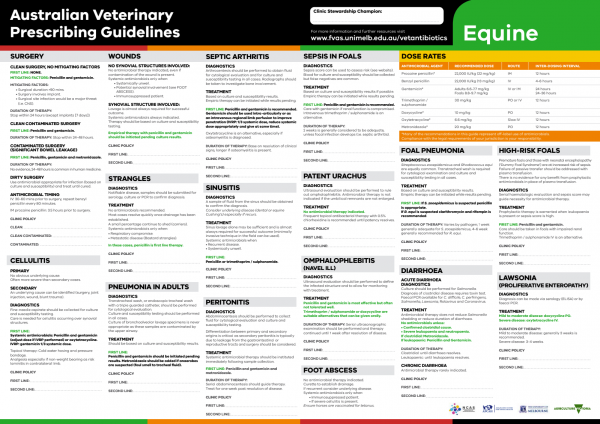
The equine Australian Veterinary Prescribing Guidelines poster. This document that outlines different antimicrobials for use in horses according to different diseases.
Funding for these guidelines was provided by the Australian Veterinary Association (AVA), Animal Medicines Australia (AMA) and AgriFutures Australia.
These guidelines would not have been possible without the considerable expertise and efforts of the Expert Panel: Associate Professor Laura Hardefeldt, Dr. Leanne Begg, Dr. Stephen Page, Professor Glenn Browning, and Professor Jacqueline Norris. We are also extremely grateful to the additional contributing authors.
The dedicated and skilled work of Project Manager Dr. Kellie Thomas is gratefully acknowledged, as are the contributions of the Project Steering Committee: Dr. Phillip McDonagh, Dr. John Messer, Professor James Gilkerson, and Dr. Melanie Latter. Open access publishing facilitated by The University of Melbourne, as part of the Wiley - The University of Melbourne agreement via the Council of Australian University Librarians.



Suggest a disease, syndrome or key evidence you think we should include.