
Traffic light - Horses
A document that outlines via a traffic light system, the different importance level of antimicrobials for use in horses.
Seminal vesiculitis may be caused by several bacterial species and can be contracted via a range of routes, including both ascending and descending infection from the urinary and reproductive tracts (118). It occurs when pathogenic bacteria colonise the seminal vesicles, resulting in the accumulation of inflammatory products within the gland that are expelled during ejaculation (119). Diagnosis of the disease is usually achieved by cytological examination of semen samples, as affected stallions can appear clinically normal. Treatment of seminal vesiculitis in the stallion can often be unrewarding, as achieving adequate therapeutic concentrations of antimicrobial drugs within the seminal vesicles is difficult.
Clinical signs are usually absent in stallions with seminal vesiculitis. However, variable numbers of white blood cells and bacteria within the stallion’s ejaculate are usually characteristic of the disease. Grossly, the ejaculate may appear discoloured and flocculant, but, in some cases, no gross changes may be apparent. Swabs can be collected from the prepuce, urethral fossa, semen, and the urethra pre- and post-ejaculation to determine the source of infection. A heavy pure growth of bacteria from the post-ejaculatory urethra and semen is strongly suggestive of infection in the seminal vesicles.
To differentiate seminal vasculitis from other diseases of the urogenital tract, a semen sample can be fractionated to isolate the pre-ejaculatory fluid from the sperm-rich fraction and the gel fraction expelled at the completion of ejaculation. As the seminal vesicles contribute a significant portion of the gel fraction in the stallion’s ejaculate, more white blood cells are likely to be detected in the gel fraction than in the other fractions. The gel fraction can be filtered from a normal collection obtained with an artificial vagina using a commercial semen filter. Simple smears can be prepared on a slide and stained with Diff-Quik to examine white blood cell morphology and to compare the sperm-rich and gel fractions.
A definitive diagnosis can be achieved using uroscopy to catheterise the seminal colliculi, allowing direct sampling of the seminal vesicles, with or without trans-rectal massage. Transrectal ultrasonographic examination may help to confirm the diagnosis, with the affected vesicles appearing enlarged, with variable echogenicity. However, this procedure is often unrewarding (120).
The culture of the organism is imperative to allow the formulation of a treatment plan. The species most commonly cultured from the seminal vesicles of stallions include Staphylococcus spp., Streptococcus spp., E. coli, Pseudomonas aeruginosa and Klebsiella pneumoniae (119, 120, 121). In addition to compromising the fertility of semen from the affected stallion, venereal transmission of these bacteria may result in bacterial endometritis in susceptible mares.
Treatment of seminal vesiculitis is often unrewarding. Even after treatment with both systemic and local application of antimicrobials, there is a high recurrence rate. Treatment of acute seminal vesiculitis appears to be more successful (119).
Endoscopic catheterisation of the seminal colliculus is the most effective method to achieve direct delivery of antimicrobials to the site of infection. This method also allows targeted treatment with mucolytics and gland lavage to physically remove biofilms and inflammatory products. Whilst this treatment method is an intensive “in-hospital” method of antimicrobial delivery, it is the most effective treatment method for achieving resolution of the infection. A combination of systemic and direct therapy is recommended, as this disease often reoccurs.
Systemic therapy is often the most practical way to tackle seminal vesiculitis in the stallion. However, it is important that the antimicrobial selected has good penetration into the reproductive tract, in addition to antibacterial efficacy against the targeted organism. Lipophilic (fat-soluble) drugs should be selected to achieve good penetration into these tissues. Treatment duration may vary between individuals. However, it is likely that 2-4 weeks of therapy will be required before there is an appreciable reduction in contamination of semen with bacteria and white blood cells. The response to treatment can be monitored with routine culture and susceptibility testing of the semen/seminal plasma. Resolution is only effective if the antimicrobial selected can achieve adequate penetration into the seminal vesicles and reach therapeutic concentrations (119). Microorganisms capable of forming biofilms complicate therapy and a combination targeted approach is usually more effective.
If the stallion needs to continue his breeding duties whilst being treated for this condition, careful management of the ejaculate may prevent venereal transmission. The most effective post-ejaculatory treatment of semen is the use of gradient or colloid centrifugation. In addition to the removal of seminal plasma and the selection of a “good” population of spermatozoa (122), colloid centrifugation also removes bacteria and viral particles from semen (123, 124). Reducing or even eliminating the bacterial load of the semen sample may allow control of bacterial contamination without the excessive use of antimicrobials. Mixing an affected ejaculate with a commercial semen extender containing appropriate antimicrobials may also provide effective treatment of an ejaculate prior to insemination.
Seminal vesiculectomy is rarely performed in the stallion. However, there are some reports of chemical cauterisation of the seminal vesicles, which may be effective in cases of chronic and persistent seminal vesciulitis in a breeding stallion (119).
Because the efficacy of antimicrobial therapy is poor and the recurrence rate in stallions is high, the prognosis for affected breeding stallions is guarded. Unless routine semen evaluation is being performed, the condition is rarely identified early, which would enable more effective treatment and elimination of the disease. Treatment of the stallion may result in transient resolution of bacterial shedding and pyospermia, which may improve fertility transiently to enable breeding or semen cryopreservation prior to castration. However, there is a high chance of re-infection after treatment. In chronically affected stallions refractory to treatment, semen collection and colloid centrifugation is the recommended method for preparation of semen for insemination.
A document that outlines via a traffic light system, the different importance level of antimicrobials for use in horses.
The Australian Veterinary Prescribing Guidelines cattle and horse flipbook, detailing antimicrobials for use in cattle and horses.
The equine Australian Veterinary Prescribing Guidelines for antimicrobial use as a pocket guide booklet.
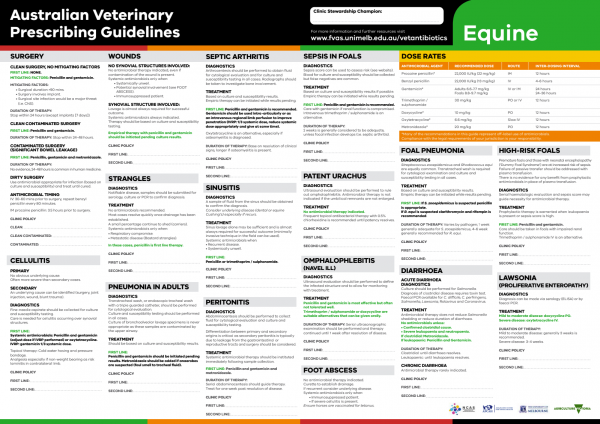
The equine Australian Veterinary Prescribing Guidelines poster. This document that outlines different antimicrobials for use in horses according to different diseases.
Suggest a disease, syndrome or key evidence you think we should include.