
Traffic light - Horses
A document that outlines via a traffic light system, the different importance level of antimicrobials for use in horses.
Click here (https://doi.org//10.1111/avj.70003) to view the guidelines in their entirety.

Equine urinary tract infection (UTI) is uncommon and rarely occurs as a primary event. When UTIs do occur in horses, they are most commonly after a mechanical or functional impairment of normal urine flow. The bacteria most frequently isolated in recent global case reports include E. coli, Staphylococcus spp., Streptococcus spp. and Enterococcus spp. (1, 2, 3). However, it is worth noting that most cultures from published case series of sabulous (sandy) cystitis, urolithiasis and idiopathic haemorrhagic cystitis do not yield growth. In addition, these organisms have been detected in cultures of normal equine urine (4). This finding suggests that weakened host defences allow virulent strains of normal flora to contribute opportunistically to ascending UTI in the horse and supports the proposal that, as in other animal species, asymptomatic bacteriuria should not be treated.
In cases of suspected UTI, a definitive diagnosis and isolation of causative organisms by culture, with antimicrobial susceptibility testing, should be pursued. To minimise contamination of urine, samples should be collected by catheterization, following cleansing of the distal penis or perivulvar region with chlorhexidine-based soap. The first 20 ml of urine should be discarded and the next 20 ml collected for analysis. Causative organisms are not predictable and multi-drug resistance is becoming increasingly common, particularly in cases of sabulous cystitis where chronicity is a feature. Culture of more than 20,000 CFU of bacteria/mL of urine should be used as a cut-off for a diagnosis of UTI for free-catch samples (Table 9.1) (4). In vitro resistance may not reflect in vivo efficacy for common antimicrobials (such as penicillins, cephalosporins and potentiated sulphonamides), as high concentrations are achieved in the urine because of glomerular filtration and active tubular secretion. In such cases, the clinical response to therapy should be interpreted alongside susceptibility testing results.
Table 9.1. Bacteriuria in male and female horses
Empty Cell | Clinically relevant (CFU/mL) | Suspicious (CFU/mL) | Contamination (CFU/mL) |
|---|---|---|---|
Midstream voided urine | > 40,000 | 20,000 - 40,000 | < 20,000 |
Catheterized urine | > 1,000 | 500 - 1,000 | < 500 |
Abbreviation: CFU/mL, colony-forming units of bacteria per millilitre of urine.
Data from MacLeay JM, Kohn CW. Results of quantitative cultures of urine by free catch and catheterization from healthy horses. J Vet Intern Med 1998;12:76–8 (4).
Cystoscopy is a useful tool when identifying conditions that contribute to the development of UTIs. A flexible endoscope with a minimum length of 100 cm and an outside diameter of less than 12 mm is appropriate for visualization of the bladder in adult horses of either gender (5).
Because UTI is most often secondary in horses, it is critical to diagnose and treat the primary problem before, or concomitant with, antimicrobial therapy.
The trimethoprim/sulphadiazine combination is an excellent choice for treatment of UTIs in horses because of its broad antibacterial spectrum, low cost, and ease of administration.
Penicillins are also a good choice because of the high concentrations excreted into the urine. Procaine penicillin G or benzyl penicillin may be combined with aminoglycosides to enhance activity against Gram-negative urinary tract pathogens.
The recommended duration of therapy is based on those for other animal species.
Guarded and dependent on primary disease.
A document that outlines via a traffic light system, the different importance level of antimicrobials for use in horses.
The Australian Veterinary Prescribing Guidelines cattle and horse flipbook, detailing antimicrobials for use in cattle and horses.
The equine Australian Veterinary Prescribing Guidelines for antimicrobial use as a pocket guide booklet.
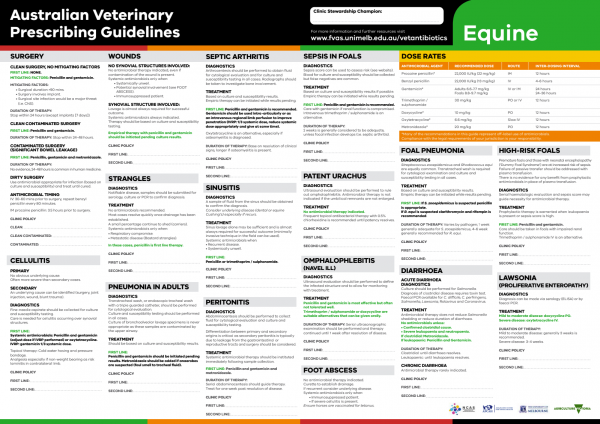
The equine Australian Veterinary Prescribing Guidelines poster. This document that outlines different antimicrobials for use in horses according to different diseases.
Funding for these guidelines was provided by the Australian Veterinary Association (AVA), Animal Medicines Australia (AMA) and AgriFutures Australia.
These guidelines would not have been possible without the considerable expertise and efforts of the Expert Panel: Associate Professor Laura Hardefeldt, Dr. Leanne Begg, Dr. Stephen Page, Professor Glenn Browning, and Professor Jacqueline Norris. We are also extremely grateful to the additional contributing authors.
The dedicated and skilled work of Project Manager Dr. Kellie Thomas is gratefully acknowledged, as are the contributions of the Project Steering Committee: Dr. Phillip McDonagh, Dr. John Messer, Professor James Gilkerson, and Dr. Melanie Latter. Open access publishing facilitated by The University of Melbourne, as part of the Wiley - The University of Melbourne agreement via the Council of Australian University Librarians.


Suggest a disease, syndrome or key evidence you think we should include.