
Traffic light - Horses
A document that outlines via a traffic light system, the different importance level of antimicrobials for use in horses.
It is a complication of the early post-partum period, but can be seen up to 7 - 10 days after foaling. Predisposing factors include dystocia, retained foetal membranes, delayed uterine clearance and uterine atony. Occasionally, no predisposing factors are identified. It is important to note that it does not occur in the normal post-foaling mare (43). Equine metritis is a potentially life-threatening condition and requires appropriate and immediate treatment in the acute phase for a positive outcome.
There is considerable contamination of the uterine environment during parturition. In the absence of a fully functional defence system, bacterial (or fungal) overgrowth may occur. Damage to the uterine tissues allows systemic absorption of toxins from the uterine lumen, resulting in overwhelming endotoxaemia, septicaemia and/or the systemic inflammatory response syndrome (SIRS) (43).
Several bacterial species can cause equine metritis, but Gram-negative organisms are most commonly associated with overwhelming endotoxaemia. The species isolated from clinical cases include E. coli, Klebsiella spp., Enterobacter spp., Streptococcus equi subspecies zooepidemicus, other Streptococcus spp., Enterococcus spp. and Staphylococcus spp., as well as other Gram-negative and Gram-positive organisms (44). A mixed bacterial population is most often detected (44), consistent with the contamination experienced during parturition. As a result, culture is often non specific and empirical treatment, including broad spectrum antimicrobials, is recommended.
Diagnosis of clinical metritis is usually made following a reproductive tract examination in the post-partum period. Clinical signs of equine metritis include:
The severity of clinical signs may vary, with more severe signs indicative of a guarded prognosis. A reproductive tract examination of the mare should include vaginoscopic examination, manual palpation of the caudal reproductive tract and trans-rectal ultrasonographic examination to evaluate the uterine size, tone, wall thickness and the echogenicity of any uterine contents (45). In metritis cases, the following are common:
It is recommended that a trans-abdominal ultrasonographic examination is performed to rule out a uterine tear or other gastrointestinal complications, as these conditions may result in similar clinical signs in the post-partum period. Haematology is usually indicative of overwhelming systemic inflammation, with a pronounced neutropaenia, depending on the severity and disease progression (46). A double-guarded uterine swab can be used to sample the uterine fluid for culture and sensitivity. However, empirical treatment is usually initiated, and clinical signs are often resolved prior to receiving the results from culture and susceptibility testing.
Treatment for post-partum metritis aims to reduce bacterial overgrowth, reduce inflammation and treat the systemic sequelae. As there is an inevitable delay between the submission of swabs for culture and the availability of results, it is imperative that a mare with suspected metritis receives treatment immediately, as there is a high risk of life-threatening complications (such as laminitis) if treatment is delayed. Broad-spectrum antimicrobials and anti-inflammatories should be initiated as soon as practicable. More than 65% of the organisms isolated in one study were susceptible to the combination of procaine penicillin and gentamicin i (45). If an anaerobe is suspected, metronidazole may also be included in the treatment regimen. Early intervention in these cases is imperative for a good clinical outcome. Anti-inflammatories, such as flunixin meglumine, which also ameliorate the effects of endotoxin (see Section 7), are recommended in these cases. Whilst lower doses are often recommended for this purpose, it is also important to address the pain and inflammation associated with any additional trauma that may have occurred during parturition. Therefore, higher doses of 0.5 – 1.1 mg/kg IV q 12-24 h are recommended in the acute phase, prior to reducing the dose to 0.25 mg/kg IV q 8 h. Other treatments for endotoxaemia can be found in Section 7.
Physical removal of bacterial contamination from the uterus using large volume uterine lavage and ecbolic therapy is important to reduce bacterial overgrowth and promote uterine contractility. Uterine lavage can be performed using an isotonic saline solution made by dissolving 90 g of table salt in 10 L warmed clean water or a 0.05% povidone iodine solution. A large bore tube (stomach tube) is inserted through the vagina into the uterus and the lumen is gently filled and emptied using 2-3 L at a time to syphon out debris and fluid in situ. This procedure can be repeated as many times as it is tolerated by the mare or until the fluid efflux is clear. Uterine lavage should be performed initially once to twice daily, or more often if required to ensure a minimal nidus for further endotoxin absorption. There appear to be adverse negative effects of uterine lavage on the inflammatory profile of mares with metritis and it is the safest and fastest way to remove debris and toxic material from the uterine lumen (47). Use of ecbolic therapy - oxytocin at 10-20 IU IM or IV as frequently as q 2 h, in addition to uterine lavage, helps to further promote uterine contractility.
If there is evidence of an increased digital pulse or signs of laminitis, cryotherapy should be considered to mitigate the effects of endotoxaemia on the sensitive laminae. Other supportive care, such as IV fluid therapy, is often indicated in hospitalised cases. The systemically ill broodmare may also experience a significant decline in milk production. Promotion of lactation in these mares can be supported by the administration of domperidone (1.1 mg/kg PO q 12 h) and regular milking or nursing by the neonate.
The prognosis is good if treatment is initiated early in the disease process, prior to overwhelming SIRS and other disease sequelae such as endotoxemia and laminitis. Equine metritis is a life-threatening condition and should be high on the list of differential diagnoses for the unwell post-partum mare. Careful investigation and monitoring of mares with retained foetal membranes, delayed uterine clearance or after a dystocia may help to identify mares at risk and facilitate prompt initiation of treatment.
A document that outlines via a traffic light system, the different importance level of antimicrobials for use in horses.
The Australian Veterinary Prescribing Guidelines cattle and horse flipbook, detailing antimicrobials for use in cattle and horses.
The equine Australian Veterinary Prescribing Guidelines for antimicrobial use as a pocket guide booklet.
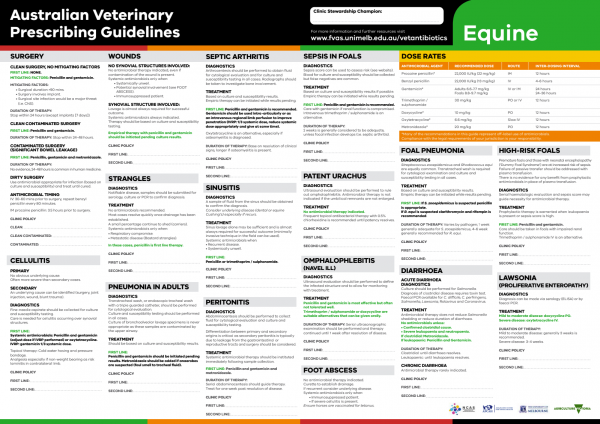
The equine Australian Veterinary Prescribing Guidelines poster. This document that outlines different antimicrobials for use in horses according to different diseases.
Suggest a disease, syndrome or key evidence you think we should include.