
Traffic light - Horses
A document that outlines via a traffic light system, the different importance level of antimicrobials for use in horses.
Foals at 1 to 6 weeks of age are the predominant age group affected, both sporadically and as outbreaks.
The causative agent is Clostridium piliforme, a spore-forming soil and manure-borne Gram-negative obligate intracellular bacterium. The pathogenesis is poorly understood, but oral exposure through ingestion of spore-containing faeces from carrier horses is presumed. Oral administration of faeces from experimentally infected horses to foals results in clinical disease.
Reported clinical signs are non-specific and include lethargy, loss of the suckle reflux, dehydration, fever, icterus, diarrhoea and seizures, followed rapidly by recumbency, weakness, coma and death.
Clinical pathology generally reveals severe metabolic acidosis, hypoglycaemia, and marked hepatocellular injury.
A definitive diagnosis of Tyzzer’s disease is based on histological demonstration of the organisms in hepatocytes surrounding necrotic foci in the liver or in sections of the intestine stained with silver. Infection can also be diagnosed by PCR of the faeces or affected tissues, and serology using an indirect immunofluorescence assay or a multiplexed fluorometric immunoassay.
Intensive care is required if treatment is to be attempted. IV fluid therapy should be instituted for shock and to correct acid-base abnormalities and electrolyte derangements. Plasma and total or partial parenteral nutrition are also often provided.
Antimicrobials with efficacy against Clostridium spp. should be administered intravenously. Benzyl penicillin (12-16 mg/kg IV q 6 h) or ampicillin (30 mg/kg IV q 8 h) are appropriate empirical choices. Metronidazole should be avoided, as neurological signs can be exacerbated in horses with liver disease when they are administered metronidazole.
This disease is generally fatal in foals. There is only one published report of successful treatment of a confirmed case.
A document that outlines via a traffic light system, the different importance level of antimicrobials for use in horses.
The Australian Veterinary Prescribing Guidelines cattle and horse flipbook, detailing antimicrobials for use in cattle and horses.
The equine Australian Veterinary Prescribing Guidelines for antimicrobial use as a pocket guide booklet.
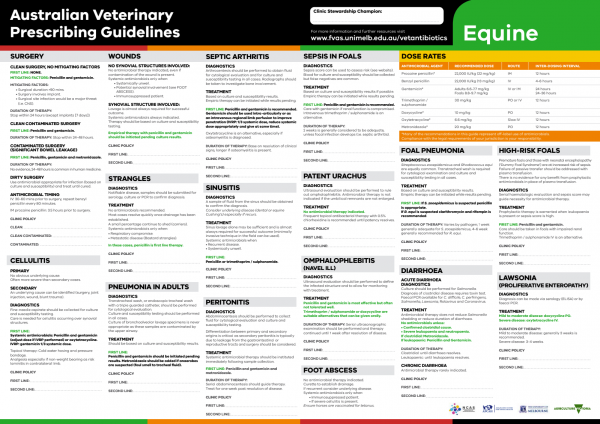
The equine Australian Veterinary Prescribing Guidelines poster. This document that outlines different antimicrobials for use in horses according to different diseases.
Funding for these guidelines was provided by the Australian Veterinary Association (AVA), Animal Medicines Australia (AMA) and AgriFutures Australia.
These guidelines would not have been possible without the considerable expertise and efforts of the Expert Panel: Associate Professor Laura Hardefeldt, Dr. Leanne Begg, Dr. Stephen Page, Professor Glenn Browning, and Professor Jacqueline Norris. We are also extremely grateful to the additional contributing authors.
The dedicated and skilled work of Project Manager Dr. Kellie Thomas is gratefully acknowledged, as are the contributions of the Project Steering Committee: Dr. Phillip McDonagh, Dr. John Messer, Professor James Gilkerson, and Dr. Melanie Latter. Open access publishing facilitated by The University of Melbourne, as part of the Wiley - The University of Melbourne agreement via the Council of Australian University Librarians.

Suggest a disease, syndrome or key evidence you think we should include.