
Traffic light - Horses
A document that outlines via a traffic light system, the different importance level of antimicrobials for use in horses.
The inflammation probably originates in the gastrointestinal tract and ascends the biliary tree, but it appears rare that inflammation does not extend into at least the periportal region. Neutrophils predominate, which distinguishes the disease from other non-suppurative inflammatory hepatopathies (chronic active hepatitis).
Retrospective studies have identified Gram-negative and anaerobic bacteria as the most common organisms isolated from the liver tissue of affected horses. E. coli, Actinobacillus equuli, Streptococcus spp., Klebsiella spp., Enterococcus spp., Clostridium spp. and Bacteroides spp. have all been implicated (23). However, in the author’s experience, culture is only successful in around 50% of cases and empirical treatment is often required. Ponies were overrepresented in a United Kingdom case-control study (24), but this could be geographically specific and may not reflect the Australian demographics. In the author’s experience in Australia, horses are as commonly diagnosed as ponies, but biases in hospital populations may influence this. No risk factors have been identified.
The classical clinical presentation is the triad of fever, colic, and jaundice. The severity of the colic varies with the degree of biliary obstruction. Complete biliary obstruction is associated with intractable abdominal pain, but, in most cases, outflow is reduced, but possible, and the colic is mild to moderate and responsive to NSAIDs.
Haematology and serum biochemistry generally reveal leukocytosis due to a mature neutrophilia, hyperfibrinogenaemia and elevation in both hepatocellular (aspartate aminotransferase [AST], sorbitol dehydrogenase [SDH]) and hepatobiliary enzymes (alkaline phosphatase [ALP], gamma-glutamyl transferase [GGT]). Hepatobiliary enzymes are typically increased more than hepatocellular enzymes. Bile acids are also elevated.
Ultrasonic examination of the liver is useful, but visualisation of the liver may be difficult in older horses, as the liver is subject to age-related atrophy. Hepatomegaly can be present in the acute phase. The main advantage of ultrasound is to guide liver biopsy. The liver can generally be imaged on the right side between the 7th and 16th intercostal spaces (ICS), and less reliably on the left (6-9th ICS) or in the ventral cranial abdomen. Fibrosis is generally quite advanced before there are changes in echogenicity on ultrasound, but dilated bile ducts are pathognomonic for biliary obstruction, and the most common reason for biliary obstruction is suppurative cholangiohepatitis. Small, calcified calculi are often found, including in normal horses, and appear as an acoustic shadow distally. Finding a high frequency of these ultrasonographic lesions is consistent with cholangiohepatitis.
A presumptive diagnosis can be made from clinical signs, haematology and serum biochemical analysis, but liver biopsy is very important for several reasons. Firstly, histopathology provides information on the degree of fibrosis, which is valuable in confirming the diagnosis and formulating a prognosis. Secondly, biopsy material should be cultured to guide antimicrobial selection and maximise the efficacy of treatment. Coagulation capacity should be assessed prior to liver biopsy, as severe liver disease can impair coagulation.
Antimicrobial therapy is critical for effective therapy. Antimicrobial selection is frequently empirical, as culture of hepatic biopsies is, frustratingly, often unsuccessful. The trimethoprim-sulphonamide combination has adequate spectrum against common pathogens, distributes well to the liver and can be administered orally, making it a good candidate for empirical treatment. Penicillin and gentamicin combinations and fluoroquinolones have also been used successfully.
Treatment duration is typically extended, with treatment recommended to continue until hepatic enzymes return to normal ranges (the median duration in one case series was 51 days (25)). Serum biochemistry should be repeated fortnightly. Early discontinuation can result in recurrence of disease, although recurrence can also occur following “appropriate” durations of therapy.
Recurrence of disease occurs in some horses and subsequent bouts may increase hepatic fibrosis. The greater the degree of periportal and bridging fibrosis, the worse the prognosis.
A document that outlines via a traffic light system, the different importance level of antimicrobials for use in horses.
The Australian Veterinary Prescribing Guidelines cattle and horse flipbook, detailing antimicrobials for use in cattle and horses.
The equine Australian Veterinary Prescribing Guidelines for antimicrobial use as a pocket guide booklet.
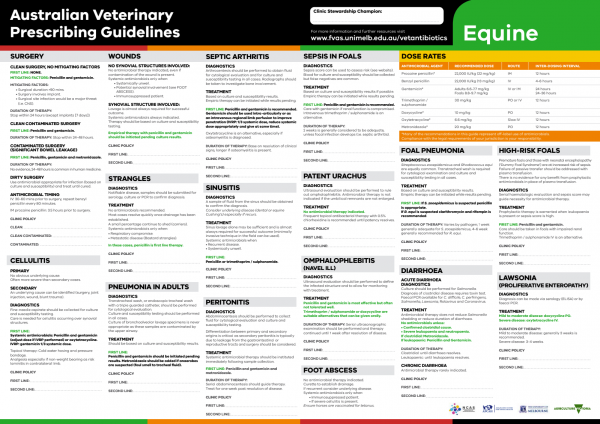
The equine Australian Veterinary Prescribing Guidelines poster. This document that outlines different antimicrobials for use in horses according to different diseases.
Funding for these guidelines was provided by the Australian Veterinary Association (AVA), Animal Medicines Australia (AMA) and AgriFutures Australia.
These guidelines would not have been possible without the considerable expertise and efforts of the Expert Panel: Associate Professor Laura Hardefeldt, Dr. Leanne Begg, Dr. Stephen Page, Professor Glenn Browning, and Professor Jacqueline Norris. We are also extremely grateful to the additional contributing authors.
The dedicated and skilled work of Project Manager Dr. Kellie Thomas is gratefully acknowledged, as are the contributions of the Project Steering Committee: Dr. Phillip McDonagh, Dr. John Messer, Professor James Gilkerson, and Dr. Melanie Latter. Open access publishing facilitated by The University of Melbourne, as part of the Wiley - The University of Melbourne agreement via the Council of Australian University Librarians.



Suggest a disease, syndrome or key evidence you think we should include.