
Traffic light - Horses
A document that outlines via a traffic light system, the different importance level of antimicrobials for use in horses.
Clinical signs include pyrexia, colic, inappetence and a dull demeanour, and, in chronic cases, weight loss.
In cases of secondary peritonitis, the principal decision is whether surgical or medical therapy is most appropriate. Horses with any of the following clinical findings are more likely to survive to discharge without surgery: absence of colic signs, normal rectal temperature or fever responsive to therapy, normal intestinal borborygmi or intestinal borborygmi that return after therapy, normal faecal production, normal rectal palpation, no gastrointestinal reflux or yellow/orange peritoneal fluid. Horses with colic, fever unresponsive to therapy, absent intestinal borborygmi following therapy, abnormal faeces, abnormal rectal palpation, gastrointestinal reflux or red/brown peritoneal fluid should be considered for exploratory laparotomy.
In cases of uterine rupture following parturition, in the only recent study, there was no difference between medical and surgical therapy. Medical treatment may be a reasonable alternative to surgical treatment for uterine tears, although the severity of a tear that can resolve with medical treatment is unknown, and medical therapy can be as expensive as surgical treatment. Tears in this study were most likely to occur in the right horn (33). This is relevant, as there is a recent case series describing laparoscopic repair (34), which may be a useful alternative to ventral midline laparotomy.
In cases without an identified cause, primary or idiopathic peritonitis is diagnosed. Primary peritonitis has been associated with Actinobacillus equuli, which is associated with better outcomes. In a study in Sweden, in 21% of cases of primary peritonitis, peritoneal fluid cultures yielded Actinobacillus spp. (A. equuli, A. suis, A. suis-like) (35). Other species isolated included b-haemolytic streptococci, Bacteroides spp. and E. coli, and other bacterial species.
Diagnosis is generally based on evaluation of peritoneal fluid, with elevated nucleated cell counts (> 10,000 cells/µL) indicative of peritoneal inflammation. Abdominal ultrasonographic examination may reveal increased peritoneal fluid and may be useful for identifying pockets of fluid to sample when effusion is minimal.
Peritoneal blood glucose of 0 mmol/L and peritoneal lactate (> blood lactate) can be indicative. Some use a difference between blood and peritoneal glucose of >2.8 mmol/L as a marker, but the accuracy of this marker is low (36).
Culture and susceptibility testing should be pursued in all cases. Haematology can reveal a lymphocytosis and a mature neutrophilia or leukopaenia, especially in cases with endotoxaemia.
All cases should have extensive evaluation for an underlying cause. A history of NSAID use should increase suspicion of right dorsal colitis. Parasitism should also be considered (Parascaris equorum or encysted larval cyathostominosis in particular, although Strongylus vulgaris could also be considered in regions other than Australia).
Antimicrobial therapy is indicated in all cases. In primary peritonitis, penicillin monotherapy is likely to be sufficient, but broad-spectrum therapy is indicated pending culture results, and particularly in cases where there is clinical evidence of endotoxaemia. Antimicrobial therapy can be de-escalated when culture results are available.
Flunixin meglumine is generally administered for anti-pyretic, pain-relieving and anti-endotoxic properties. IV fluid therapy is often required.
AND gentamicin at 6.6 mg/kg IV q 24 h
+/- metronidazole at 25 mg/kg PO q 12 h
Cases of secondary peritonitis have a survival rate of between 40-86%. Cases of primary or idiopathic peritonitis have survival rates of between 57 and 94%.
A document that outlines via a traffic light system, the different importance level of antimicrobials for use in horses.
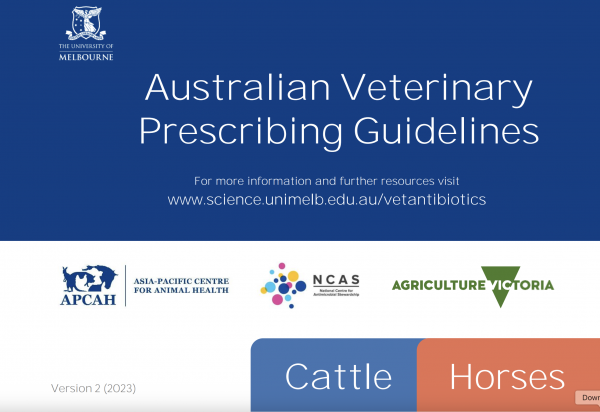
The Australian Veterinary Prescribing Guidelines cattle and horse flipbook, detailing antimicrobials for use in cattle and horses.
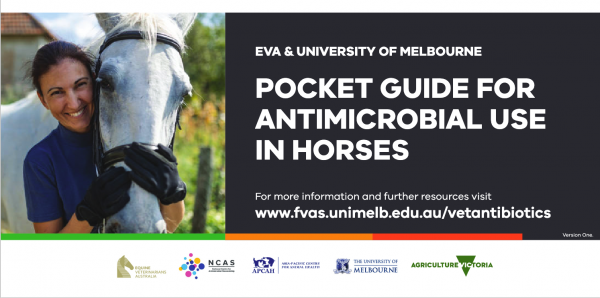
The equine Australian Veterinary Prescribing Guidelines for antimicrobial use as a pocket guide booklet.
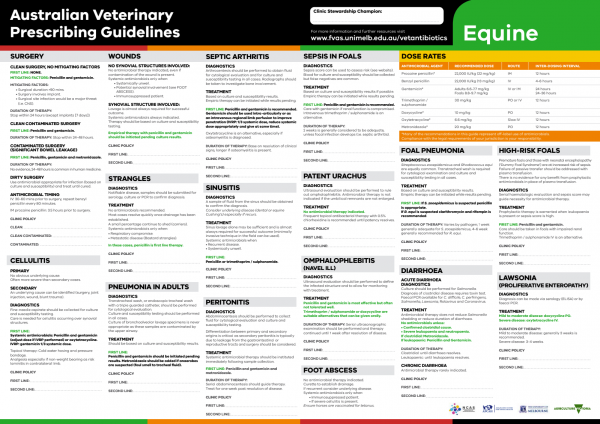
The equine Australian Veterinary Prescribing Guidelines poster. This document that outlines different antimicrobials for use in horses according to different diseases.
Funding for these guidelines was provided by the Australian Veterinary Association (AVA), Animal Medicines Australia (AMA) and AgriFutures Australia.
These guidelines would not have been possible without the considerable expertise and efforts of the Expert Panel: Associate Professor Laura Hardefeldt, Dr. Leanne Begg, Dr. Stephen Page, Professor Glenn Browning, and Professor Jacqueline Norris. We are also extremely grateful to the additional contributing authors.
The dedicated and skilled work of Project Manager Dr. Kellie Thomas is gratefully acknowledged, as are the contributions of the Project Steering Committee: Dr. Phillip McDonagh, Dr. John Messer, Professor James Gilkerson, and Dr. Melanie Latter. Open access publishing facilitated by The University of Melbourne, as part of the Wiley - The University of Melbourne agreement via the Council of Australian University Librarians.

Suggest a disease, syndrome or key evidence you think we should include.