Vaccinations available for equine animals
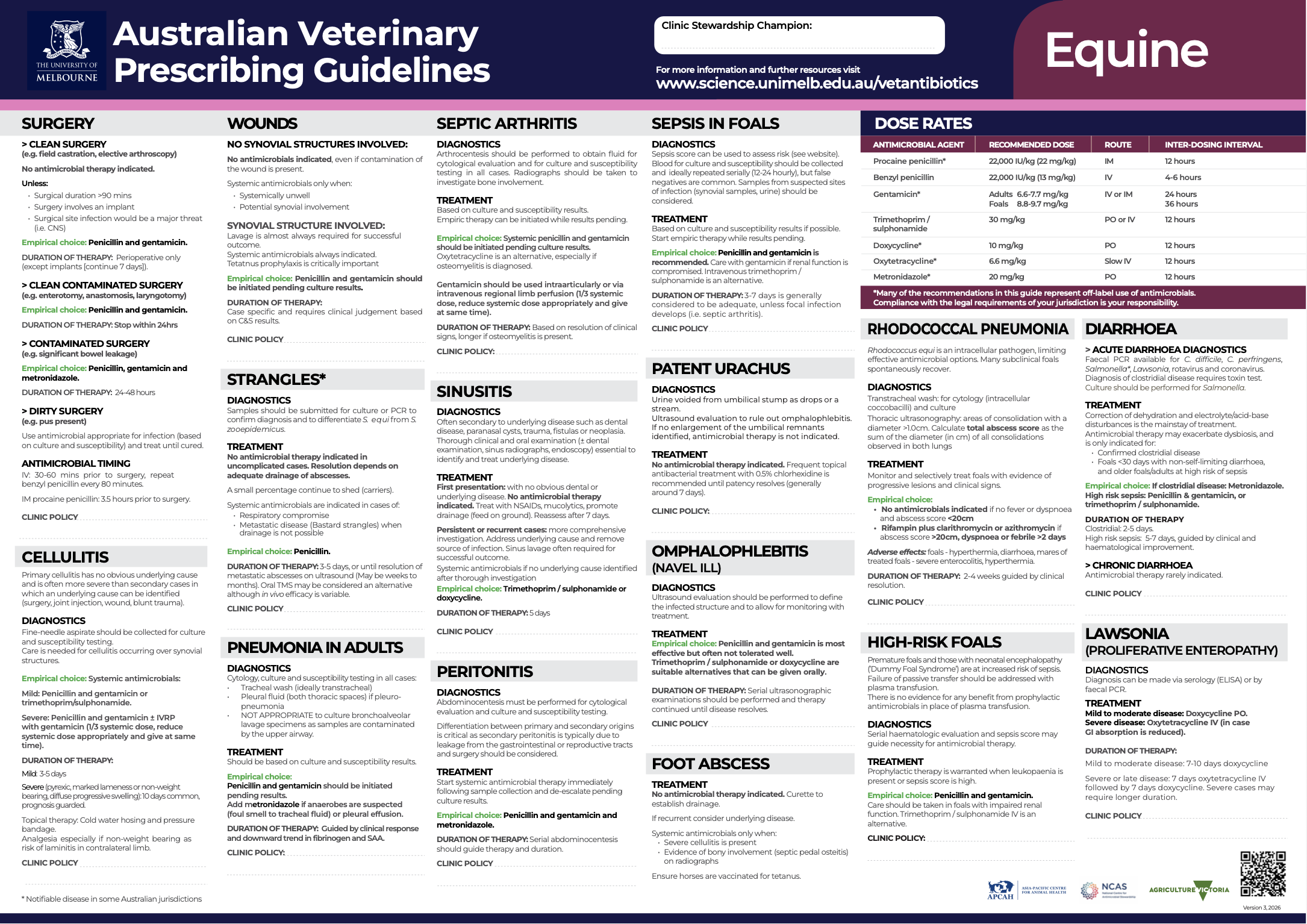
The agents of disease against which vaccines are currently available for horses in Australia include Clostridium tetani (tetanus), Streptococcus equi subspecies equi (strangles), Hendra virus, equine herpesviruses 1 and 4, Salmonella spp. and rotaviruses.

Click here (https://doi.org//10.1111/avj.70003) to view the guidelines in their entirety.
Key issues
Vaccination can reduce the severity and frequency of disease, which is critical in improving welfare and reducing antimicrobial use.
Vaccines
-
Preventative vaccination
Tetanus is caused by the anaerobic bacterium Clostridium tetani. The spores are found in soil, dust and animal faeces and survive in the environment for long periods, as they are highly resistant to heat and desiccation. Tetanus spores are introduced into the subcutaneous tissues or muscles by any penetrating wound, injections, surgical procedures, foot abscesses or erupting teeth. The key element is that the trauma causes tissue damage and results in anaerobic conditions suitable for germination of the spores and vegetative growth of C. tetani. The feet of horses are less well supplied with blood and are thus favoured places for instilled tetanus spores to germinate. C. tetani then produces a neurotoxin that results in spastic paralysis of the skeletal muscles, resulting in rigidity and spasm. The incubation period varies, and is dependent on the time taken for germination and growth of the organism in the damaged tissue and for the ascent of the neurotoxin (tetanospasmin) from the wound to the central nervous system via the axons of motor and sensory fibres. Once clinical signs commence, the progression of disease is rapid. Tetanus has a high case-fatality rate in horses, which are the species most sensitive to the effects of tetanospasmin. Prophylactic vaccination with a toxoid vaccine, which induces production of antibody against tetanospasmin, is extremely effective. Protective responses are usually attained within 2 weeks of the second dose of the vaccine.
Post-exposure anti-toxin
Administration of 1500 IU of tetanus antitoxin provides immediate protection and lasts for 2-3 weeks, with higher doses believed to provide longer lasting protection. Although rare, there is an association between administration of tetanus antitoxin and Theiler’s disease (serum sickness, serum hepatitis) in horses, so vaccination should be advocated rather than relying on administration of antitoxin. Tetanus antitoxin administration can be combined with tetanus toxoid vaccination so long as injections are given at different sites (such as opposite sides of the neck).
-
Detailed information about Strangles can be found elsewhere (Section 3, Chapter 6). Vaccination with currently available vaccines may reduce the severity of clinical signs but does not prevent disease.
-
Hendra virus is a highly pathogenic zoonotic virus causing disease with high mortality rates in people (57%) and horses (80%). Hendra virus first emerged in Australia in 1994 and is a notifiable disease in all states and territories of Australia. Horses generally have severe respiratory and/or neurological signs, but there are no pathognomonic clinical signs. The natural hosts of Hendra virus are the black flying fox, the grey headed flying fox, the spectacled flying fox and the little red flying fox. Horses are an amplifying host. Direct or indirect contact with flying fox urine is thought to be the main route of transmission from bats to horses. Infected horses can transmit the virus to other horses and humans via aerosols. Most outbreaks occur in the autumn and winter months and the disease has previously only been detected in Queensland and northeast NSW, but positive cases have now been found as far south as Newcastle. The natural range of bat species implicated as reservoirs of Hendra Virus is wide and climate change may result in disease in other parts of the country over time. The vaccine is protective while antibody titres remain above 64.
-
Detailed information about Equine Herpesviruses 1 and 4 can be found elsewhere (Section 15). Vaccination reduces the clinical signs of respiratory disease caused by both EHV 1 and 4. The vaccine is also used as an aid in the control of abortion caused by EHV 1.
-
Detailed information about salmonellosis can be found in Section 6. A commercial vaccine is available to aid in the control of disease caused by Salmonella Typhimurium. The vaccine is only recommended for mares and foals and should not be administered to horses in training or to stallions. Research has shown that vaccination of mares results in increased Salmonella-specific antibody delivery to foals, but the impact of vaccination varies between farms and there is no information on the effect it has on clinical disease (1).
-
Detailed information about rotaviruses can be found in Sections 6 and 8. Vaccination of pregnant mares boosts colostral antibodies and may enhance protection of foals by increasing lactogenic immunity. Results from field vaccination studies have been equivocal, with some studies reporting a reduction in the incidence and severity of diarrhoea and the shedding of virus in faeces (2, 3), while another study found no significant reduction in the incidence of diarrhoea (4). However, as foals from vaccinated mares in all of these studies were still affected by rotavirus diarrhoea, at best these vaccines can only be considered partially protective.
Treatment
Figure 16.1 to 16.5 demonstrate the recommended vaccination protocols for foals, breeding mares, and adult horses in Australia, including recommendations for tetanus prophylaxis for wounds or surgery in foals and adult horses.
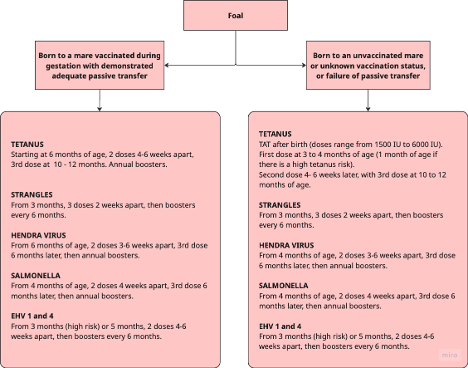
Figure 16.1. Immunisation protocol for foals.
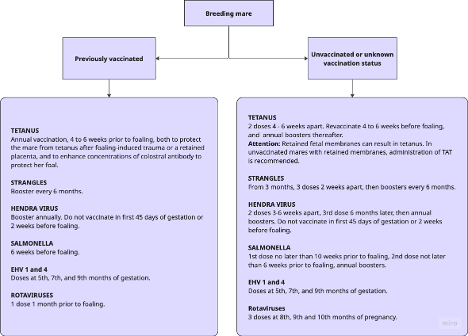
Figure 16.2. Immunisation protocol for breeding mare.

Figure 16.3. Vaccination protocol for adult horses.

Figure 16.4. Tetanus prophylaxis for wounds or surgery in the foal.
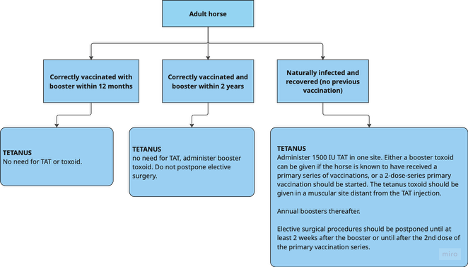
Figure 16.5. Tetanus prophylaxis for wounds or surgery in the adult horse.
Further reading
- Wang X, Wise JC, Stewart AJ. Hendra Virus: An Update on Diagnosis, Vaccination, and Biosecurity Protocols for Horses. The Veterinary clinics of North America Equine practice. 2023;39(1):89-98.
- Ramsauer AS, Badenhorst M, Cavalleri JMV. Equine parvovirus hepatitis. Equine veterinary journal. 2021;53(5):886-94.
- Fortier C, El-Hage C, Hue E, Sutton G, Marcillaud-Pitel C, Jeffers K, et al. Hepatitis viruses: prevalence of equine parvovirus-hepatitis virus and equine hepacivirus in France and Australia. Equine Veterinary Journal. 2021;53(S56):68-.
References
-
- Bailey CS, Fallon L, Wang W, Borst L, Timoney J. Serum and Colostral Antibody Responses of Pregnant Mares to Salmonella Bacterins and Colostral Antibody Transfer to Their Foals. Journal of equine veterinary science. 2012;32(9):575-8.
- Barrandeguy M, Parreño V, Lagos Mármol M, Pont Lezica F, Rivas C, Valle C, et al. Prevention of rotavirus diarrhoea in foals by parenteral vaccination of the mares: field trial. Dev Biol Stand. 1998;92:253-7.
- Imagawa H, Kato T, Tsunemitsu H, Tanaka H, Sato S, Higuchi T. Field Study of Inactivated Equine Rotavirus Vaccine. Journal of Equine Science. 2005;16(2):35-44.
- Powell DG, Dwyer RM, Traub-Dargatz JL, Fulker RH, Whalen JW, Srinivasappa J, et al. Field study of the safety, immunogenicity, and efficacy of an inactivated equine rotavirus vaccine. Journal of the American Veterinary Medical Association. 1997;211(2):193-8.
Resources


Acknowledgments
Funding for these guidelines was provided by the Australian Veterinary Association (AVA), Animal Medicines Australia (AMA) and AgriFutures Australia.
These guidelines would not have been possible without the considerable expertise and efforts of the Expert Panel: Associate Professor Laura Hardefeldt, Dr. Leanne Begg, Dr. Stephen Page, Professor Glenn Browning, and Professor Jacqueline Norris. We are also extremely grateful to the additional contributing authors.
The dedicated and skilled work of Project Manager Dr. Kellie Thomas is gratefully acknowledged, as are the contributions of the Project Steering Committee: Dr. Phillip McDonagh, Dr. John Messer, Professor James Gilkerson, and Dr. Melanie Latter. Open access publishing facilitated by The University of Melbourne, as part of the Wiley - The University of Melbourne agreement via the Council of Australian University Librarians.


Help make the Guidelines better
Suggest a disease, syndrome or key evidence you think we should include.