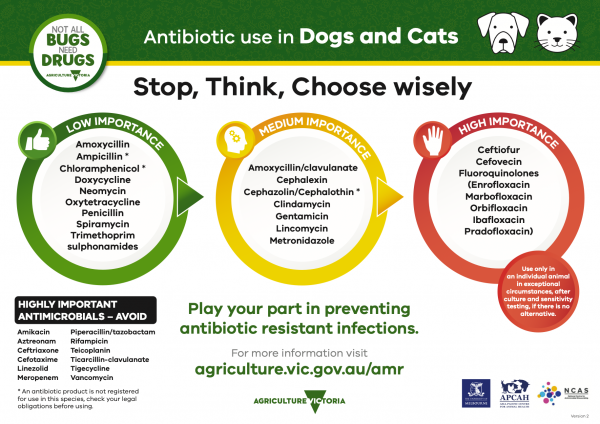
Traffic light - dogs & cats
A document that outlines via a traffic light system, the different importance level of antimicrobials for use in dogs and cats.
The following guidelines are based on the Antimicrobial use Guidelines for Treatment of Respiratory Tract Disease in Dogs and Cats: Antimicrobial Guidelines Working Group of the International Society for Companion Animal Infectious Diseases.
Check for feline leukaemia virus and feline immunodeficiency virus.
Limited benefit to performing cytology of nasal discharges.
Interpretation of culture and sensitivity results from nasal discharges is difficult, as some pathogens are difficult to grow, and positive culture is often with commensal organisms of no significance.
| Nasal discharge characteristics | Antimicrobial recommendation |
|---|---|
| Serous or lacks a mucopurulent or purulent component | None |
| Mucopurulent or purulent |
No antimicrobial therapy if have history of contact with shelter, or in-contact humans or animal contact with shelter (increased risk of infection by B. bronchiseptica)
Doxycycline if have fever, lethargy or anorexia |
If within 10-day observation period fever, lethargy or anorexia is present along with mucopurulent nasal discharge.
Amoxicillin is an acceptable alternative when Chlamydia felis and Mycoplasma are not highly suspected. Cefovecin has been shown to be inferior to doxycycline or amoxycillin so it is not recommended.
Most cats rapidly improve within 10 days with or without antimicrobial therapy. If no response to therapy in 7-10 days, further diagnostics should be performed. Only if these are refused by the owner should antimicrobial therapy be changed empirically.
Further diagnostics should be performed, especially when there has been treatment failure.
Antimicrobials should be selected on the basis of culture and sensitivity. There is no evidence that 3rd generation cephalosporins and fluoroquinolones are more effective than doxycycline and amoxycillin for the treatment of chronic bacterial upper respiratory infection. Azithromycin is not as effective as doxycycline for treating ocular chlamydiosis, so it should be reserved for situations where chlamydiosis is not suspected and amoxicillin and doxycycline are not viable options.
Therapy should be continued for as long as there is progressive clinical improvement and for 1 week past resolution of clinical signs.
Empirical therapy can be reinstated if there is a recurrence of disease once. It is recommended to avoid frequent courses of antimicrobial therapy as the risk of resistance developing is high.
| Case characteristics | Testing and antimicrobial recommendation |
|---|---|
Single cases with:
| Additional diagnostic tests are not recommended as interpreting results is challenging. |
| Outbreak of disease | Diagnostic testing is warranted |
Antimicrobials only if fever, lethargy or inappetance and mucopurulent nasal discharge.
If no evidence of pneumonia, empirical therapy with doxycycline. Amoxycillin is acceptable second option if doxycycline is not tolerated.
7-10 days.
For dogs and cats with chronic cough, with or without respiratory distress, should have diagnostic imaging and airway washings taken for cytology, aerobic culture and sensitivity and Mycoplasma culture.
While awaiting culture and sensitivity results no antimicrobials or if clinical disease is severe, empirical therapy with doxycycline.
7-10 days.
Investigation should include full physical examination, complete blood count, thoracic radiographs and airway washings (for cytology, aerobic culture and sensitivity and Mycoplasma culture) taken prior to antimicrobial therapy. Investigation should also include a search for an underlying disease process that predisposed to pneumonia.
Consult with a microbiologist in interpretation of laboratory results as airway contaminants are common.
Following sample collection antimicrobials should be started as soon as possible, especially if signs of sepsis are present. Common organisms isolated include E.coli, Pasteurella spp., Streptococcus spp., B. Bronchiseptica, Enterococcus spp., Mycoplasma spp., S. pseudintermedius and other coagulase-positive Staphylococcus spp., and Pseudomonas spp.
Mild pneumonia: doxycycline is recommended.
Aspiration pneumonia that is mild: either no treatment or amoxycillin, ampicillin or 1st generation cephalosporin.
Pneumonia and sepsis: enrofloxacin and amoxycillin or ampicillin or clindamycin are recommended until culture and sensitivity results are available with therapy adapted in light of these results.
Need for therapy should be reviewed after 10-14 days.
Diagnostic imaging should be performed after therapeutic thoracocentesis. Pleural fluid should be submitted for cytology, aerobic and anaerobic culture and sensitivity, and Mycoplasma culture (cats).
Common organisms:
| Cats | Fusobacterium, Prevotella, Porphyromonas, Bacteroides, Peptostreptococcus, Clostridium, Actinomyces, Filifactor villosus, Pasteurella spp., Streptococcus spp., and Mycoplasma sp. |
|---|---|
| Dogs |
Mixed anaerobes (Prevotella spp., Peptostreptococcus, Clostridium, Actinomyces, and Filifactor villosus) Enterbacteriaceae (E.coli, Klebsiella pneumoniae) Also implicated: Streptococcus canis, Staphylococcus spp., Enterococcus spp., Corynebacterium spp., Bacillus spp., Trueperella (formerly Arcanobacterium) pyogenes, Pasteurella, Acinetobacter, Capnocytophaga spp., Enterobacter spp., Stenotrophomonas maltophila, Aeromonas hydrophilia, Achromobacter xylosoxidans, Serratia marcescens and Pseudomonas spp., Actinomyces spp. |
Empirical therapy should be initiated immediately and modified when culture and sensitivity results are obtained. A fluoroquinolone and penicillin or clindamycin is recommended along with therapeutic drainage with or without lavage. Treatment with an agent effective against anaerobes should continue regardless of culture results and anaerobic culture is not always successful for fastidious anaerobic bacteria.
Need for therapy should be reviewed after 10-14 days.
A document that outlines via a traffic light system, the different importance level of antimicrobials for use in dogs and cats.
The companion animal Australian Veterinary Prescribing Guidelines for antimicrobial use in flipbook format.

The companion animal Australian Veterinary Prescribing Guidelines poster. This document that outlines different antimicrobials for use in dogs and cats according to different diseases.
Suggest a disease, syndrome or key evidence you think we should include.