
Traffic light - Horses
A document that outlines via a traffic light system, the different importance level of antimicrobials for use in horses.
Some mares will develop a mild hindlimb lameness, ventral oedema, and become febrile, dull and anorexic (33, 34). Mastitis can occur at any age but is most commonly seen in lactating mares. A higher case prevalence has been reported through the summer months (34). It more commonly occurs during lactation when a foal fails to nurse normally, or in the weeks following weaning (35, 36). It can occur in mares that have not had a foal in multiple years, mares that have never been in foal, and even the newborn or younger filly (33, 34, 37). Infection probably results from entry of bacteria through the teat canal, although percutaneous or haematogenous spread to the mammary tissue is also possible (38).
The most common pathogens isolated from mares with clinical mastitis are Streptococcus equi subspecies zooepidemicus, Staphylococcus spp., Klebsiella spp., Actinobacillus spp. and Escherichia coli. A range of other pathogens are less common causes. Fungal mastitis has been reported on rare occasions, along with verminous mastitis and toxic mastitis following exposure to avocado trees and fruit (38, 39).
General hygiene is the best way to prevent mastitis. Close monitoring of mares after weaning, cleaning of the udder and insect control are helpful. Frequent milking of mares that have a foal that is unable to nurse also helps prevent mastitis (40).
After careful cleaning of the teats, secretions should be collected from each teat canal to identify which mammary lobe(s) are affected. This can be difficult in cases that are severely inflamed. The secretions may show abnormal discolouration or consistency, but the samples should be examined cytologically and submitted for culture and antimicrobial susceptibility testing. Cytology of milk from mares with clinical mastitis often reveals neutrophils and cellular debris, and bacteria are evident in a subset of cases.
Haematology and serum biochemistry may be useful in monitoring cases of clinical mastitis. Haematology is likely to reveal a leukocytosis and neutrophilia. Increased inflammatory markers have potential use diagnostically and to monitoring the success of therapy (38, 41).
Ultrasonographic examination is useful in differentiating mastitis from udder abscessation, neoplasia and trauma. Ventral oedema just cranial to the mammary gland is common in late gestation and should be considered as a differential diagnosis when mammary enlargement is reported in late pregnancy.
Therapy includes treatment with systemic and local antimicrobials, and non-steroidal anti-inflammatory drugs, in combination with frequent milking or stripping of the affected gland, hot packing and hydrotherapy (34, 40). In a review from North America, more than 75% of bacterial isolates were susceptible to trimethoprim-sulphadiazine (TMS), while less than 60% of isolates were susceptible to penicillin (34). Stripping the mammary gland is necessary to remove bacteria and necrotic debris from the affected gland. Hot packs and cold-hosing can help reduce oedema and promote drainage.
The choice of antimicrobials should be based on culture and susceptibility testing results, but treatment is usually initiated prior to the availability of these results. Broad-spectrum antimicrobials should be selected initially and then adjusted based on the susceptibility test results.
In most cases, an intramammary preparation is infused once into the teat of the affected gland to initiate local treatment, along with systemic antibiotic therapy.
Numerous formulations of intramammary antibiotic infusions are available.
Systemic antibiotic therapy is used in ongoing or advanced cases of clinical mastitis.
OR
Cases of acute, clinical mastitis often respond quickly to appropriate therapy. Recurrence is uncommon, and the mammary gland usually returns to a normal anatomy and function.
Chronic, severe or recurrent cases have been associated with fibrosis of the gland and a potential reduction in milk production. Surgical resection of the mammary gland has been described for cases refractory to medical treatment (42).
A document that outlines via a traffic light system, the different importance level of antimicrobials for use in horses.
The Australian Veterinary Prescribing Guidelines cattle and horse flipbook, detailing antimicrobials for use in cattle and horses.
The equine Australian Veterinary Prescribing Guidelines for antimicrobial use as a pocket guide booklet.
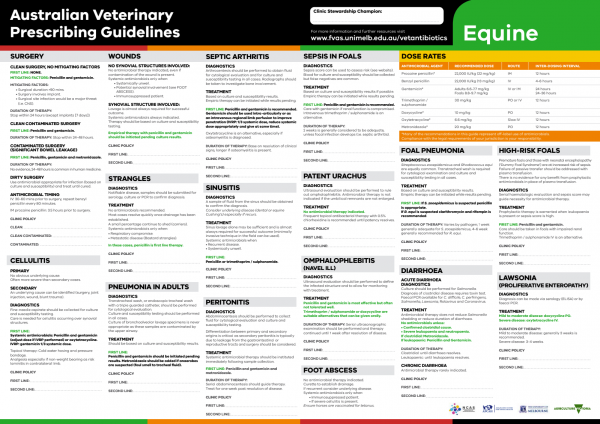
The equine Australian Veterinary Prescribing Guidelines poster. This document that outlines different antimicrobials for use in horses according to different diseases.
Suggest a disease, syndrome or key evidence you think we should include.